Biroldo and Sopressata | The Mountains Cook With Everything
A Hungarian-Tuscan breakfast at the butcher paper

The sea gives abundance. The mountains do not. In the mountains, you take what you have, and what you have is what you have killed in October and what you have dried and what you have salted and what you have buried in clay or marble for a winter, and then in February you eat it, all of it, and you waste nothing, because there is nothing to waste with. Every food culture in every mountain range on earth follows this rule, and the foods produced under it are recognizable to one another across continents and languages. The Apuane and the Garfagnana produce two of them in particular, and I want to tell you about them, because they are the foods I now eat for breakfast more often than any other thing in this country, and because I came from a different mountain culture across Europe that produces a near-identical cousin of them, and because the convergence of the two on a piece of butcher paper in my kitchen on a Sunday morning is one of the small private pleasures of having moved to where I have moved.
I grew up on the slopes of the Mátra, the tallest range in Hungary, modest by Italian standards but real mountains where I come from. I grew up in a village where slaughtering a pig was not a tourist excursion but something we did for each other in November: four men, a fire in the yard, a half-day of work. By the end of the day, there was a pig in pieces on a long table and a small economy of cuts arranged around it, the loins for one purpose, the legs for another, the belly for another, the fat for rendering, and at the very end of the cutting, the parts that did not fit any clean category. The head. The ears. The tongue. The tail. The skin. The blood. None of it was thrown away. None of it had ever been thrown away in any village where this had ever been done. What we did with those parts was make a pressed terrine of head meat, skin, and fat that we called disznósajt, which translates literally as pork cheese, although there is no cheese in it. The name is a joke and a description: it sets like a cheese, in a wrap, sliced cold, eaten on bread.
Italy has its versions. Almost every meat culture in Europe has its version. The English call theirs brawn. The French call theirs fromage de tête, also a pork cheese with no cheese. The Germans have Sülze. The Spanish have cabeza de jabalí. Italy has many regional names, but in Tuscany, in the Apuane, Lunigiana, and Garfagnana, the two you encounter most are the soppressata toscana and the biroldo.
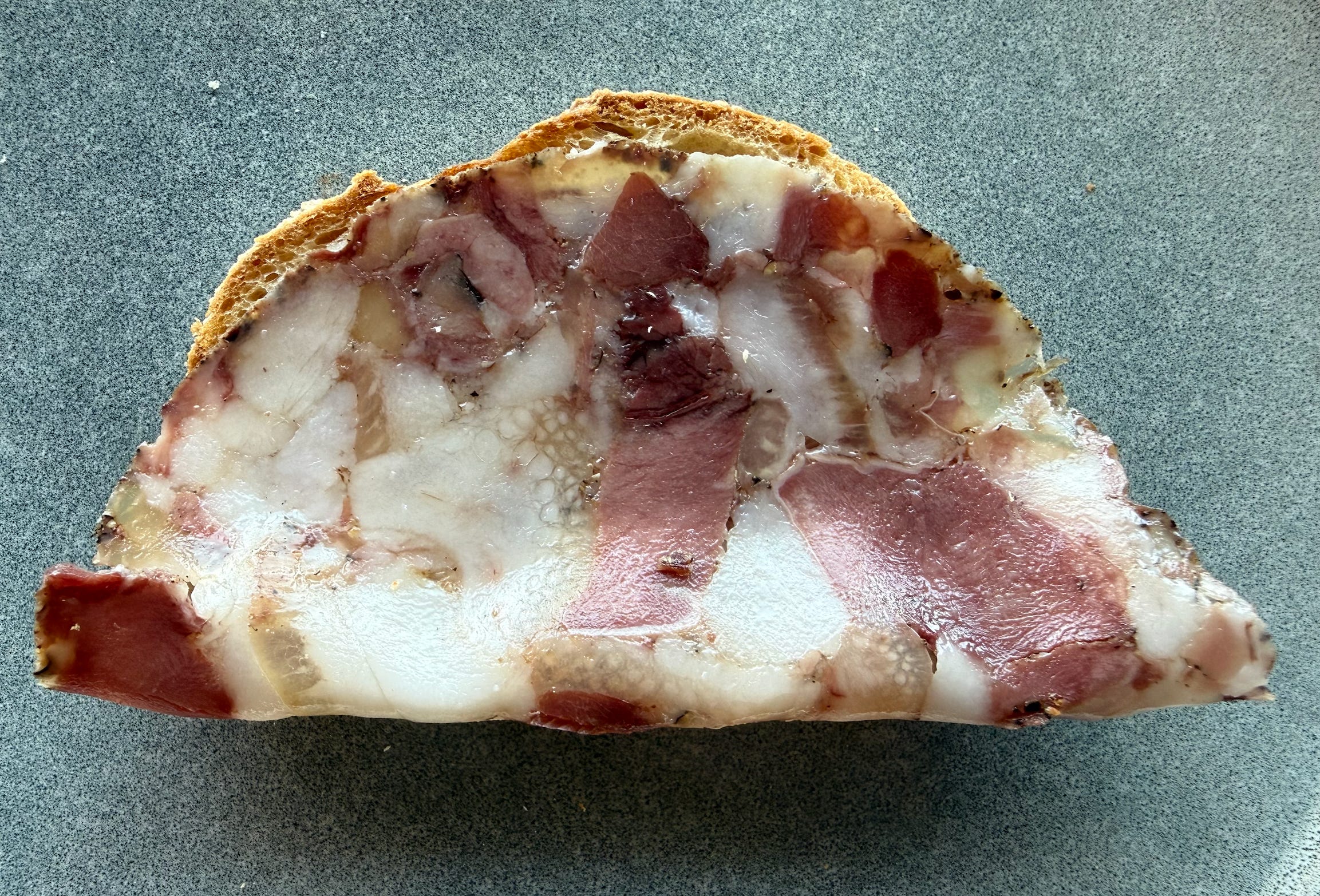
The Tuscan soppressata is not the hard-cured salami of the same name made further south in Calabria and Basilicata. The Tuscan version is a head cheese: pig head meat, ear, tongue, skin, simmered for hours in spiced water with bay, garlic, fennel, and a little wine, then chopped, packed warm into a casing or a cloth, pressed under a weight, and cooled. You slice it cold, in thick rounds, and you can see in the slice the architecture of what went into it: a bit of pink lean tongue here, a translucent piece of skin there, a marbling of soft fat, a fragment of ear that catches the light differently. People who do not eat this kind of food look at the slice and turn away. People who do eat this kind of food know they are about to have a very good breakfast.
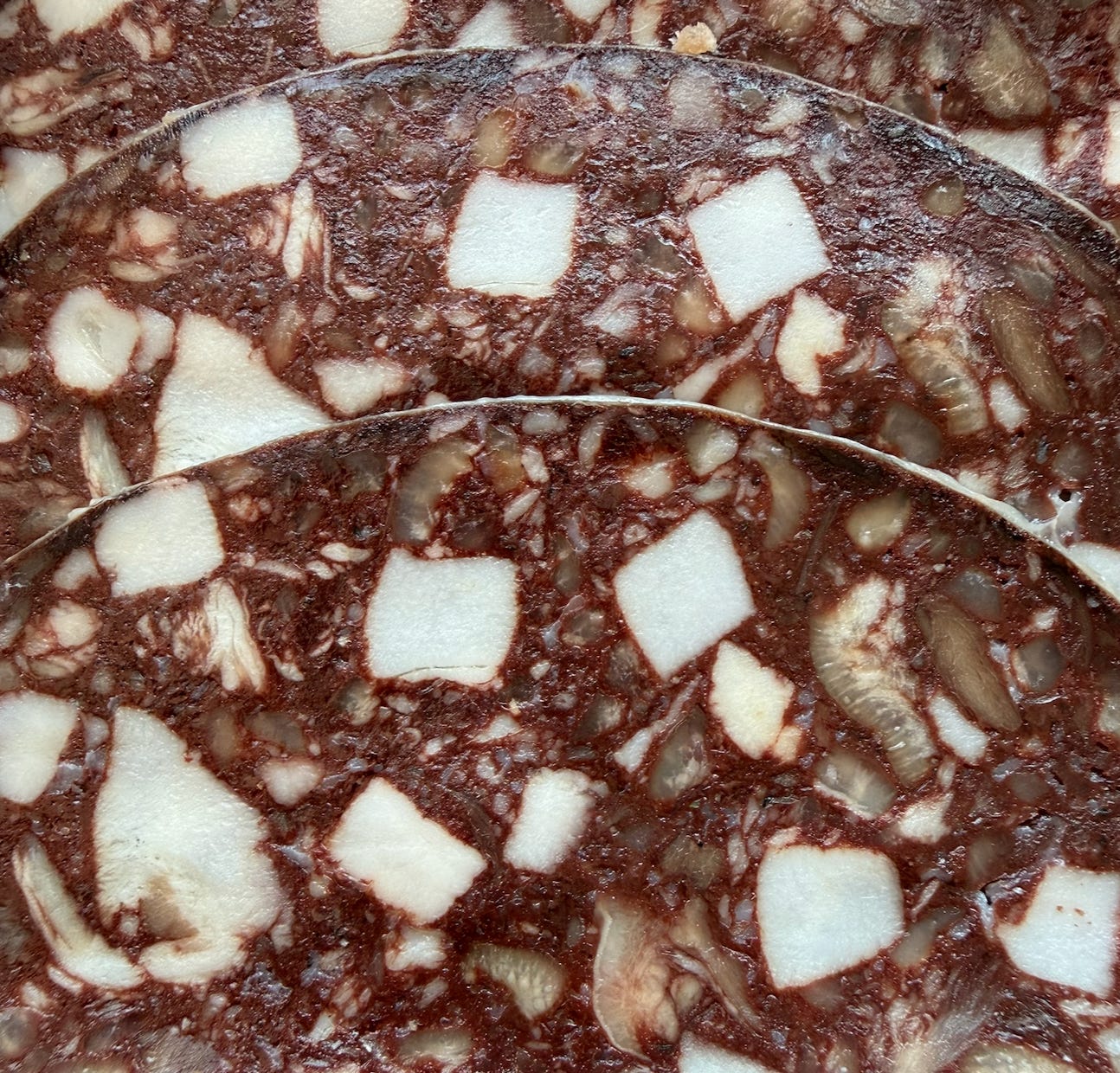
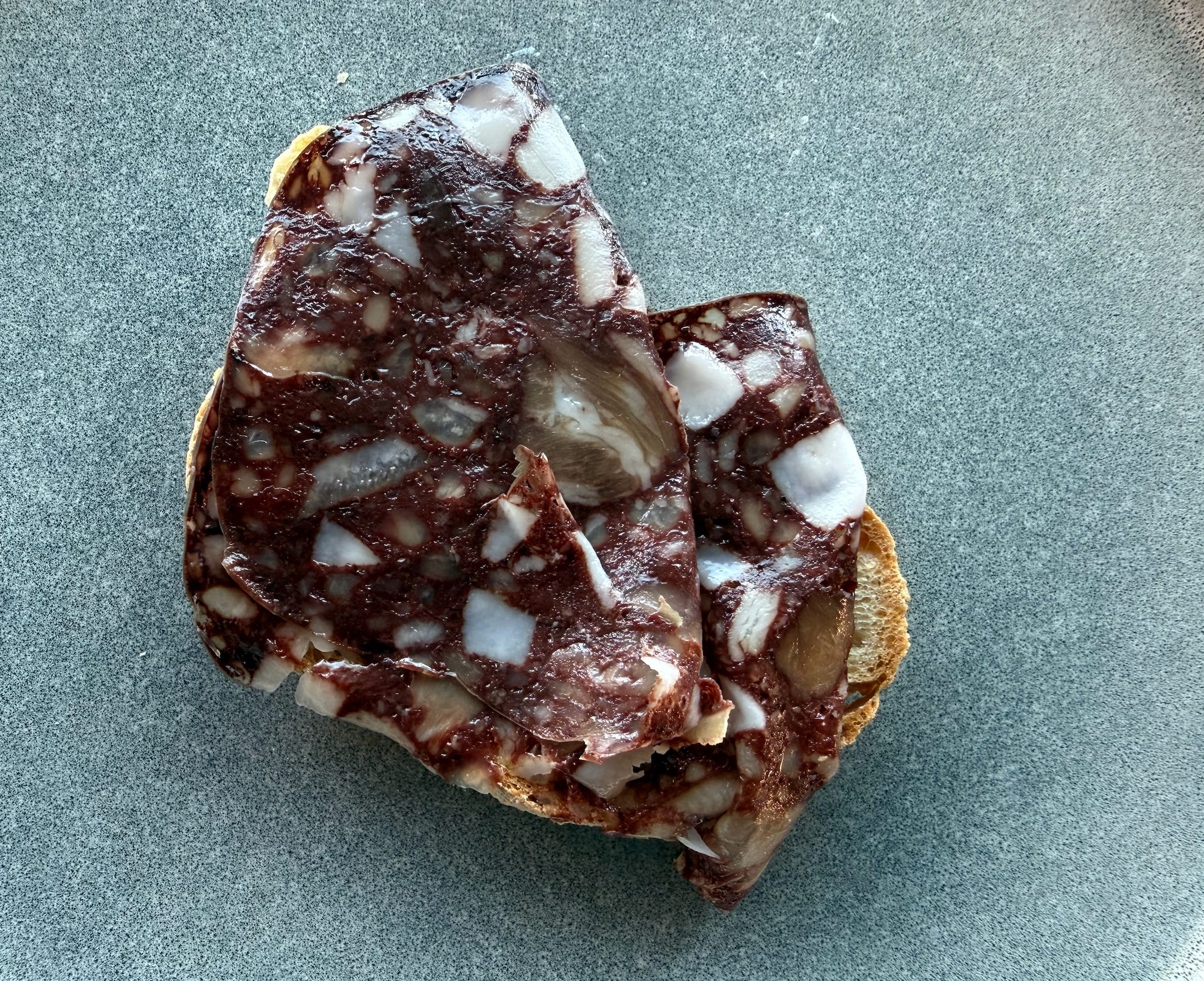
The biroldo is the same idea, with two crucial additions. First, the blood. Pig’s blood is mixed with the cooked head meat before pressing, which gives the slice its dark, almost black-purple color and a deeper, richer, iron-tasting quality that the soppressata does not have. Second, the sweetness. Garfagnana biroldo has, traditionally, raisins and pine nuts, and sometimes a hint of fennel pollen worked into it, the slight medieval-spice profile that survives in mountain Tuscan cooking from when these recipes were already old. The biroldo is softer than the soppressata, more pâté-like, more obviously offal-flavored, more polarizing for the uninitiated, and more rewarding for the converted.
Both belong to a larger logic that runs through everything you eat in these mountains, and I want to name it directly, because the more time I spend up here, the more I see it.
The lardo di Colonnata, now sold for 50 euros a kilo in airports and designated an IGP product by the marble town of Colonnata above Carrara, is pig fat. Just pig fat. Cured for six months in marble basins with sea salt, pepper, rosemary, and garlic, and then sliced thin and eaten on warm bread. There is no economic universe in which a pre-modern peasant economy invents the practice of curing pig fat for six months for any reason other than that they had a lot of pig fat and very little else. Lardo is poverty refined into art. It exists because the marble quarrymen of Colonnata had pigs and salt and marble basins and time, and pig fat does not keep on its own, and they figured out, somewhere around the year 1200, that it would keep beautifully if you packed it under salt in a cold marble box for half a year. The result is now a luxury product. The origin is not.
The chestnut culture is the same logic running through a different ingredient. These mountains were too high and too poor for wheat, and the chestnut tree provided a calorie crop that did not require flat land or good soil. So the people of the Garfagnana and the Lunigiana built an entire cuisine around the chestnut: chestnut flour for castagnaccio and pattona and necci and manafregoli, chestnut honey, chestnut spread, chestnut beer. None of this was invented because chestnuts tasted good. It was invented because there was nothing else, and over a thousand years, the eating of nothing else became delicious, became identity, became the autumn festivals you can attend in twenty different Garfagnana villages between September and November.
The farro of the Garfagnana is older than that. It is emmer wheat, the grain the Romans ate, a cereal too primitive and too low-yielding for the rest of Europe to bother with after the Middle Ages, but the Garfagnana kept growing it because nothing else would grow on those upper slopes. It is now an IGP product, sold at a premium to Slow Food restaurants in Florence and Milan. The Roman legionaries’ grain, surviving in one mountain valley because nothing better would come up out of that soil for two thousand years.
All of it is the same logic. The mountains make you cook with what you have, and the mountains do not give you very much, so you learn to use everything, and you learn to use it well, and a thousand years later, somebody from Milan drives up the SS12 in a German car and pays forty euros for what your great-grandmother ate because she had nothing else.
The soppressata and the biroldo sit exactly inside this logic. The pig was the family’s whole protein supply for a year. The pig was killed in November. By the time you got to the head and the ear and the tongue and the blood, you had already used the loins and the legs and the belly for sausages and prosciutto and salami and lard. What was left were the parts that took the most work for the least clean meat, which are exactly the parts that became the cured meats with the longest preparation, the most spice, and the most invention, because the cooks had time and the cuts demanded it.
I prefer the Italian version to the Hungarian one now. Disznósajt is a Hungarian breakfast food, the way biroldo is a Tuscan breakfast food, and the comparison is direct, and the differences are small but consistent. Hungarian disznósajt is spicier, with paprika worked through the meat, the way paprika works its way through everything Hungarian. It is meant to be eaten with raw onion, with hot peppers, and white bread. It punches you. It announces itself. The Italian biroldo and soppressata are quieter, less seasoned, more meaty, more fatty, more frank about what they are, and they are eaten with much less around them: a piece of unsalted Tuscan bread (hint: slightly toasted, rubbed with a raw clove of garlic), the meat laid on top, perhaps a few slices of red onion or a tomato in summer, perhaps nothing, and a glass of cold water or a small coffee. The Italian version trusts the meat to carry the plate. The Hungarian version dresses the meat for performance. Both are correct in their context. I have come, over time, to want the quieter one.
There is an etiquette to buying it. In a chain supermarket, the woman behind the counter will, by default, slice it for you razor-thin, paper-thin, the way deli meat is sliced everywhere now, and you take ten of those slices in a small white packet, and you go home. This is fine. It is not, however, what mountain people do. In a real salumeria in Castelnuovo, Coreglia, or Aulla, you can ask for what you want, and the higher you are in the mountains, the more pleased the butcher will be when you ask for it the right way. The right way is to point at a whole soppressata or biroldo and say: me ne tagli un pezzo grosso, così, tutto in un blocco, lo avvolga nella carta. Cut me a big piece, like that, all in one block, wrap it in paper. The butcher will smile a small private smile. This is the order of someone who knows what they are about to do with it. They will hand you a quarter-kilo block in butcher paper. You will take it home. You will not put it in the fridge; it does not need to be there until the end of the day. You will put it on the cutting board. You will cut your own slices off, thicker than the supermarket cuts, the thickness of a finger, the way you actually want to eat it.
This is what I do on Sunday mornings, more often than I should. I get up. I make coffee. I take the block of biroldo I bought the day before in Pietrasanta market on Saturdays. I take the unsalted Tuscan bread we keep in the kitchen, especially for this reason, which I also bought the day before. I cut a thin slice of the bread and put it in the toaster on the lightest setting possible. I take it out before it browns, while it is still pale and slightly crusted. I rub it with a half clove of garlic, which dissolves into the warm crust as you draw it across. I cut a giant slice of biroldo, the thickness of a finger. I lay it on the bread. I put a few red onion rounds next to it. Maybe some radish. I eat it standing at the kitchen counter, with my hands, off the butcher paper that came around it, no plate, no fork. I drink a small espresso. I drink a glass of cold sparkling water. I do not season anything. I do not add anything. Breakfast of champions.