Camaiore | I Could Get Old Here
Where life is simple, slow, and happy.

I watched eight old men stand up at once, and something in me quietly rearranged itself.
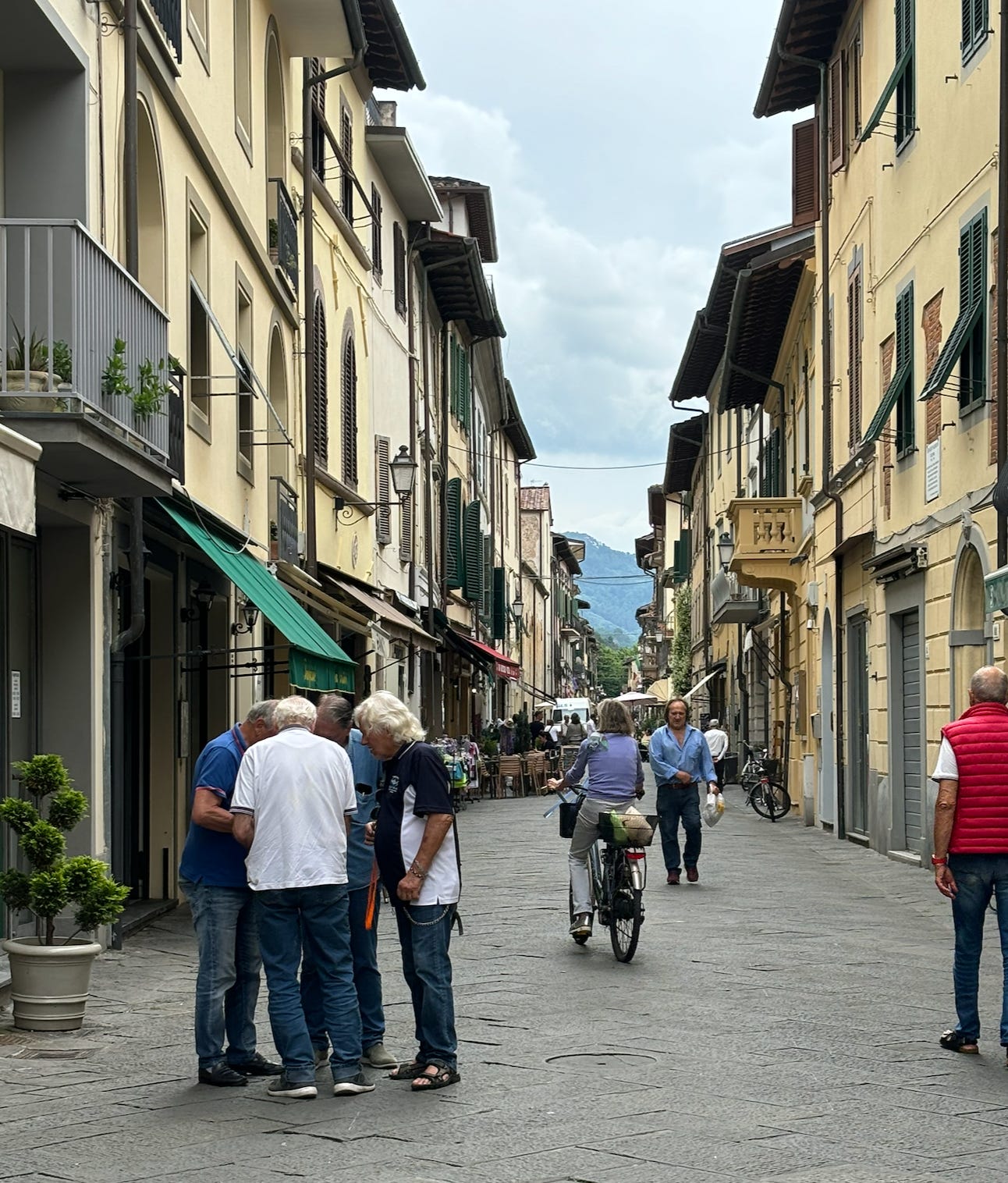
They had been sitting at Caffè Celero on Piazza San Bernardino for most of an hour, maybe longer, doing what men over sixty do on an Italian piazza, which is nothing, but nothing done carefully and particularly.
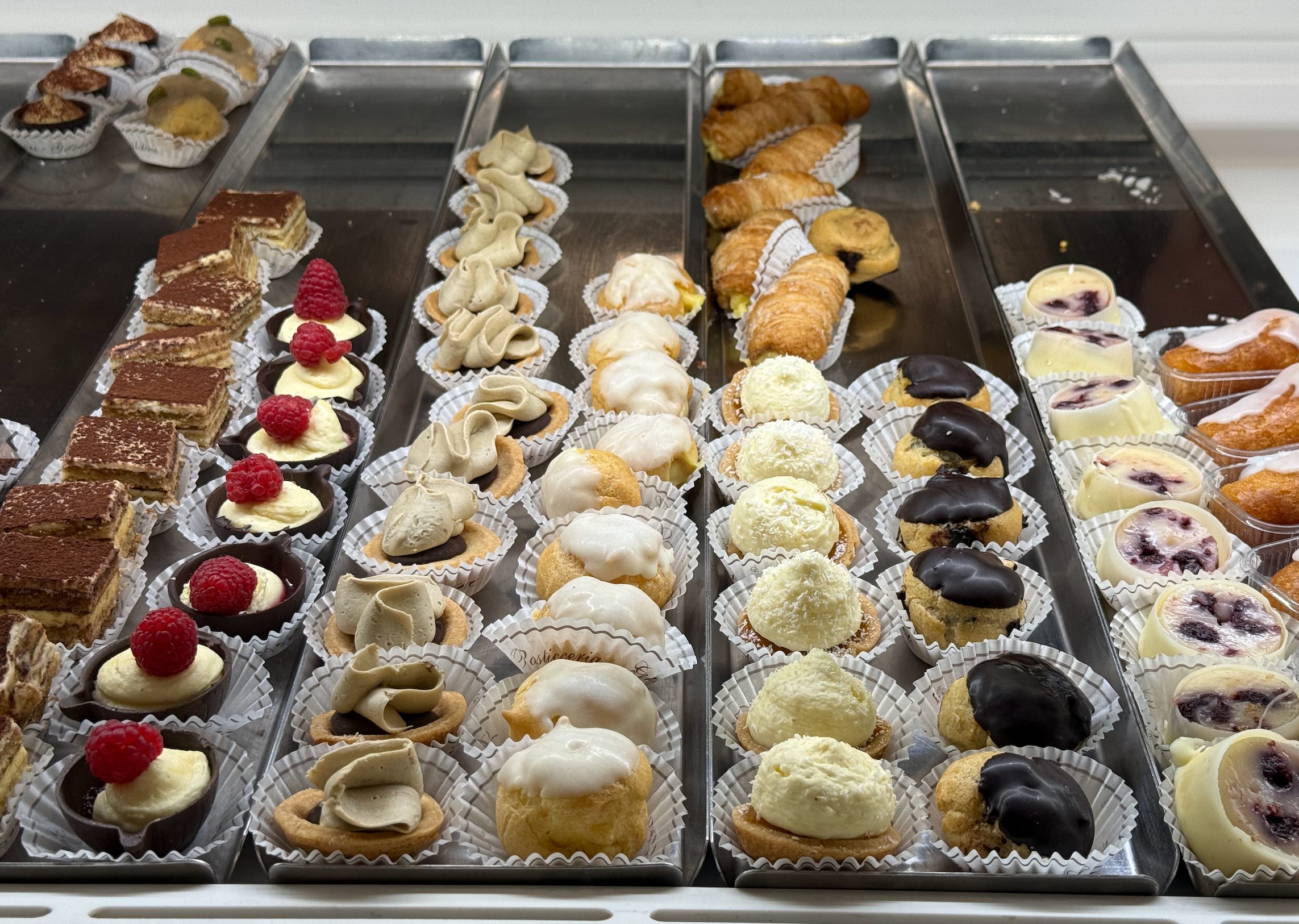
Espresso cups empty. Newspapers folded, actual paper newspapers, because here everyone still reads one. The conversation had the rhythm of a conversation that has been going on since 1974 and does not need to be finished today. Across a stretch of stone ten meters wide, their wives were at Pasticceria Del Dotto, working on a second coffee and a small plate of biscotti, same age bracket, same posture, different café, more sweets and cakes. This division is not negotiable, and nobody has ever questioned it.
The church bell went at 12:30. The women had already drifted home fifteen or twenty minutes earlier, in a staggered exit I hadn’t registered until their chairs were empty. They were lighting the gas now, draining the pasta water, putting the ragù on low. At 12:30, the men, who had been inert to the point of statuary but who had also, in the meantime, been having a conversation with each other at the volume and intensity of a small court case, all stood up in near-unison and moved. Not quickly, exactly. Purposefully. Like a flock of pigeons that had heard something the rest of the piazza couldn’t hear. Within forty seconds, the terrace was empty except for two waiters stacking cups, and us.
My wife and I call it the Santa Pranzo. Sacred lunch. Twelve-thirty to two in the afternoon. Everything stops. I would bet that no one really dies during this window in Italy. There’s just no room for it, it’s the sacred lunchtime.
That was when I said it, in my head first and then out loud to Sophie. I could get old here.
I had never in my life said that about a place. I had said I could live here. I had said I could stay a while. Get old was a different sentence. Get old meant I had run out of reasons to keep moving.
I have lived in many countries. Before Italy, there were Hungary and England and several in between, and by the time my wife and I arrived in Versilia, I had traveled to somewhere close to a hundred countries, though I never counted, and the number matters less than the habit.
Not as a tourist, mostly. I have worked online for the last twelve-plus years, which means I travel slowly when I travel at all, staying in one place for a month or six, getting to know a baker, a greengrocer, and a couple of bars, then moving on. I had always assumed this was a permanent condition. I love being a foreigner. Not knowing what others are talking about. Watching people and things. For a long time, I thought that was the whole of who I was, and that arriving anywhere, in the serious sense of that word, was not something that would happen to me.
Then the eight old men stood up, and the bell rang, and I understood, sitting there, that I had been wrong about myself. You get to a certain age — I’m forty-four now — and you either notice what kind of life the body is asking for or you don’t. Mine, it turned out, was asking for a piazza.
Here is the geographic puzzle. When we first moved to Versilia, we didn’t live in Camaiore. We lived in Lido di Camaiore, and we didn’t realize for the first few months that the two names referred to the same commune. Lido is the four-kilometer beach strip between Viareggio and Marina di Pietrasanta, a piece of coast that deserves its own treatment another time. Camaiore, the city the commune is named for, is seven kilometers inland and three hundred meters higher, in a valley where the Apuan Alps open up at exactly the right angle to catch the morning light. Most people who come to the coast for a two-week holiday never go up there. They never even know there is one up there to go to.
Camaiore is one of the largest communes in Versilia by territory, which is already counterintuitive, because most people have never heard of it. The frazione everyone has heard of is a beach town. The city it is named after, seven kilometers inland, most people never hear of at all. When you drive up for the first time, you have the peculiar sensation of visiting the administrative capital of a place you thought you already knew.
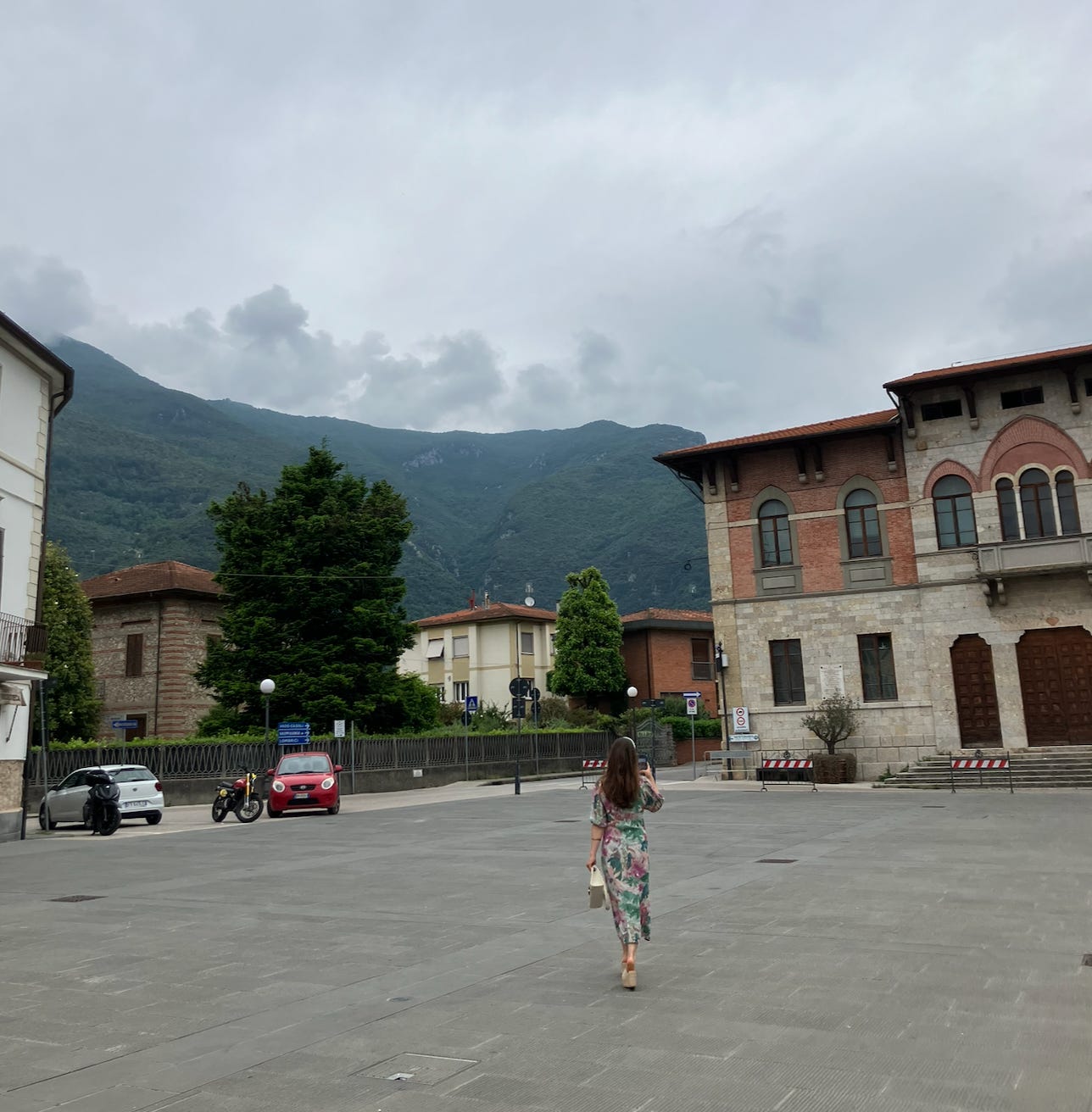
The first time I went, it was the casual summer reflex of someone who had figured out that the mountains are always a few degrees cooler than the coast. I wasn’t expecting a medieval town. I just got one. Camaiore is essentially three parallel streets laid down the spine of a valley, with Piazza San Bernardino as the buckle in the middle and the Collegiata di Santa Maria Assunta anchoring it. Walled once, with four gates, of which one, Porta San Pietro, still stands. Roman encampment before that. The name is a corruption of Campus Maior, the big field, which is what the Romans called the plain that runs from Lucca to the sea.
Nothing about this is obscure. Camaiore sits on the Via Francigena. Sigeric, Archbishop of Canterbury, stopped here in 990 AD on his way back from Rome and recorded the town as the twenty-seventh stop on his journey, Campmaior, which at some point in the intervening ten centuries became Camaiore. If you want to make an Italian laugh, tell them you’re going to discover a town that was written about by name in the tenth century.
And yet. Stand on Piazza San Bernardino at eleven on a Tuesday morning in August, and you will see the papas, the mammas, two English-speaking couples who wandered up by accident, and a cat. Maybe more than one cat. In a region where the same month’s beaches, fifteen minutes down the hill, are a churning slurry of Emilian families and German campers and that specific shade of pink that only Northern European forearms achieve in Italian sunlight, Camaiore sits in its own valley and behaves as though none of that is happening.
There is a fact about Italian hill towns that nobody who writes about them quite says out loud. Most of them exist because someone else’s town no longer does. The slow centuries of nothing-much-happening that gave Camaiore its medieval stone houses, its three parallel streets, and its patient piazza rhythms are, if you follow the history far enough back, the quiet of a refugee settlement that succeeded. The winners built Camaiore. The losers are up on the hill, under the moss. That one is called Montecastrese, and it has some really old and genuinely not-that-interesting ruins. Camaiore was founded by people who had to stop moving.
I thought about this for a long time after that Sunday. Nothing really moves here. Everything is hyper-local, including, and maybe especially, the food.
The food is local in a way that is hard to explain to people who haven’t spent time here. Every region of Italy will tell you that the food is local, and most of them are lying about thirty percent of it. In Camaiore, the food is so local that pasta names are political statements. They are called tordelli, with a d. Not tortelli. Large meat-and-chard ravioli under a long-cooked meat ragù, with heavily grated pecorino over the top. The town cares enough about this dish to give out an annual trophy, the Tordello d’Oro, the Golden Tordello, an actual gilded statue shaped like a piece of stuffed pasta, awarded by civic vote to whichever restaurant is judged to have made the year’s definitive version. If you come to Camaiore and call them tortelli, you will be corrected. This is non-negotiable.
The version I keep going back to is at Osteria Il Rivellino, which is not technically a restaurant so much as a shop that has been haunted by a kitchen. Five tables, maybe six. The kitchen is open to the room in the sense that the kitchen is the room, and the chef cooks your food about two meters from your plate. You watch him fold the tordelli. You watch him ladle the ragù, grate the pecorino, walk four steps, and deliver it. In the mountains, this close to the marble country, the other staple is black truffle, and in season it goes on everything, including things it shouldn’t, which is part of the pleasure.
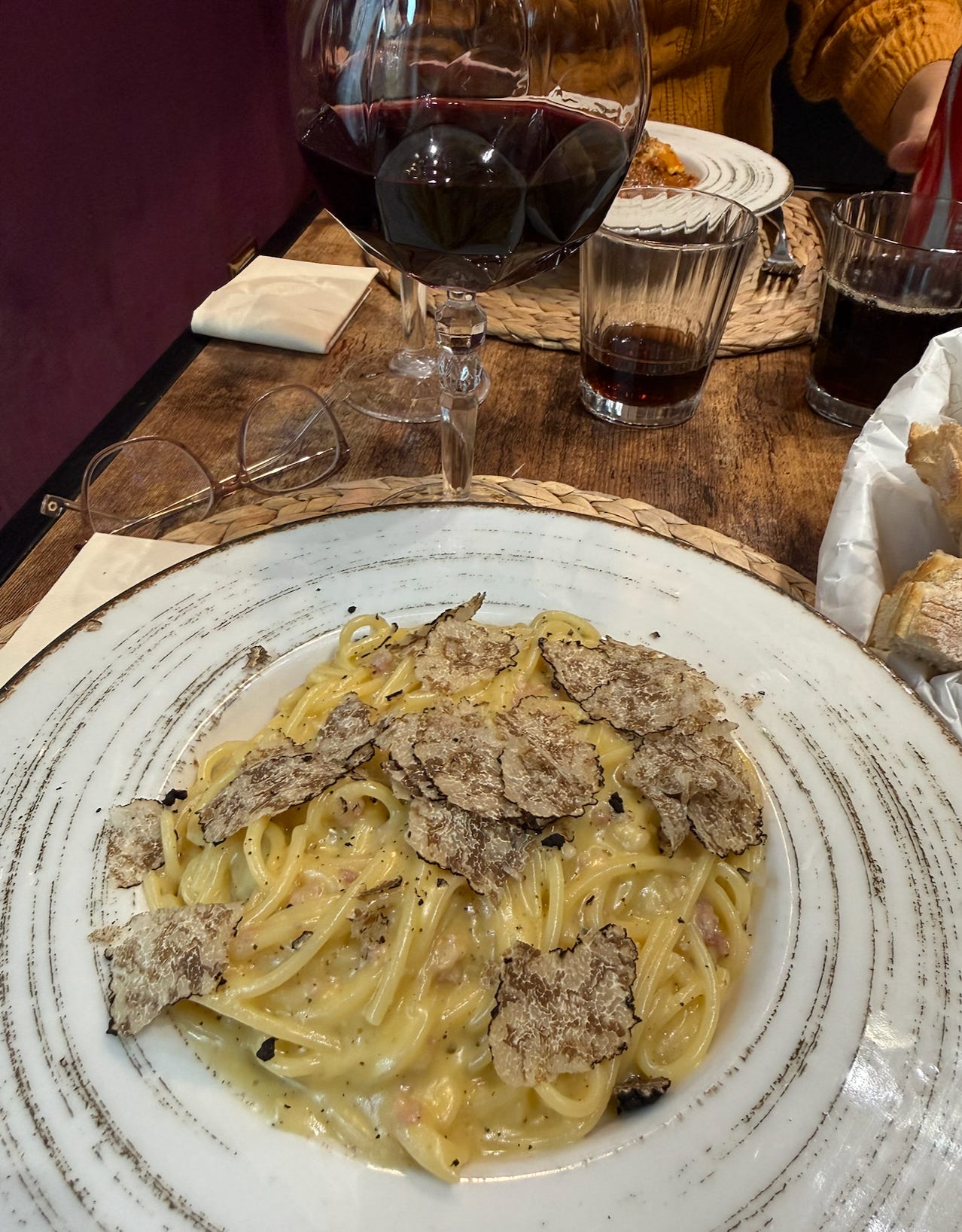
Two blocks away, on Via di Mezzo, is Bonuccelli, which is a salumeria, which is to say a temple of cured pork with a small cash register in the front. The counter is the altar. The priest is the man behind it, who will slice you sbriciolona, the local black-pepper-and-fennel mortadella not to be confused with the pale pink Bolognese thing, and lonza and prosciutto toscano on butcher paper and will look at you with mild offense if you ask for less than a hundred grams. In the back, they have a few outdoor tables. You sit down, and they bring you a plank of whatever you bought, plus bread, plus a small carafe of red from a producer in the hills above, and no menu. The bill, if you are prepared to be astonished, comes to about fifteen euros a person. I have eaten at hotel restaurants in Forte dei Marmi, twenty minutes north, where a plate of mediocre spaghetti costs more.
The first time I had the biroldo at Bonuccelli, I put my fork down. Biroldo is blood sausage, but the local kind, made with pig’s blood, pine nuts, raisins, and spices that migrated down from the Garfagnana, and the effect on the palate is something between a mild liver pâté and a cake. My grandmother in Hungary used to make véres hurka, blood sausage, which I grew up eating on Sundays. This was similar to that. Milder. Sweeter around the edges. Meatier in the middle. For a second, I was nine years old again, and I didn’t know what to do with myself in a salumeria in Tuscany.
Further down the same street is Bisteccheria da Alan, which is a butcher shop by day and a steakhouse from Friday through the weekend, with a menu of five items, five different cuts of beef, and nothing else. No pasta, no vegetables beyond whatever is next to the grill, no wine list longer than a single page. In a country where restaurants default to thirty dishes nobody needs, this is almost a provocation. It is also the correct answer. When a butcher (named Alan, obviously) decides to put tables in his shop on a Friday night, you don’t need a primo. You need the cut and the fire. Italians understand this in a way that has to be relearned, every time, by the rest of us.
Here is what I think Camaiore actually is, underneath the administrative fact that it is also a beach resort and the historical fact that it is the twenty-seventh stop on the Via Francigena.
Camaiore is a town that has already made all of its decisions.
It was decided, at some point I can’t locate on a calendar, that it would be the place where a certain kind of Italian stays until they die. There is a local clothing store that sells only hats — fedoras, panamas, flat caps, the occasional beret — and the clientele is entirely over sixty and entirely certain about its head size. There are small dress shops on Via Vittorio Emanuele that sell what I can only describe as nonna style, the beige and navy knitwear of a generation that does not require fashion to continually announce itself. The prices are heavily discounted because the target customer has been shopping at this store for forty years and does not require marking up. If you are twenty-five and looking for something to wear to a club in Milan, you will find nothing. If you are sixty-five and in need of a good raincoat, you will find exactly the one you had in mind.
The coffee bars serve the same coffee they have served since the nineteenth century. The restaurants make the dishes their mothers made. The church bell rings at the same time it rang last year. Nothing in Camaiore is performing for anyone, and when the summer festivals do pull a concert onto Piazza San Bernardino, an Italian rock band I had never heard of playing to a crowd that knew every lyric, the town fills up for exactly one night and then empties again by Tuesday, and the cats come back out.
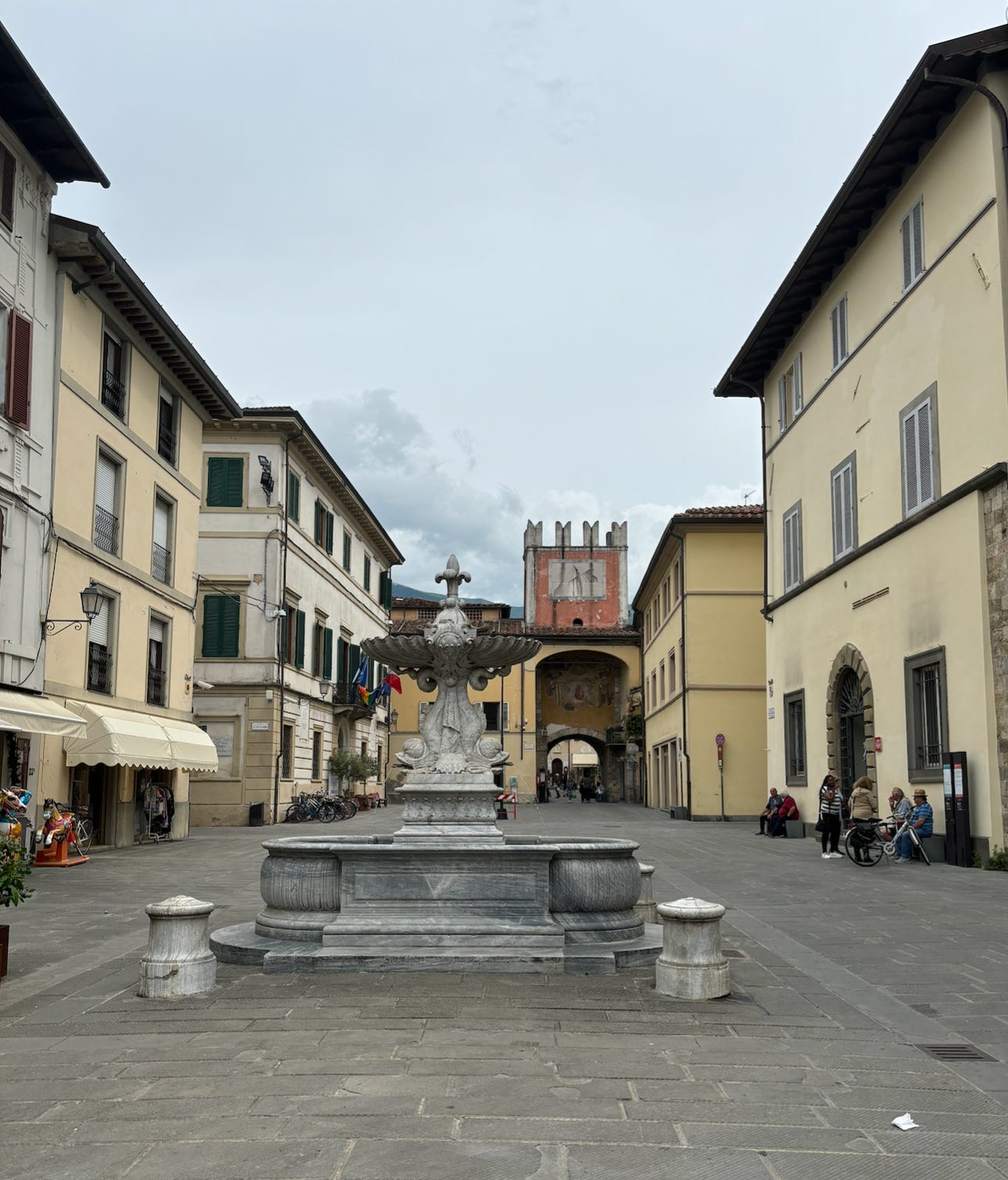
You could say this is boring. You could. Many have. The same tourists who spend six hundred euros a night in Forte dei Marmi to be seen in the right restaurant have made a specific decision not to come here, and Camaiore, in return, has made a specific decision not to care. The relationship works for both parties.
What happens to you in Camaiore is what happens to you in any town that is not trying to sell itself to you. You slow down against your will.
You walk into Piazza San Bernardino planning to have one coffee before driving on to Casoli or up into the Candalla valley or wherever you thought you were going, and you order the coffee, and you sit, and a cat walks past, and then another cat, and you order a Negroni, and the man next to you is reading Il Tirreno and occasionally snorting at something in the pages, and when you look at your phone it has been an hour and forty-five minutes. You are low on signal anyway. You order lunch. Tordelli, of course. You eat them slowly because you have realized that eating them quickly would be an insult to nobody in particular. You order a quartino of red. The quartino becomes a mezzo. You walk, in that loose post-lunch drift that is one of the reasons to learn Italian in the first place, down Via di Mezzo to Bonuccelli, and you buy a piece of sbriciolona to take home.
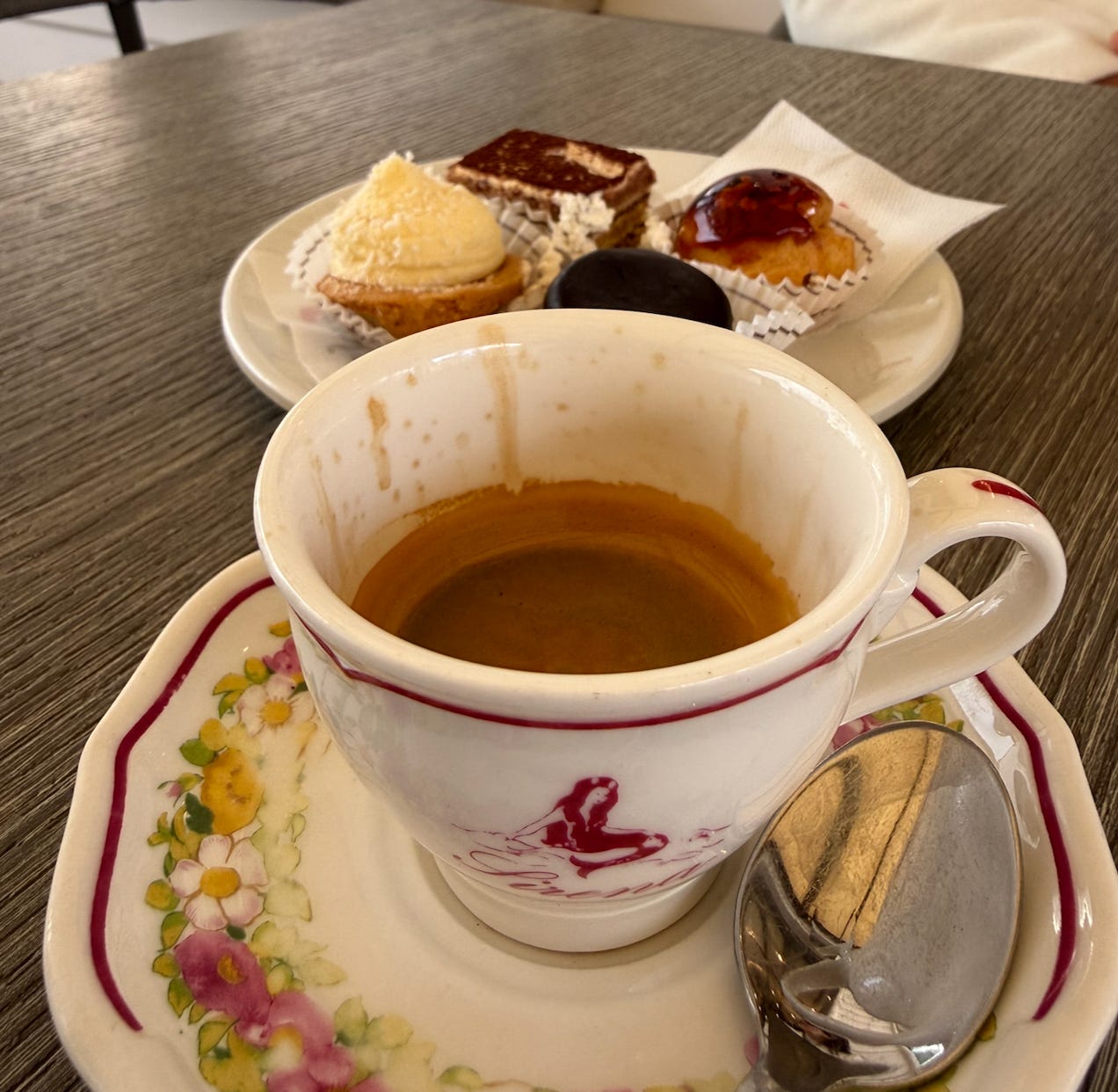
It is four in the afternoon now. You have accomplished nothing. You feel, for reasons you cannot quite articulate, as though this might have been one of the better days you have had in your life.
A specific valley. A specific piazza. A specific pasticceria where, at eleven on a Sunday morning, my wife could be eating biscotti with the other women while I read the sports pages at Celero across the square. At twelve-thirty the bell would ring. I would stand up, unhurried, with the other men, and walk home to lunch.
I could get old here. The sentence still surprises me every time I say it. But the town has been practicing it for eight hundred years, and it knows how it’s done.