
Italian Food Shops, Explained
Alimentari, salumeria, macelleria, pescheria, forno, pasticceria, pastificio, fruttivendolo, and the farmer's WhatsApp number above them all

There is a small Ape Piaggio van that arrives at the gravel turnout near our house in Pietrasanta every Tuesday between ten and twelve. The driver is a fisherman from the working harbor in Viareggio. The plastic boxes in the back of the van hold whatever the boats brought in that morning, and by noon the van is gone. The locals know the time. They arrive from ten. By eleven the better fish are gone, and you take what you take. If you missed the window, you missed it, and on Tuesday you ate something other than fish.
This is, in compressed form, the working principle of the Italian food-shopping system. The shops are organized around the food, not around the customer. The food arrives when it arrives, from where it was caught, grown, or made, and the shop opens at the hour when the food makes sense.
Travel writing about Italian food shops tends to treat them as relics, small survivors of a supermarket era that almost erased them, written about in the affectionate tone the genre reserves for narrow streets and Vespas. The framing is wrong. The Italian food shops are not relics. They are the working machinery of a food-distribution system that runs from the producer to the plate in a way no other country in Europe still bothers with at this scale, and the supermarket is not the apex predator that has cornered the rest of them. The supermarket is the floor of the system, a tier that absorbs what smaller shops cannot and that itself operates closer to the producer than the supermarkets you may know elsewhere. The whole structure is organized around one principle. The food is local. Local is the default at every tier. The shops are eight versions of asking how local, with two more tiers, the mobile and the producer-direct, above them all.
This piece teaches the system, tier by tier.
The Supermarket Floor
The Italian supermarket is the floor of the system, and the floor is already high. Three chains carry most of the country. Coop is technically a consumer cooperative, the largest in Italy, and its branding still carries the slightly socialist DNA of its origins. A Coop store feels like the local supermarket of a town that knows it is the local supermarket. Conad is the close competitor, slightly more commercial, slightly broader in reach, structurally similar. Either of them is what an Italian uses when they need to shop a full week’s groceries and the specialty shops are closed or out of reach. Both are stocked, by default, with Italian-sourced products. The vegetables are seasonal more than they aren’t. The cheeses are domestic. The pasta is the same hundred shapes you would expect, made by Italian companies. The wine section runs to two full aisles, and there is a vintage to suit every budget.
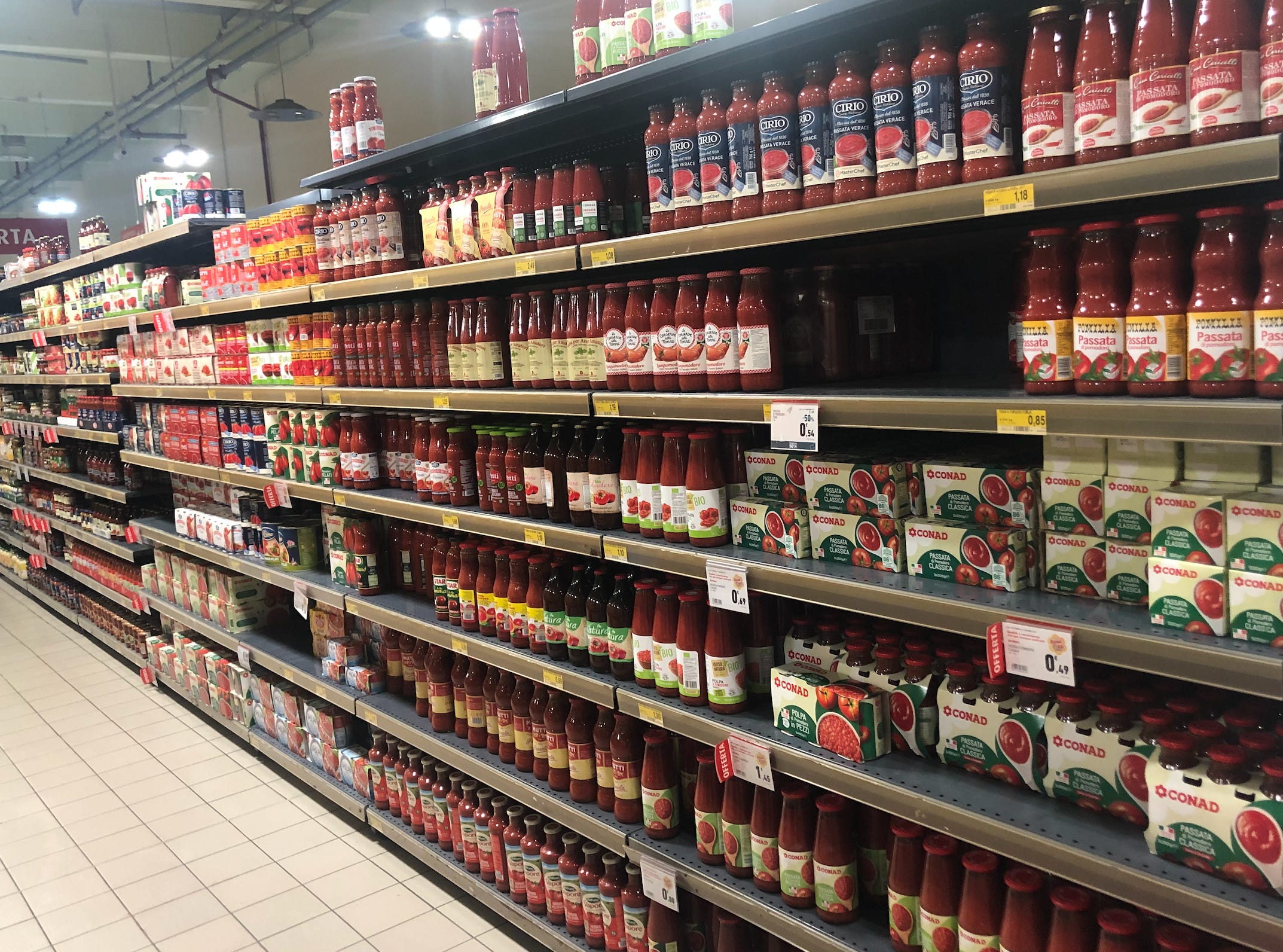
Esselunga is the upmarket tier; a supermarket, in the way an English Waitrose or a French Monoprix is. The produce is reliably fresh, the fish counter is a real fish counter, the butcher counter has a person with a knife and the willingness to use it on whatever cut you ask for, and the bread is baked on the premises. If you came to Italy and you only ever shopped at Esselunga, you would still eat better than most food shoppers in Western Europe or in the US. Especially in the US...
The argument for the specialty shops is therefore not that the supermarket is bad. The argument is that the specialty shops are doing something the supermarket structurally cannot, which is being smaller, more local, and more bound to the producer who delivered the food that morning. The specialty shops are how the system dials local up from default to deliberate.
For the price of a glass of Chianti, unlock the full Anywhere Italy experience. All of our articles, private stories, and access to our chat travel community.
Start your free 7-day trial.
The Eight Specialty Shops
There are eight food shops worth knowing. Some you find in any Italian town. Others appear only in towns with the right harbor, the right hills, or the right amount of foot traffic to keep them in business. Knowing what each one is for is the difference between shopping in Italy and shopping at Italy.
Alimentari is the small all-purpose food shop. It is not a supermarket. It is the neighborhood shop that carries the things you need for day-to-day kitchen use: dried pasta, a wheel of cheese, some salumi behind the counter, bread, eggs, a small selection of fruit and vegetables, oil, vinegar, salt, coffee. The stock varies wildly between alimentari, depending on what the owner cares about. Some carry an excellent regional wine corner. Some have a tiny fresh-pasta case. Some have nothing but dry goods. The alimentari fills the gap between the supermarket trip and the daily run, and in smaller towns where there is no supermarket within reach, it is the supermarket: older, smaller, more idiosyncratic, run by the family that has run it for two or three generations.
Macelleria is the butcher, and this is the most important specialty shop to learn, because the gap between macelleria meat and supermarket meat is the widest gap in the entire system. The butcher in our part of Versilia buys from local farmers and from hunters back from the woods. In the autumn, the case fills with cinghiale, the wild boar that is the Tuscan game meat the rest of the country recognizes as Tuscan, with the occasional wild hare, and with whatever bird the hunters have brought down that week. Year-round, Chianina beef is raised on local farms, dry-aged in the back room, and sliced for the bistecca. The salumi are local, and the butcher will gladly tell you who made them, where, and on which farm. Esselunga carries decent cuts. The macelleria carries the real article. Most of the macelleria sell wine on the spot as well, usually red, which is best for meat.
Pescheria is the fishmonger. It exists in coastal Italy as the working partner of the local fishing fleet, and inland as a smaller, slightly more limited version that gets its product trucked up overnight. The pescheria operates on the rhythm of the boats. On Sundays the boats do not go out, which means Mondays are bad for fish, which means most pescherie are closed on Mondays. The window for the morning catch is small. By two in the afternoon the day’s best has been bought and the case looks thin. The rule, for the visitor, is straightforward. Arrive before noon. Ask what came in this morning. Let the fishmonger talk you into something you weren’t planning to buy. The thing you weren’t planning to buy will be the best thing on the counter, because it is the thing the fishmonger personally hand-selected from the boat when it docked at six.
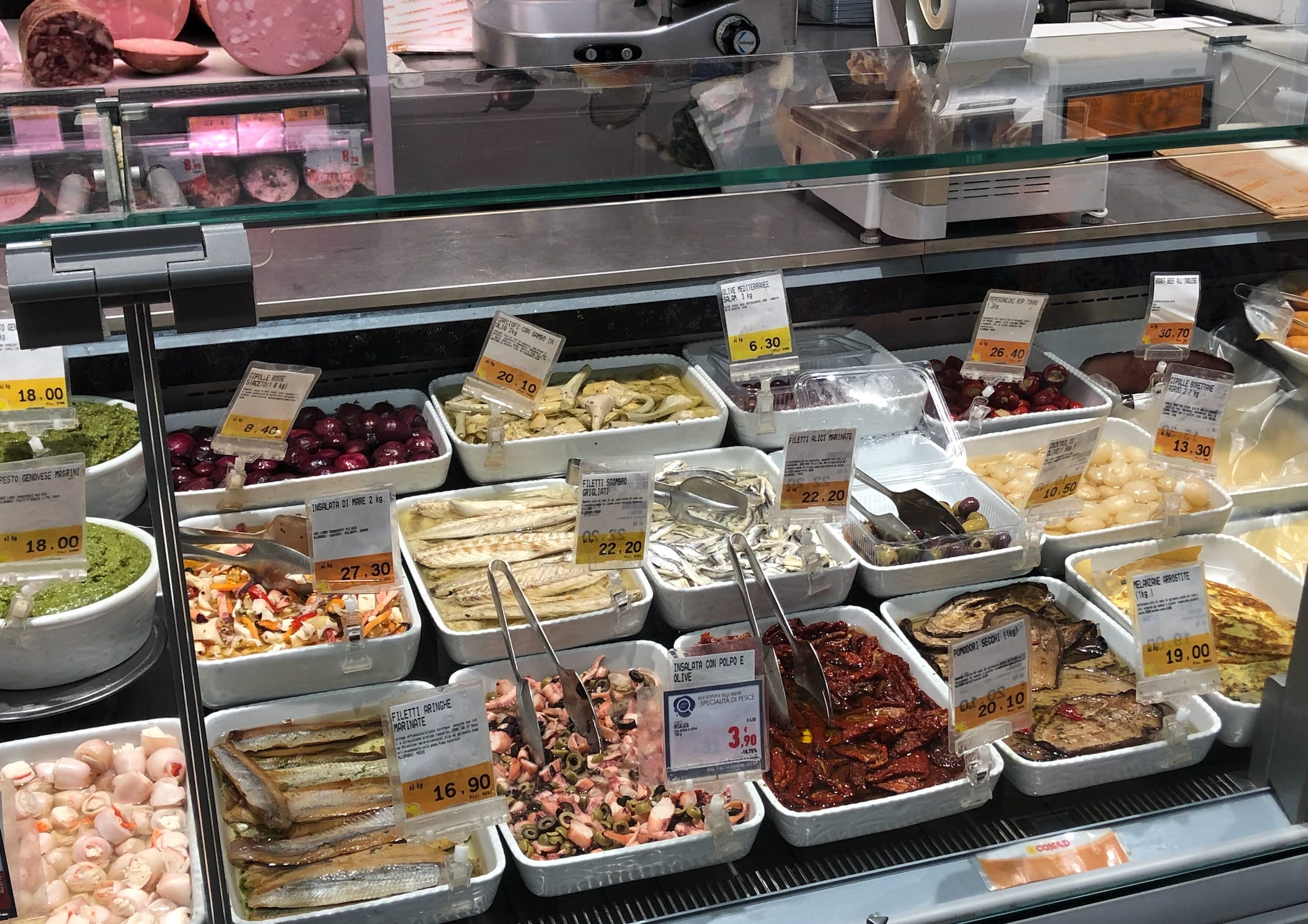
Salumeria is the cured meats and cheeses shop. Prosciutto crudo, sopressata, mortadella, salami of fifteen different geographical denominations, and the cheeses, including Parmigiano of different ages, Pecorino of different ages, the soft fresh cheeses of the region, the local hard wheels. The salumeria is what you go to when you are putting together a board for friends, when you need a cheese for the after-dinner course, when you want to take something to a friend’s house and not look like a tourist about it. The ordering etiquette is its own small ritual, and once you have it down, the salumeria becomes the single most rewarding shop in the whole system. Many salumerie now double as a small alimentari, with dry goods on a side shelf and a wine corner along one wall. They also sell full products, salads, and anything that can be put in a small plastic container for takeaway.
Forno is the bread shop. The word forno literally means oven. The older names panificio and panetteria are roughly equivalent. Panificio leans toward the artisan operation that bakes its own bread on-site, panetteria toward the shop that sells bread baked elsewhere or by a partner baker, and forneria is the slightly older Tuscan variant, largely interchangeable with forno. The naming doesn’t matter much, but what matters is that all of them are local. The bread of the forno reflects the bread tradition of the town it sits in, and the bread tradition of an Italian town changes every fifty kilometers. In Liguria, the forno is essentially a focaccia shop with bread on the side. In Tuscany, the forno bakes the unsalted Tuscan bread that is famously divisive, and which the locals will tell you was developed in the Middle Ages in response to a salt tax everyone has since forgotten. In Puglia the forno makes the dense Altamura sourdough that holds together for a week. Each region’s forno is a small geographic statement. You walk in, you ask for the local thing, and you eat what the town has been eating for some hundreds of years.
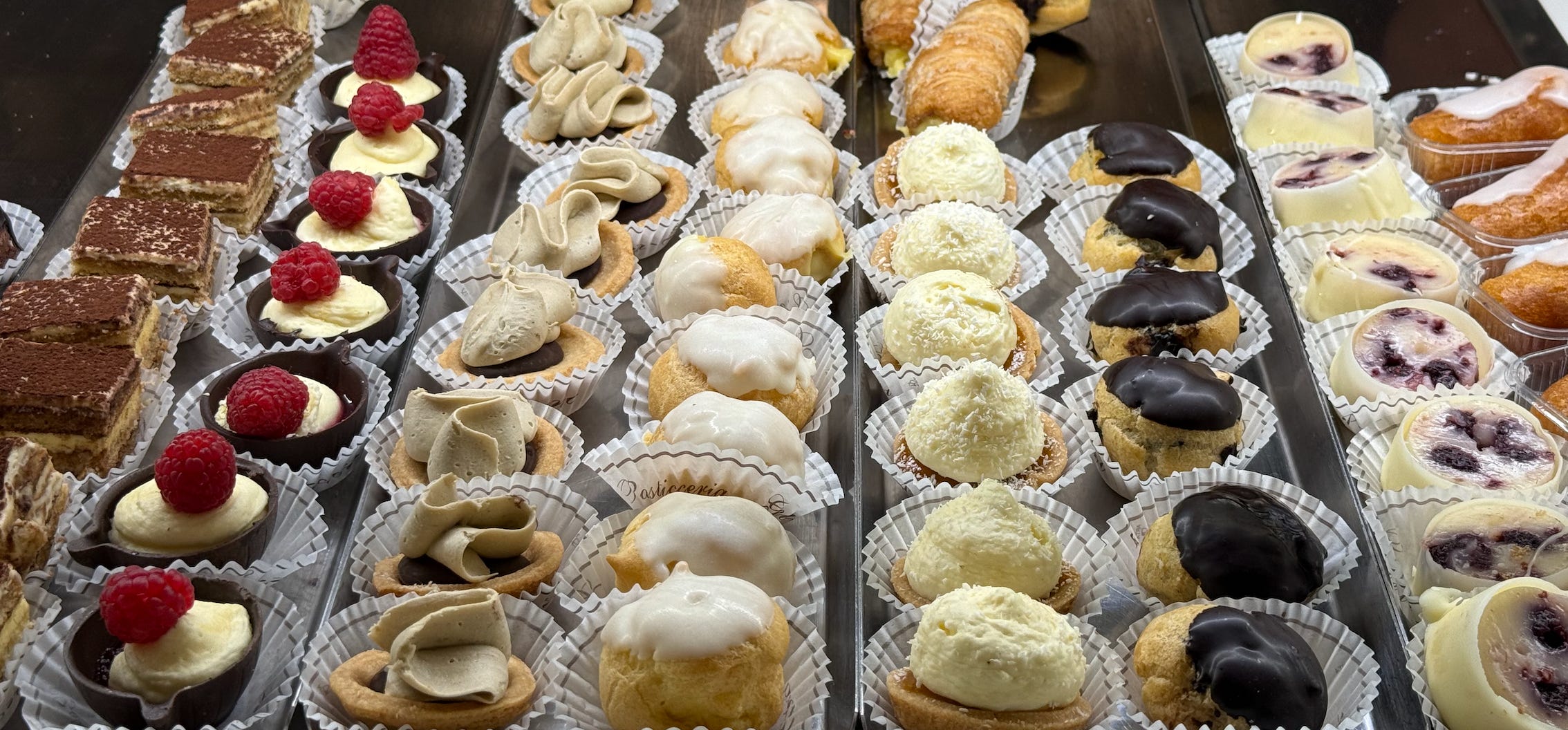
Pasticceria is the sweet shop, the place for pastries, cakes, biscotti, and, in many cases, an espresso bar at the front, with the cases running down the side. The pasticceria is the breakfast destination for an Italian, un caffè e una pasta at seven-thirty, standing at the bar, on the way to work. It is also the gift destination for any social call: a small box tied with a ribbon of local biscotti or pastries. Like the forno, the pasticceria is regional. The pasticceria in Sicily will sell you cannoli and cassata. The pasticceria in Tuscany will sell you cantucci and ricciarelli. The pasticceria in Naples will sell you the sfogliatella that does not properly exist outside Naples. The pattern repeats. Our small town pasticceria also carries high-priced drinks, like whisky, which they wrap as a gift for you.
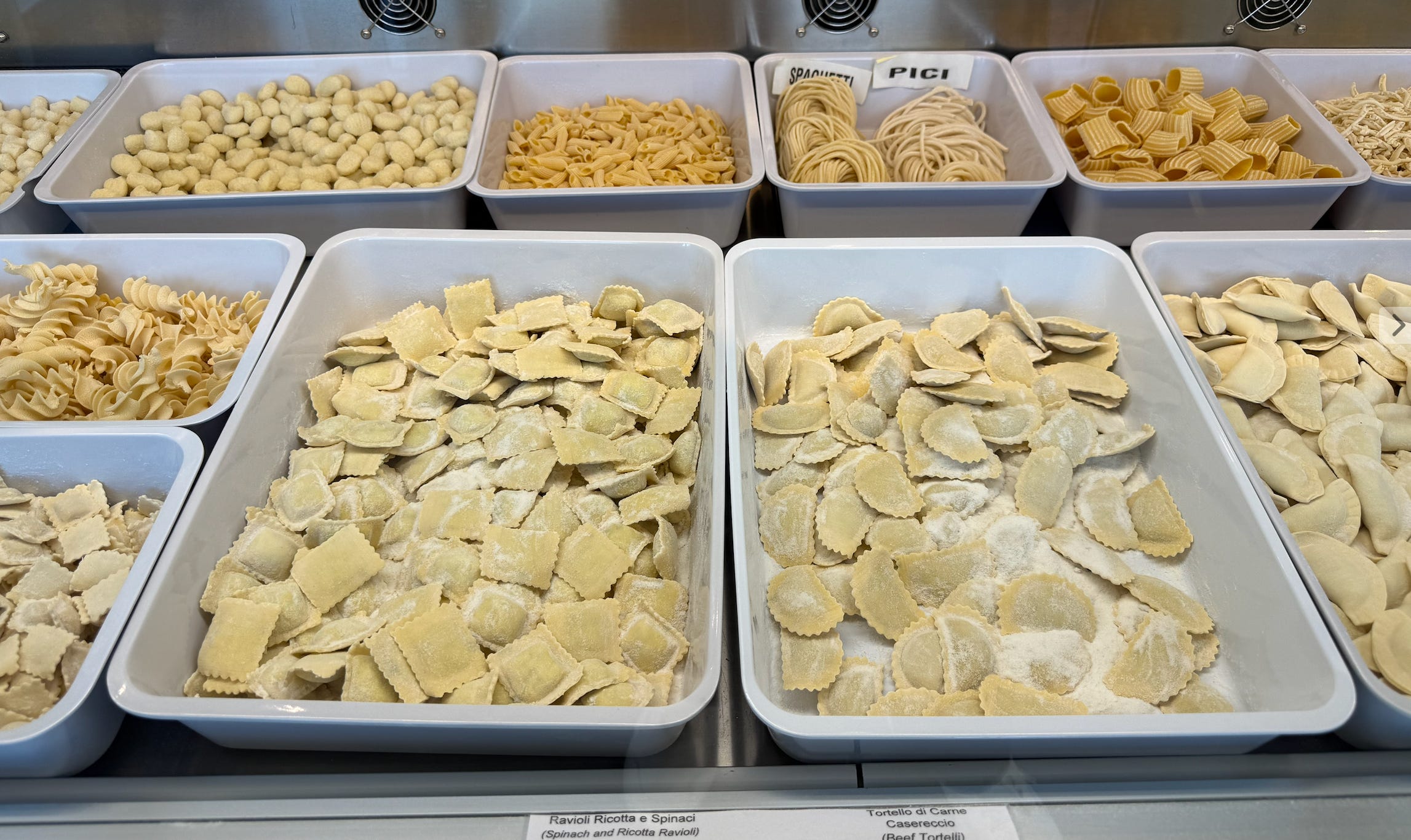
Pastificio is the fresh-pasta shop, and this is the one most travelers have never heard of. The pastificio makes the fresh pasta of the town, the ravioli, the tortellini, the local stuffed pasta, and sells it by weight along with the sauces that go with it. Twenty euros at our local pastificio in Versilia buys roughly two large bags of fresh pasta, which is enough for the better part of a week of dinners for two. Our local pastificio runs through the Versilia repertoire by the week: tordelli, the half-moon meat-stuffed pasta that is the Versilia and Lucca holiday dish, fish-filled ravioli that only makes sense on a coast that catches its own fish daily, the local pesto when the basil is right and the rougher meat ragù when it isn’t. In Liguria the pastificio repertoire shifts to Genovese pesto and the trofie that go with it. In Puglia the pastificio is the place for orecchiette and for the cream-of-tomato sauce called pesto rosso. The pasta you buy at the pastificio is alive in a way that supermarket dry pasta is not, cooks in five minutes from refrigerated, and is the dinner Italians serve other Italians on a Tuesday because they were busy. You might wonder why bother with fresh pasta when you have dried one? This is true for spaghetti, tagliatelle, or any packaged pasta, provided you buy a good brand. But buying pre-made stuffed pasta of any kind is a culinary sacrilege.
Fruttivendolo is the greengrocer, the shop or open-front stand for fruit and vegetables. It is seasonal by default in a way the supermarket cannot afford to be. In June you get the strawberries and the early tomatoes. In late October, the first porcini and the first damp-soiled walnuts of the autumn. The fruttivendolo runs on what the local farmers have brought in that morning, and the price reflects the proximity. The fruttivendolo will tell you which producer grew the lemons. The fruttivendolo will also, if you ask, tell you what to do with the artichokes you have just bought, and the answer will be honest because the fruttivendolo’s wife, sister, or mother cooks them the same way.
The Mobile Tier
These eight shops are the fixed tier. Yes, there are others too: wine shops selling local wine, or herbalista, the natural-remedies shop with local spices and herbs. But above all of them, where the geography or the population does not support a fixed shop, is the mobile tier.
The mobile tier is the Italian solution to a small town that cannot sustain a full pescheria, or to a mountain borgo of one hundred people that cannot keep a salumeria in business. The shop comes to you. The Tuesday Ape Piaggio van at our gravel turnout is one version. The food-truck salumeria that drives into a mountain village in the Lunigiana on a Friday morning and parks in the square is another. The bread van that does a loop of three hill villages above Bagni di Lucca on Mondays and Thursdays is another. The pattern is the same. The shop opens for two hours. The locals know the hours. The shopkeeper closes up and drives to the next village. The next village’s two hours start an hour later.
The Producer-Direct Tier
The tier above the mobile is the producer-direct tier, the cheapest and most local of all, and it is invisible to anyone without a phone number.
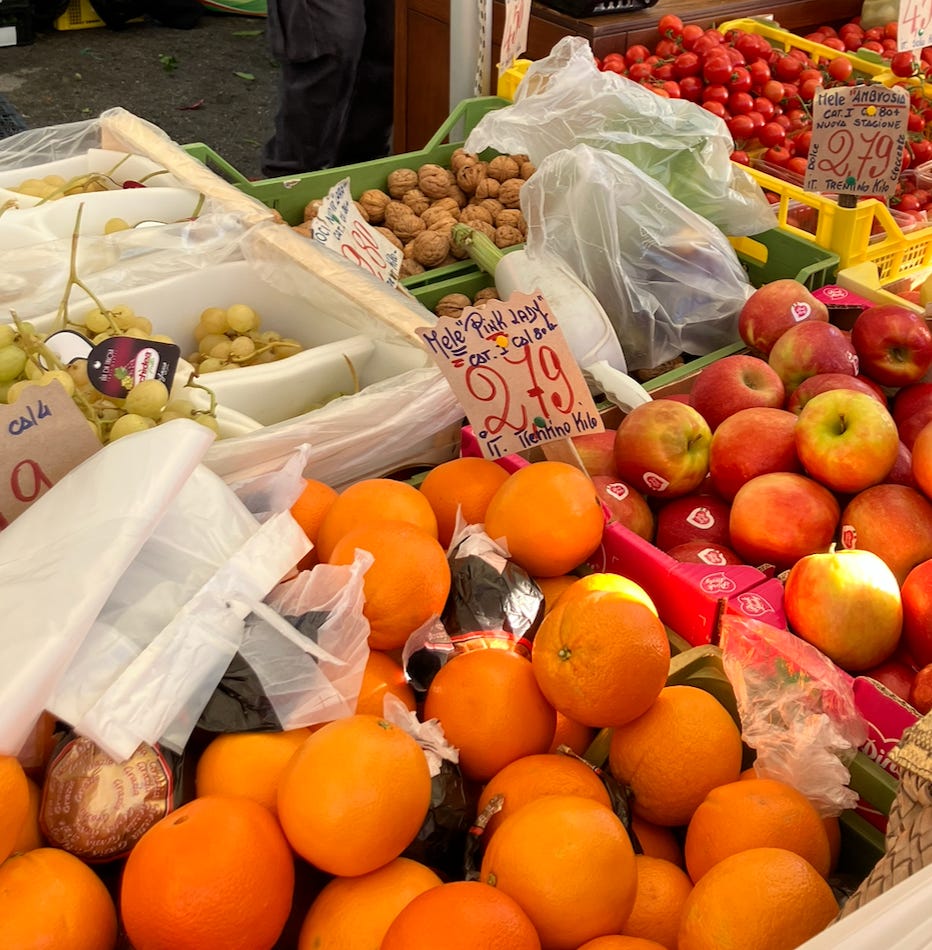
The first time we encountered this version of the system was at a small farm in the hills above Marina di Pietrasanta. During Halloween, one of the farmers transformed their yard into a Ghostbusters movie set. Yes. They even transformed their old FIAT into the Ghostbusters car. We saw it on Instagram and went in to visit. The event was free, fun, and creative. Ultimately, the goal was to meet with the farmers. We bought their local produce, exchanged phone numbers, and from there on, whatever is in season, we text, or they text, and a big basket of fresh veggies arrives at our door. You can select or define from limited availability, but it will be guaranteed the freshest and cheapest option you can get, farm-to-table in essence.
Almost every region in Italy with productive agriculture has a version of this. It is not on Google. It is not on the tourist office’s list. Oh yeah, and it’s cash-only, of course.
The Italian system is not a relic. It is a working machine. The shops that look quaint to a foreigner are operating in the gap the supermarket cannot fill, doing the job of moving local food from where it was made to where it gets eaten. The next time you walk past the forno on the way to the Conad, walk into the forno. You will not be sorry.

Planning a slow trip? My planner builds it for you. Free, no paywall, no email gate. Answer five questions (hub town, interests, travel month, days you want for slow discovery, and fitness level, because some of these towns make you climb), and you get a personalized route from my handpicked list of the 1,000 towns most travelers skip, with festivals, drive times, and a line on what each place is. Don’t like it? Refine it, swap towns, or browse the whole database by region.