Marina di Pietrasanta | A Weekend in May
Saturday market, Sunday bike, and the marina between Forte dei Marmi and Lido di Camaiore

The first cornetto on a Saturday morning in May is the one filled with apple, and I eat it dipped into a long coffee at the Margherita while the market two streets away begins its slow assembly under the plane trees of Piazza Villeparisis. The pastry has a coat of sugar on top of the sugar already inside it, and Sophia, sitting across from me with a cappuccino, has chosen the sfogliatella, which is the only honest answer when it’s fresh.
We are originally Hungarians. We do not believe in sweet breakfasts. We have lived here three years, and we still do not believe in them, but on this one morning a week, with the market noise drifting across the piazza and the vigili finishing their first pass of the streets in their reflective vests, we participate in this error and find that it is not entirely an error after all. The cornetto holds together for the first three bites. After the third bite, it becomes a piece of soaked bread, which is the point of dipping it. The man at the table next to ours is reading La Nazione with his thumb pressing the page flat against the wind, and his espresso has been sitting on the saucer untouched for four minutes, which means he is from here.
Marina di Pietrasanta is not a town. It is the seaside of a town. The town is twenty minutes inland by bicycle, and it has its own piece on this site. The marina is something else, four small frazioni stitched together along five kilometers of sand between Forte dei Marmi and Lido di Camaiore. From north to south: Fiumetto, Tonfano, Motrone, Le Focette. They are the same place, and they are not the same place. Fiumetto has the pineta and D’Annunzio’s villa. Le Focette has the old nightclub where Mina sang in 1962. Motrone is where the river once flowed before the Americans buried it during the war, so they could land scout planes on what is now the soccer field. Tonfano is where I am sitting. The center of it, if a place this small can be said to have a center, is the piazza two minutes from where I sleep, which has the pontile at one end and a cluster of bars and a porchetteria at the other. Most of what happens here happens between those two points.
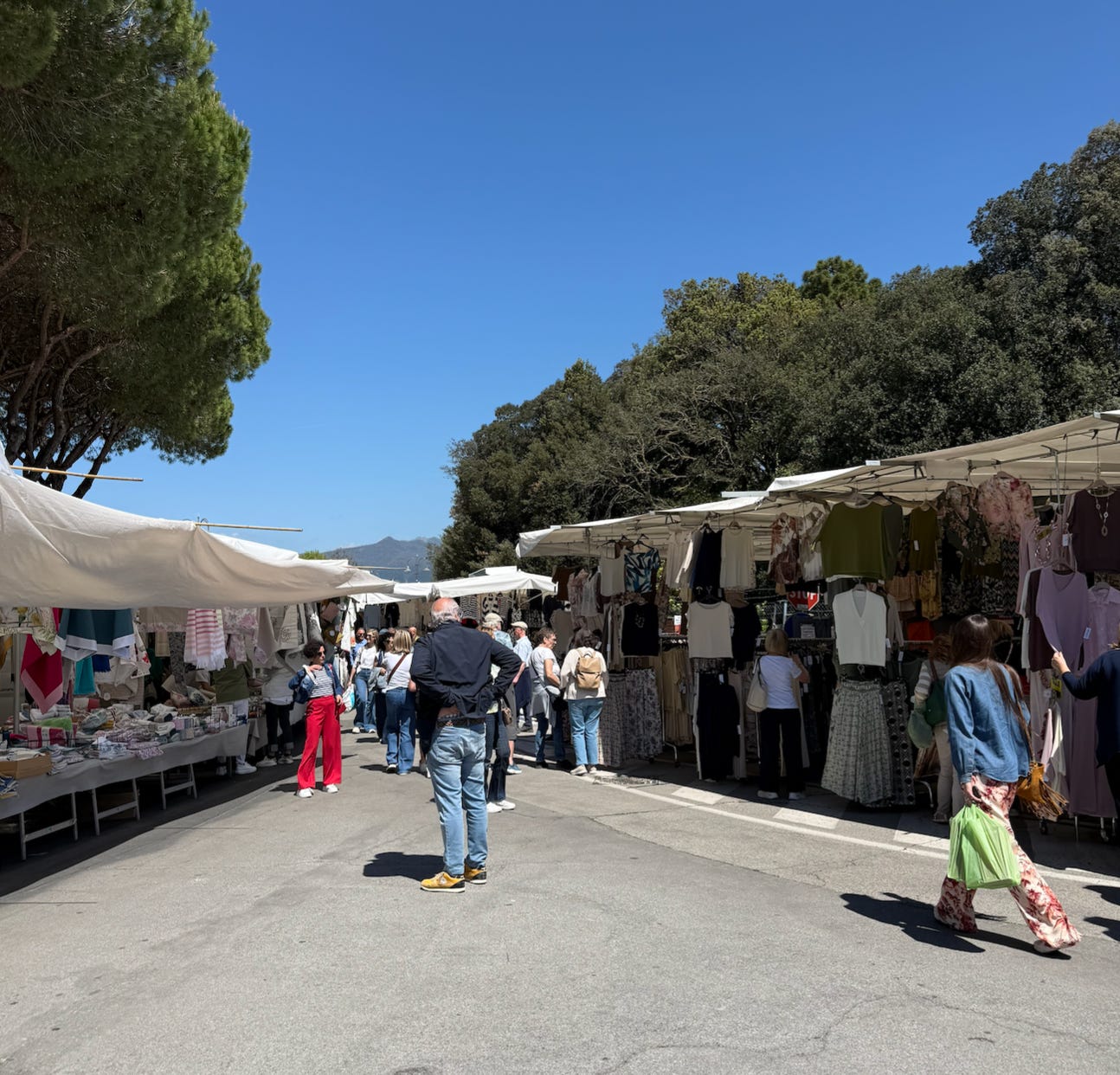
The market arrives every Saturday and leaves the same afternoon. It is run by a small group of vendors who set up at six, sell until two, are gone by three, and by four the streets have been swept and the parking restrictions are lifted with a German sort of precision that does not fit anything else about this country.
Sophia and I finish the coffee and walk into the noise. We know every meter of it. Three years of the same stalls, the same vendors, the same loud and terrible house music coming from the speakers of the two brothers who sell secondhand clothes and have apparently never agreed, in their whole working lives together, on a single song that anyone over thirty would want to hear. They wave. We wave back. I have bought four shirts from Casati Milano's pop-up, and Sophia has filled half her closet with pieces from the vintage rack at the far end. The salumeria man (Marco) recognizes us from fifteen meters away and is already cutting something I did not order, because every month I bring him a bottle of Tokaji from Hungary, and every month he repays me with finocchiona and pieces of pecorino I would not have known to ask for. He says ciao bello without looking up. I have learned to say ciao bello back without breaking stride.
By the vegetable stand, we collect four bags for ten euros, and by the time we reach the rotisserie ladies at the end, I have stopped counting what we have. The ladies know us. They shout numbers at the line and dimmi caro at us, and one of them packs the chicken into foil while another scoops fried zucchini and salsiccia into a paper bag that is already translucent with grease. The chicken is spiced with something I have given up trying to identify. We do not roast our own anymore. There would be no point.
We take the bags home and eat lunch at the kitchen table with the windows open to the piazza. Outside, the market is finishing. The umbrellas are coming down, the vans are pulling up, and below all of it, faintly, the sea is doing what the sea does.
The marsh is still here, by the way. Not visibly. But underneath. This whole strip of sand was a malarial wetland until Cosimo di Medici started draining it in the sixteenth century, and Leopoldo II had to come back and finish the job in the nineteenth. The Tonfano River, which gave Tonfano its name, was buried in the 1940s by American soldiers who needed a flat strip for reconnaissance aircraft. What was left of the smaller fossi was filled in over the decades that followed with marmettola, the pulverized waste of the marble quarries six kilometers inland. Which means that everything I am walking on, when I walk to the pontile, is reclaimed swamp filled with the dust of the white mountain. The tourists do not know this. Most of the people who live here do not know this. But the ground remembers, in the way ground does, and the houses settle in their own quiet directions, and the irrigation ditches that survived run faintly green between the hotels and the villini.
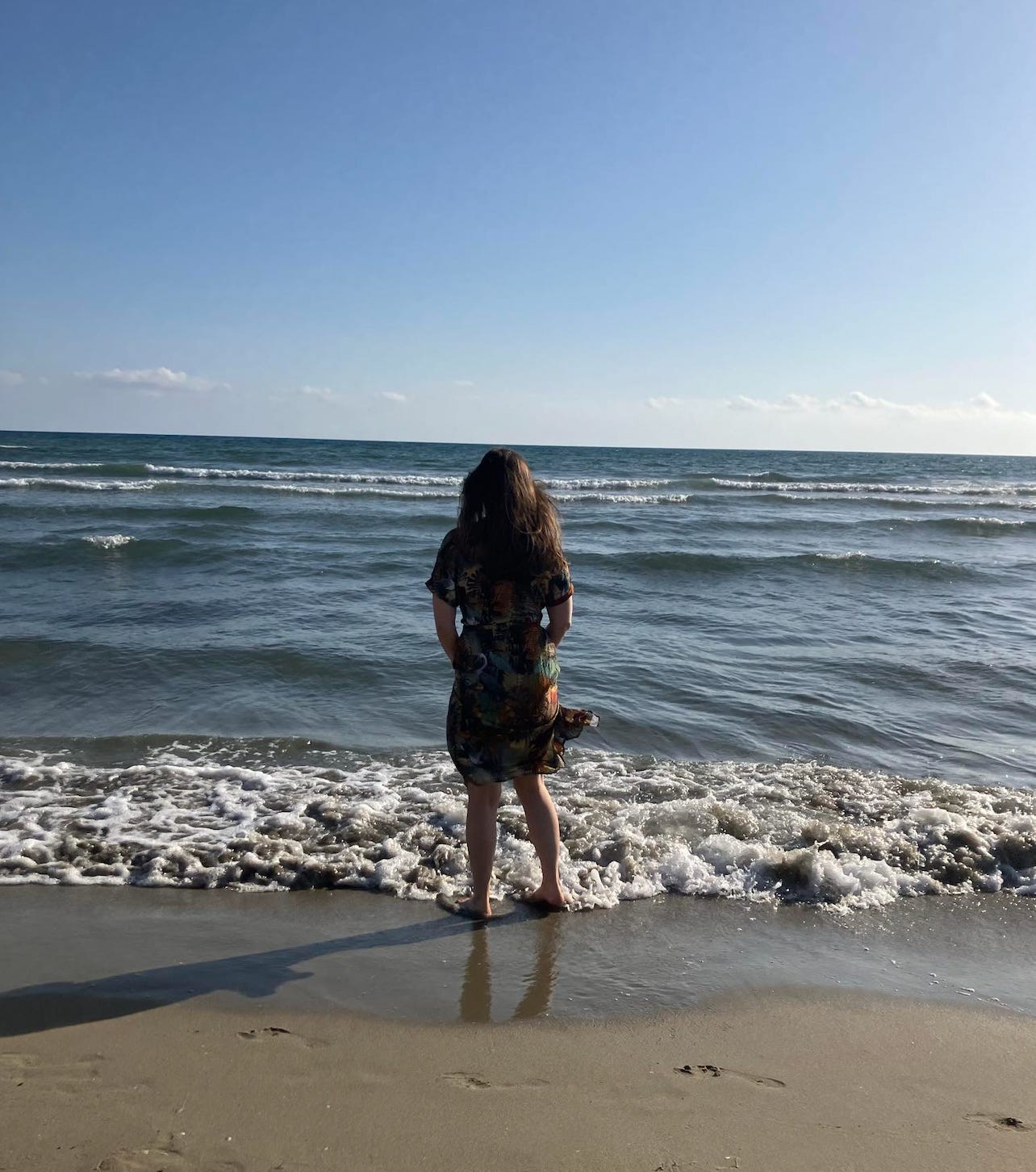
In May, the bagni are mostly closed, or half-open, or being painted by a man on a stepladder while another man holds the ladder steady and reads a newspaper. The sand has not yet been graded by the small tractors that come every morning in June. The sea is not warm. Italians from Florence, Pisa, and Lucca, who own villini here that have been in their families for two and three generations, walk along the battigia in light jackets, and the few foreigners are mostly German, already in the water because they are German.
Sophia and I bring an old white bedsheet, two bottles of water, a book, and the last edition of the local paper (I learn Italian from it), and walk past the closed gates of three bagni until we reach a stretch where nobody minds. The towel goes down past the last row of folded loungers. The sun is direct but not punishing. I read for twenty minutes, and at some point, I fall asleep briefly and wake to the sound of two children speaking Florentine to a small dog. Time has passed. The light has shifted by maybe ten degrees. The sea has come up another half-meter.
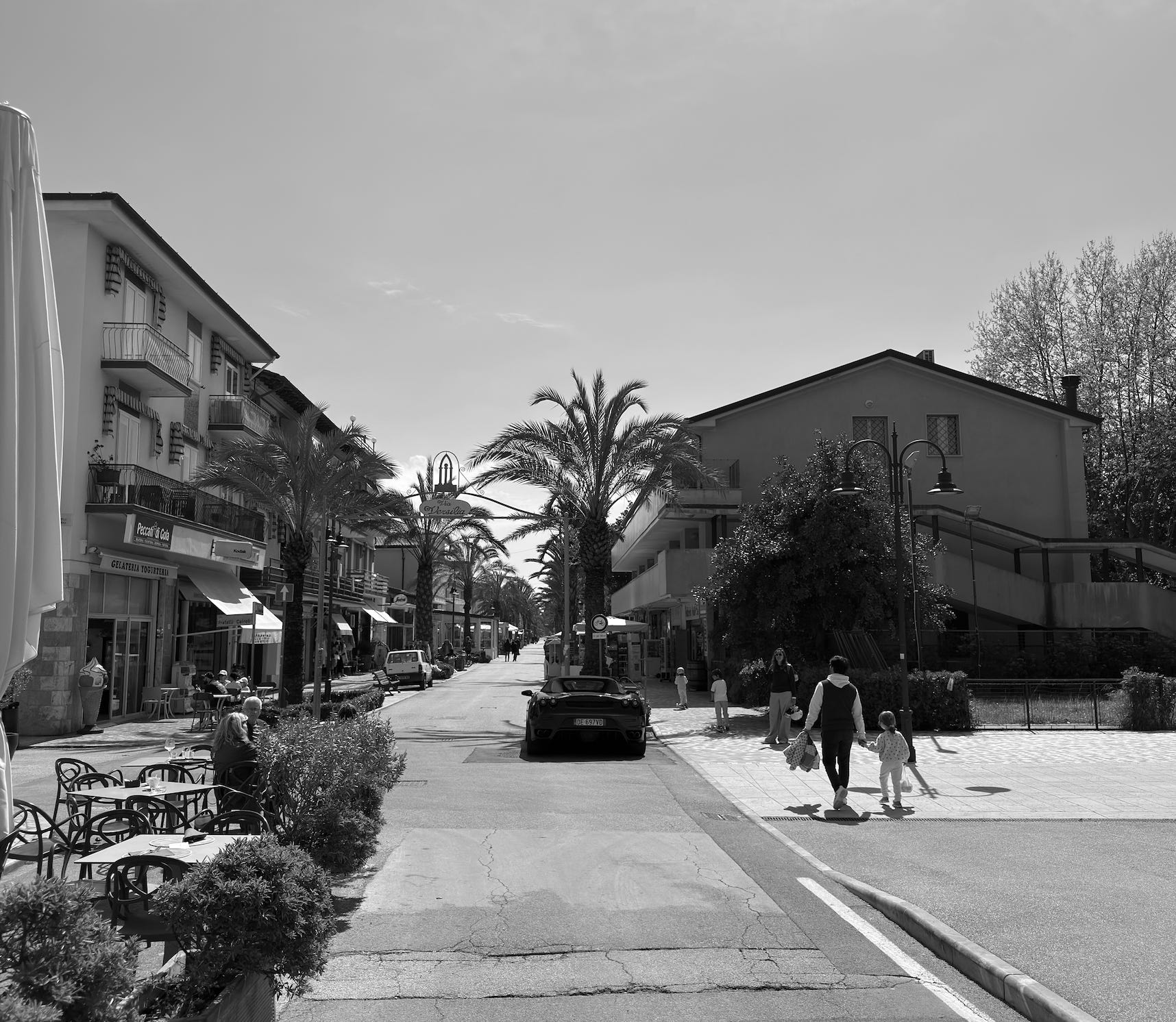
This is not Forte dei Marmi. Forte is the marina that got rich on the same coast, and it is full of Russians and concept stores and a market on Wednesdays where the cashmere is real, and the cashmere is also fake, and it is wonderful in its own way, and I have written about it elsewhere. Marina di Pietrasanta is its quieter cousin. It is mostly residential. Three streets and a pedestrian via, the Via Versilia, where the restaurants are. The Carlino is here, where the cacciucco on Sundays is the reason you come back. The Cafè Versilia is here, and the porchetteria on the main square, where, when I asked the owner if they ever put cheese in the panino with the porchetta, the way they do in Rome, he looked at me for a full second and said: No. Tuscan porchetta is meat. We add more meat. That is all. I have not asked again.
The bike path runs from Marina di Carrara in the north to the harbor of Viareggio in the south, thirty kilometers of separated lane along Viale Roma and its various names, and on Sunday morning, if Saturday’s beach was lazy, we ride. Toward Forte dei Marmi, the road passes the Versiliana, eighty hectares of macchia mediterranea and umbrella pines that survived, mostly, the wind storm of March 2015, after which the locals stopped saying bosco and started saying quel che resta del bosco, what’s left of the forest. D’Annunzio wrote La pioggia nel pineto in the villa inside it, in 1902, lying around with Alessandra Carlotti di Rudinì in some condition of summer indolence I cannot read about without becoming irritated, and every July the Festival della Versiliana sets up a stage among the pines and runs concerts until September. We saw Carmina Burana there once. The mosquitoes were terrible. The music carried.
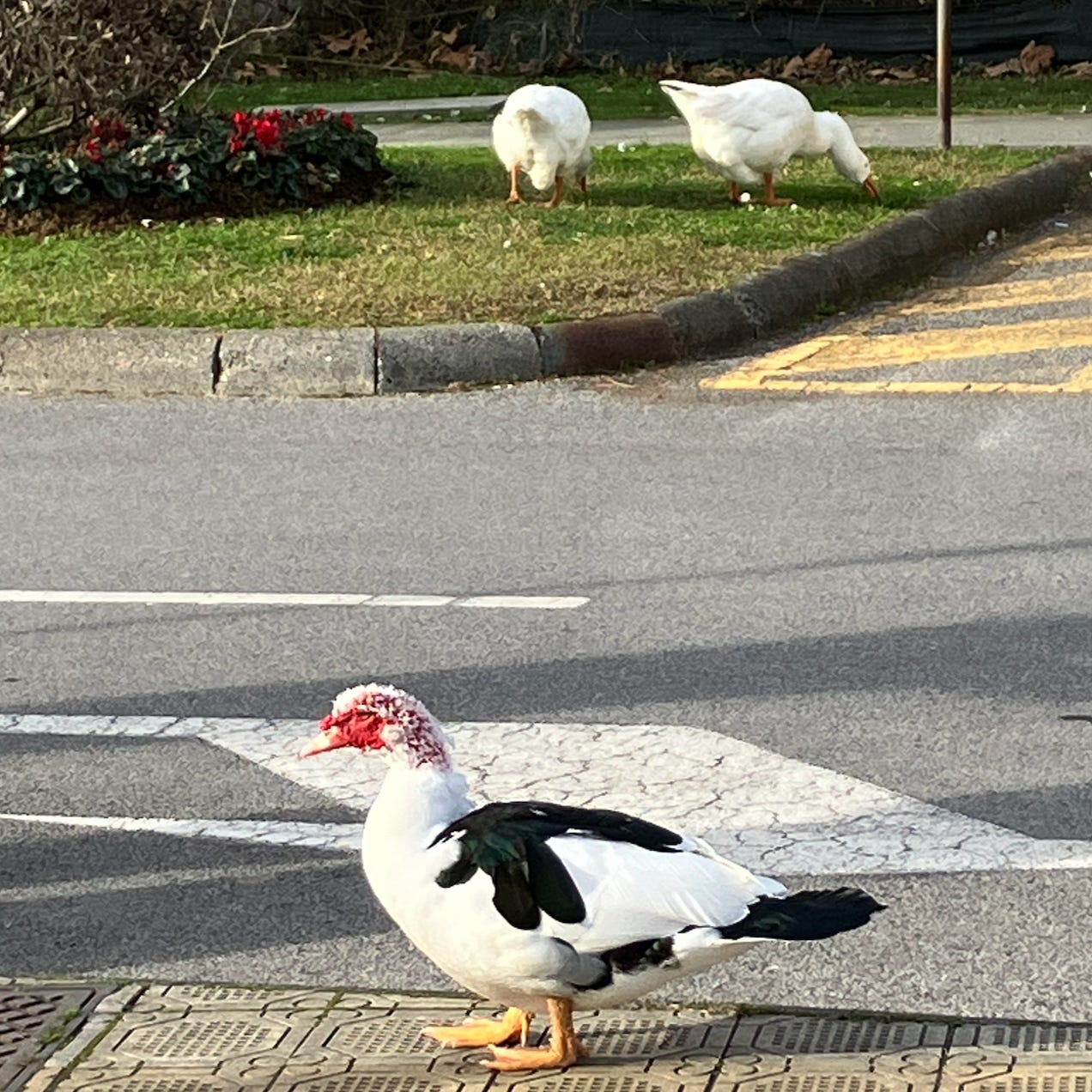
The geese live in the park. They do not know they live in the park. On weekday mornings, they wander out onto Viale Apua, six or seven of them in single file, the kind of line geese make when geese have decided where they are going, and the cars coming down the four-lane stop. Not honk. Stop. The gang of geese takes its time. They cross at goose-pace, which is the slowest reasonable pace at which an animal that can fly is willing to walk, and the drivers in their Fiat Pandas wait with the resigned good humor of people who have seen this before and will see it again, and after a long minute, the last goose makes the curb and the line of cars moves on. I have stopped finding this remarkable. It is one of the small adjustments the place asks of you, and you make it, and after a while, you forget it was an adjustment.
If you cross the Versiliana into Forte, you are in another country. Hotels, Russians, the Wednesday market, the closed-off feeling of a town that has decided what it is. If you ride south instead, past Le Focette and into Lido di Camaiore, you pass another country, the family-vacation country, the bagno country with the inflatable slides and the entertainers in matching shirts, and beyond that Viareggio, which is a city, with everything a city has, including a harbor and a cat called Ettore who lives at the end of the breakwater and who has, in his own way, become a destination.
Marina di Pietrasanta is between these two. It has the residentiality of neither. Most hotels here are small and old. The houses are villini, modest by the standards of this coast, often closed from October to May, owned by families from the inland cities who come down for the weekend in cars too clean to have come from anywhere with bad weather.
In summer, of course, it changes. By the time Ferragosto arrives in the second week of August, it is unlivable, in the literal sense that we cannot live here, and Sophia and I leave for England every year and do not come back until the first week of September, when the season has cracked, and the place exhales.
The beach clubs are open, but in a way I do not enjoy. La Bussola, on the Focette side, was Sergio Bernardini’s club from 1955, and Mina sang there, and Celentano, and Vanoni, and the entire pop canon of an Italy that does not exist anymore, and the building still stands and is still run. The Twiga is here, Briatore’s bagno, with the prices that make Forte people feel they are slumming. The Faruk, the Bussola Park, where they bring in summer concerts, this year I think Nick Cave.
The marina has its nightlife. We mostly do not have it. We have a small bar called Lo Studio, which is what we have instead, run by a man whose family used to own the building that is now the Margherita, who sold it for what must have been a great deal of money and used the proceeds, as far as anyone can tell, to open a place that exists for the purpose of letting him dress as a clown and serve cocktails to his friends. The cocktails are excellent. The clown costume is real. The space is some hybrid of bar, antique shop, concert venue, and circus, and the logic of it is: I have made my money, now, I will have fun. It is among the most Italian things I have ever encountered.
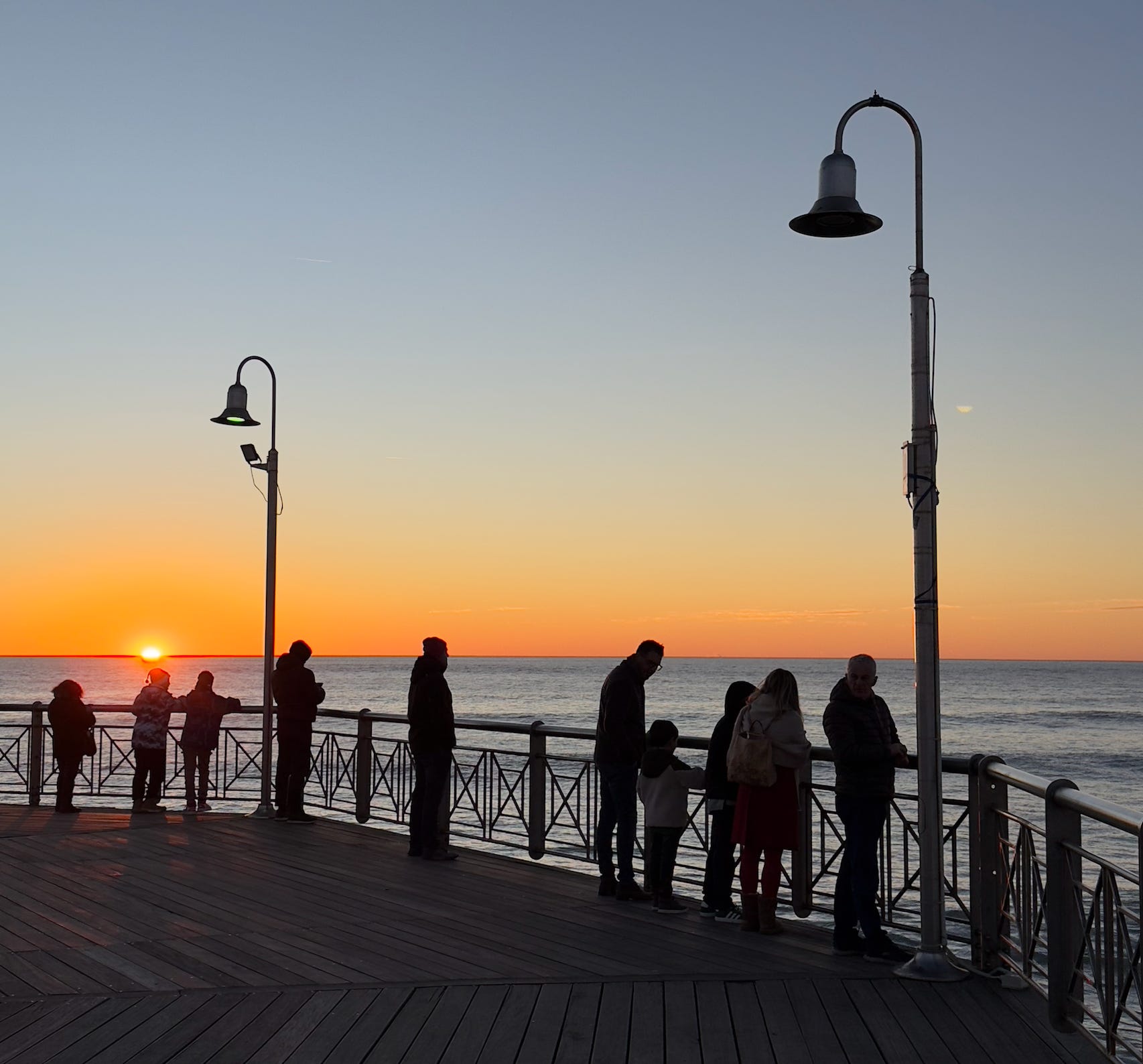
We have a butcher, Angelo, from whom we buy the meat. We have a hairdresser, Michela, whom Sophia goes to and waits and chats and waits some more. We have a farmacia where the woman behind the counter knows what Sophia takes for her allergies and starts pulling it down before Sophia has finished saying buongiorno. None of this is unique. This is what every small Italian commune offers, eventually, to anyone who stays long enough. What is unique to here is what is two minutes’ walk from my front door, which is the pontile of Tonfano, two hundred meters of concrete pier walked into the sea, and the bronze statue of Sant’Antonio submerged just south of it that you can see only when the water is calm, the head of the saint looking up through the green-gray.
Sophia and I have a theory we developed in Budapest. We used to live in a house above the city, with a terrace, and a view that was, by any reasonable measure, extraordinary. Six months in, we stopped going out onto the terrace. A year in, we forgot the view was there. You get used to anything. The place becomes the place where you live, and the extraordinary thing about it becomes the thing that is just behind the door, the way the sound of a refrigerator stops being the sound of a refrigerator after the second day.
I am writing this from my bedroom. The end of the pontile of Tonfano is a five-minute walk from where I am sitting, and the sea is doing its work in a low rhythm I can hear if I listen for it, and the market is gone, and the streets have been swept, and the parking is allowed again. By the theory, I should have gotten used to it. By the theory, I should have stopped noticing. I have not. I do not know when it will happen, or if it will.
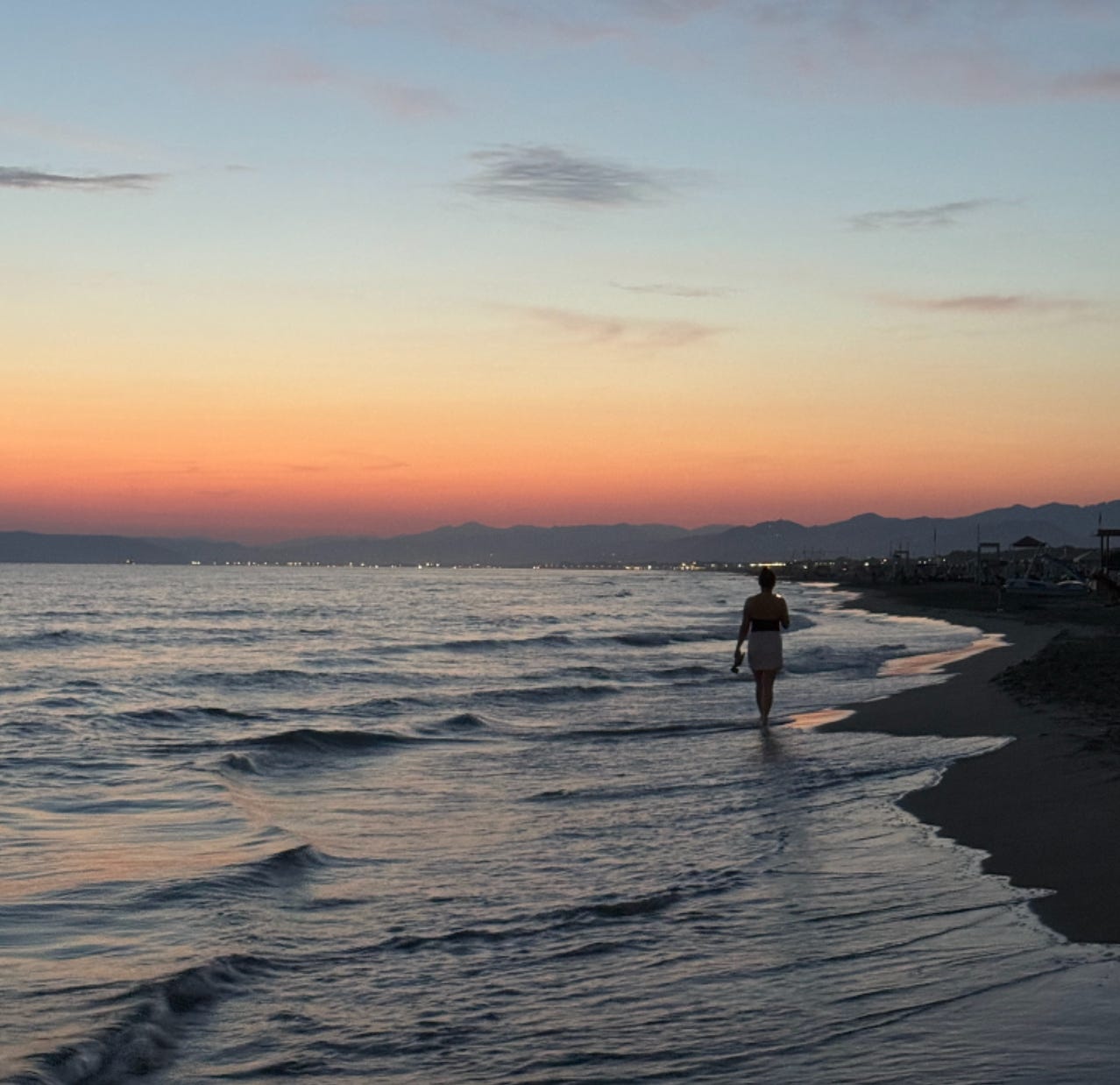
Last night at sunset, I walked to the end of the pier with Sophia, and we stood there while the sun went into the sea behind the breakwater of Carrara, and I thought, again, the same thing I think most evenings: this is where I live. I still do not believe it.