Pietrasanta | Old Money, Long Afternoons
The capital of Versilia. Where art is the lifestyle.

The first town we lived in was up in the mountains, a hundred people above a curve in the road, a church, a grocer who opened for four hours a day twice a week and closed if it rained, and for the first few weeks we had all of it, the stone houses and the old men on the benches and the kind of silence you read about in books, and the wanting and the having lined up the way they almost never do. The town was called Marciaso, up in the Apuan Alps, and by the second month, we had understood what we didn’t know when we moved in, which is that silence is a skill most of us don’t have, and that a thirty-minute drive for bread stops being a charming detail the fourth time you make it in the dark. Reality is a big killer of romanticism.
So we looked at the map. Pietrasanta sat twenty kilometers down, where the Apuan Alps stop and the sea starts, the town was said to be full of galleries, my wife is a designer, and I had always cared about art without ever doing anything useful about it. That was all we knew when we signed the rental in Marina di Pietrasanta, five minutes by car from the historic center. We have been there ever since.
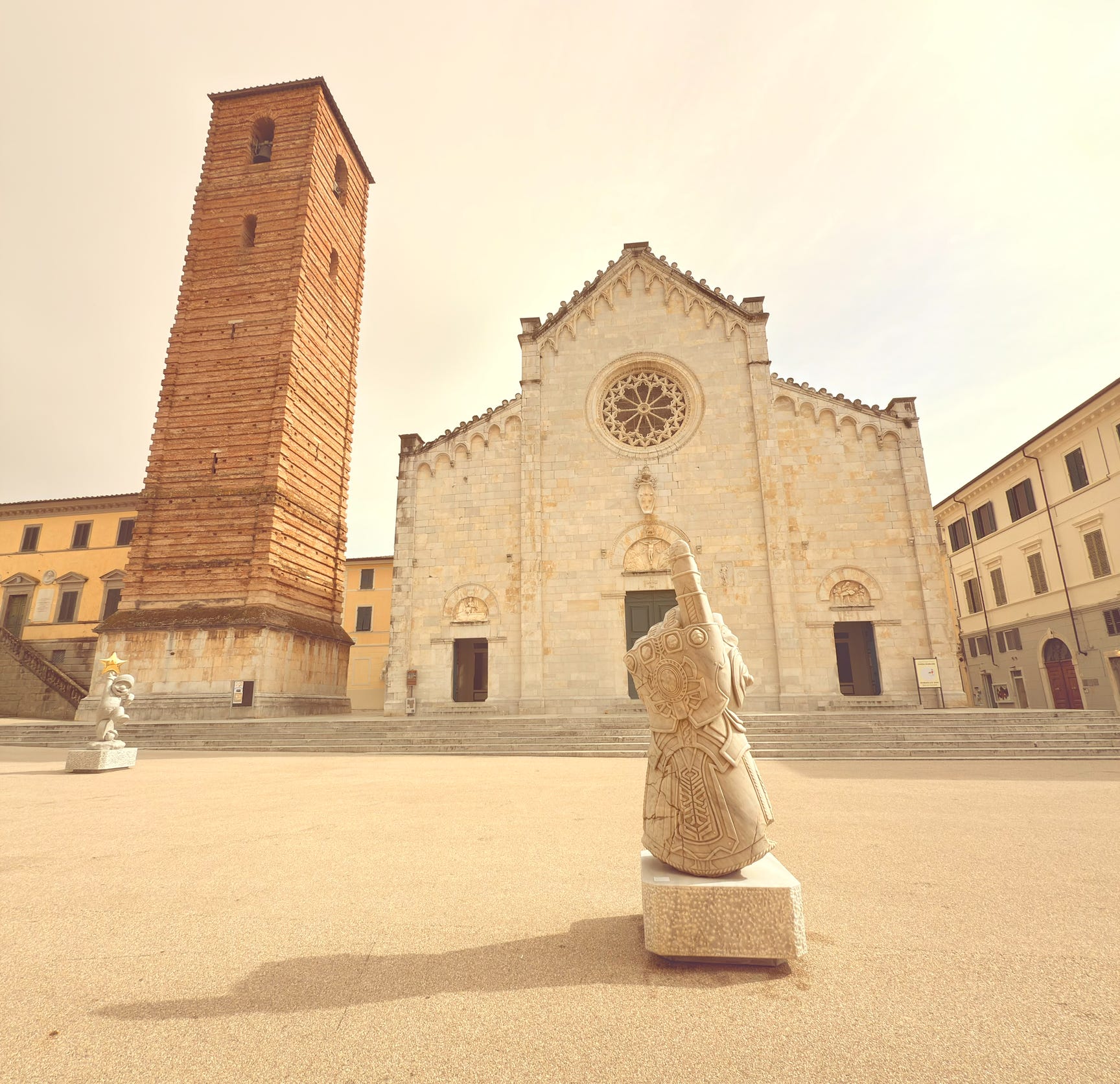
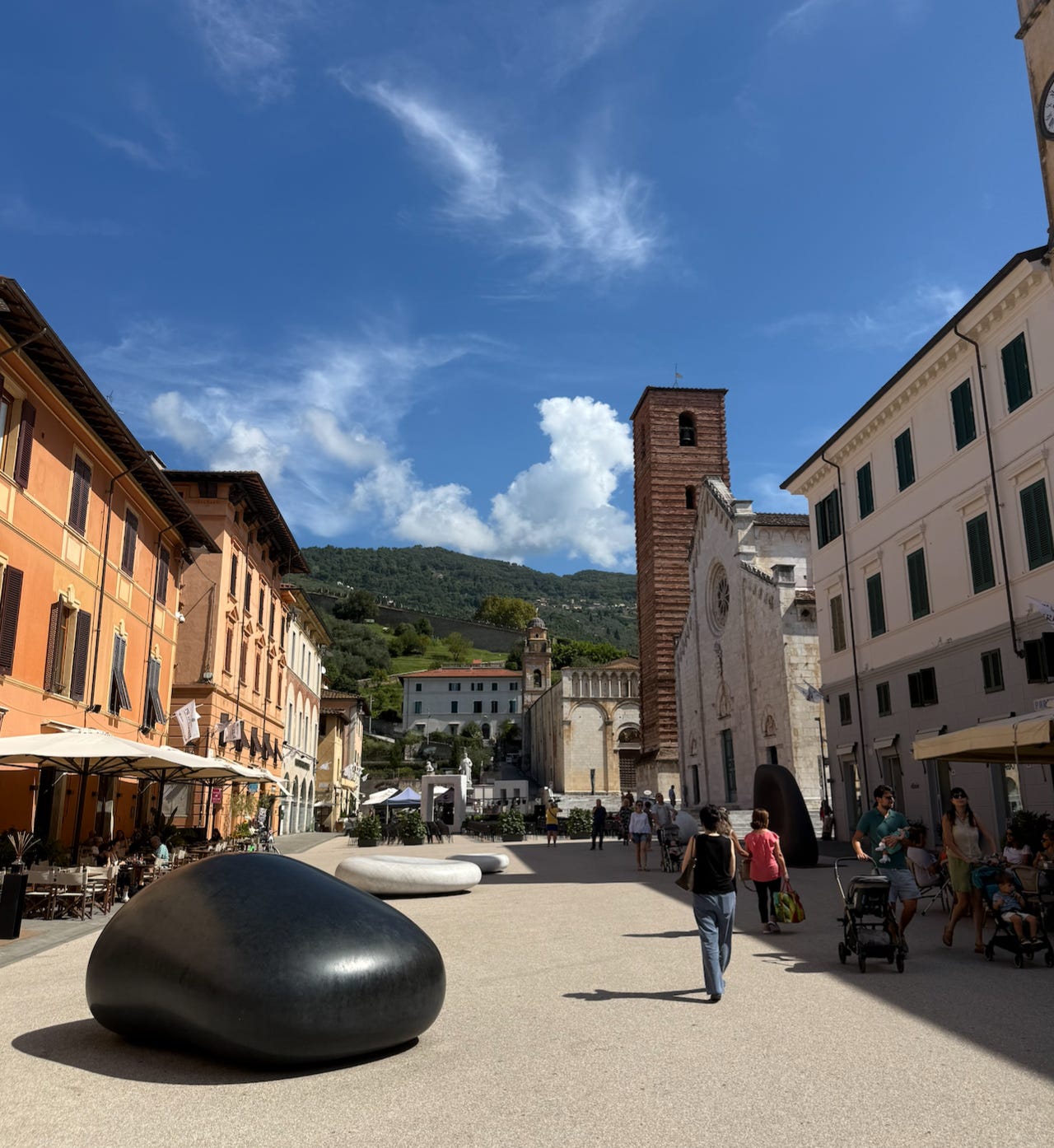
I walked into the center for the first time on a Tuesday in late afternoon, parked outside the wall, came in through what used to be the main gate and is now the street beside the post office, and by the time I reached the Piazza del Duomo, I had already begun to suspect that I had misread the town. I had expected architecture. There are some competent and quiet, three parallel streets inside a partially preserved medieval wall, a duomo in red brick and white marble, a bell tower that was designed to be clad in stone and never was, and a stretch of rampart climbing the hill above the square. You can walk the whole thing in twenty minutes and leave thinking you have seen it. I walked it in twenty minutes. I was wrong.
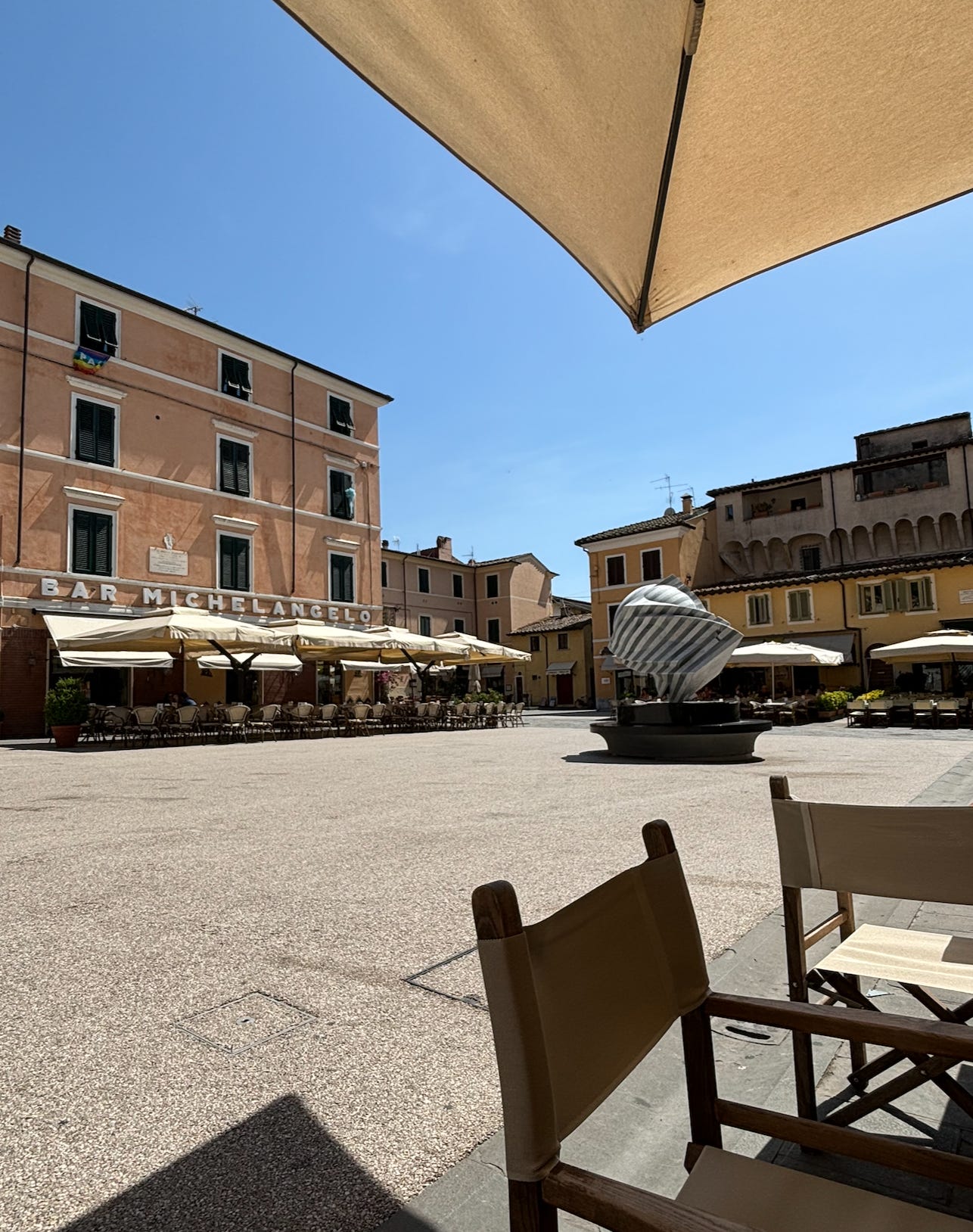
What I had seen was the postcard. The town was the thing that was going to happen to me once I stopped walking, and I stopped walking when I reached the piazza and sat down at Il Duomo, the café on the south side of the square with tables spread out across the stone, because the light was doing something to the brick of the cathedral that I wanted to watch for a minute before I left. I ordered a glass of wine. The small plate arrived without being asked for: olives, chips, and little squares of focaccia. I did not leave for three hours.
I had lived in Rome. I had lived in Florence. I knew what an aperitivo was the way a foreigner knows what pasta is, technically, abstractly, without quite believing in it, because in a big city you don’t sit on a piazza for three hours. Something is always pulling you somewhere else: a museum closing, a reservation, a friend running late who texts every ten minutes, and the aperitivo when you live in Rome is a thing you squeeze between two other things. In Pietrasanta, there is nothing else. Or rather, the other things move at the same speed as the aperitivo, which is to say they don’t.
I watched a wedding come out of the church. A truck from the coast pulled up on the far side, and a young man in an apron carried crates of artichokes past my table toward the café next door, three crates, one at a time, unhurried. A woman argued with her husband in dialect about whether the dog should be allowed on the bench between them, and the dog, who had clearly won this argument before, waited patiently for the woman to win it again. An entire side of the square went from shadow to gold as the sun dropped behind the bell tower. None of this was an event. All of it was the event. My wife and I have a phrase we use with each other now, when one of us is being rushed about something that doesn’t deserve it. Why are you hurrying? Don’t you have time? We picked it up on that square, though not from anyone in particular. It is the question the town asks you, in different forms, every afternoon, until you either answer it or leave.
On the second glass, I began to notice the marble. It’s everywhere once you look. The steps are marble. The doorframes are marble. The window sills are marble. The ashtray on the next table was marble, chipped at one corner, a piece of white Carrara that had probably been cut from an offcut in a workshop two streets away. There is a reason for this, and the reason is the entire town.
The Apuan Alps sit behind Pietrasanta, and the quarries of Carrara are twenty minutes up the coast, and between them they produce the whitest and most expensive stone on the planet. Michelangelo came here in 1518 to source marble for the façade of San Lorenzo in Florence. He never got the façade built, the project collapsed in politics and money the way projects do, but he left his name on a plaque on the piazza and a pattern the town has followed since, which is that the best marble on earth is down the road, and the artists who work it live here. Fifty workshops and foundries are still active, spread through the streets and the outskirts, and when I walk into town in the morning, I hear the wet grind of a diamond blade through stone from three directions at once.
I learned most of this later. On that first afternoon, I only registered the ashtray, and then, walking back toward the car after the second glass, the fact that the roundabout at the edge of the centro had a marble sculpture in the middle of it instead of a municipal flower bed. Nobody in the cars circling it was looking at it. It was just what was there.
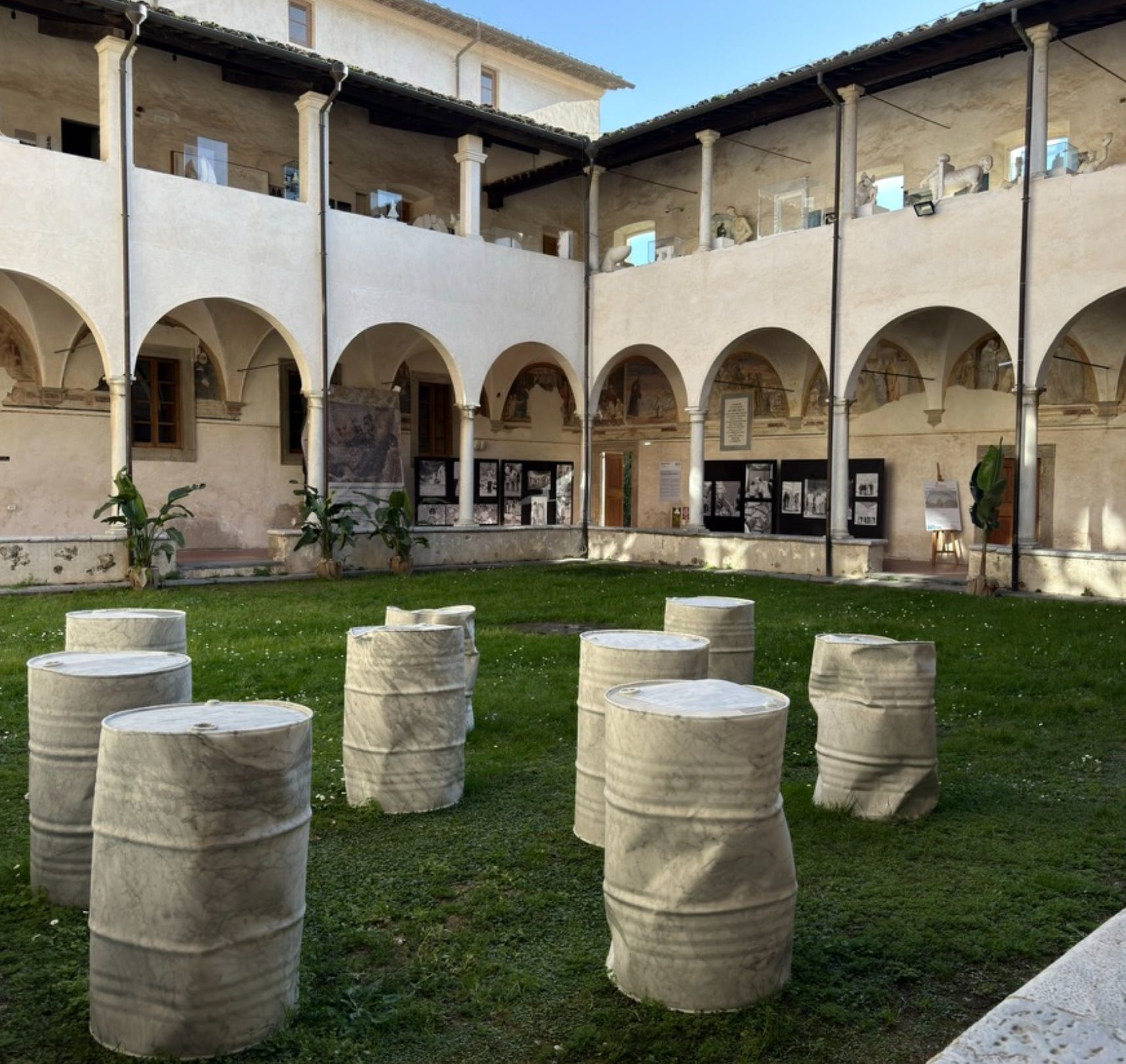
The marble is what the town is made of, but old money is what makes the town behave the way it does. This I also learned slowly, afternoon by afternoon, sitting at Il Duomo and watching the piazza. The money here is not Milan money, not the visible kind. It is older. Families have been in the same palazzi for four hundred years, the sculpture above the mantel was commissioned directly from the sculptor three generations ago, nobody has any particular reason to sell it. You can spend more in a single Pietrasanta gallery than the entire Gucci store in Forte dei Marmi grosses in a week, and you will do it in a back room by appointment, and nobody outside the transaction will ever know it happened. The pieces don’t end up in Los Angeles or Dubai. They go to houses that have had the same address since the Medici.
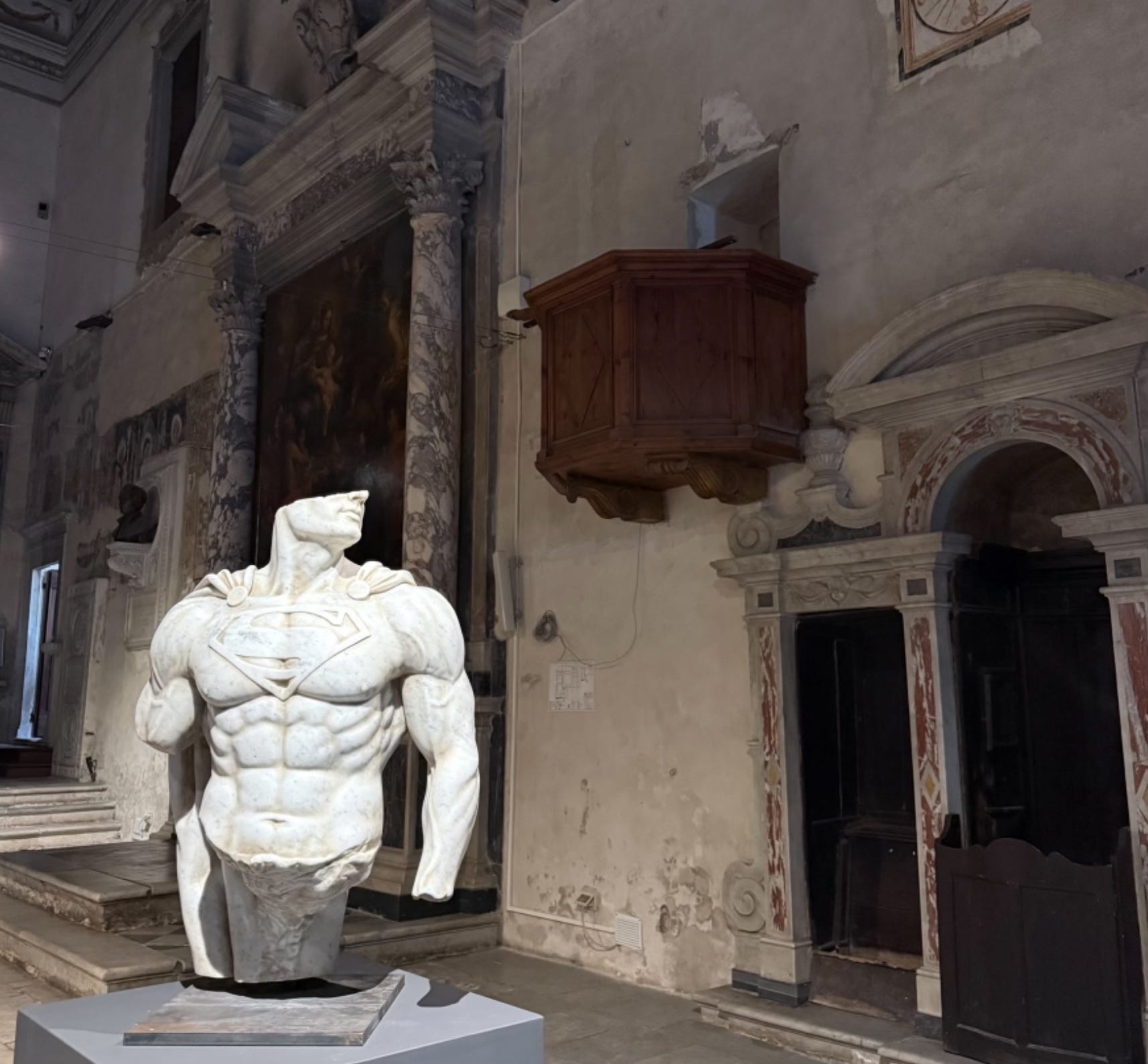
You see it if you know what to look for. A gallery owner crosses the square at five in the afternoon, carrying a canvas wrapped in brown paper, sets it carefully against the leg of a café chair, orders a coffee, and reads her phone. She is dressed as if she came from a house on Lake Como, which she might have. The deconsecrated fourteenth-century Sant’Agostino, on the other side of the square, had an exhibition on the first time I walked past, and I went in to find life-size marble superheroes staged among the medieval frescoes, a Spider-Man in red-white Carrara coiled on a column, a Superman leaning against a side chapel, absurd and beautiful and entirely at home. The curator was sitting at a folding table at the back of the nave, reading a newspaper, drinking from a small cup of coffee someone had brought him. He nodded at me without looking up.
One afternoon at Il Duomo, a few months after we had moved down, I watched a man in dust-covered work clothes sit down at the next table. Mid-fifties, maybe older. He looked a little homeless, honestly. Grey hair, long and in need of a wash. Hands streaked black and white from whatever he had been working on that morning. Marble dust on his jacket where he had rested against a block, the way you can tell a mechanic by the grease on the hip. He pulled a Toscano cigarillo from his pocket and lit it, slowly, the way someone does who has done it every day for forty years, and the waiter was at his table in four seconds, faster than I have ever seen an Italian waiter move for anyone.
Buonasera, Maestro.
Coffee, a glass of water, no charge. The man sat for ten minutes, smoked, finished the coffee, nodded to the waiter, and walked off without paying because there was nothing to pay. I do not know who he was. I would not be surprised to find his work in museums I have been inside.
The food is the same lesson, translated into eating. We went to Il Vaticano on a Thursday, early, eight o’clock, a small room off a side street where they serve Fiorentina steak and fresh lardo from Colonnata and little else. The lardo came first, thin slices on warm bread, the fat still soft from the room it had been kept in, salt and pepper, and rosemary. I asked the waiter about contorni. He looked at me as if I had misunderstood the meal, and then, politely, as if the misunderstanding were probably his fault and not mine, he asked whether I meant more bread. I said I meant more bread. He brought more bread. The steak arrived a quarter of an hour later, two kilos for two people, served on a wooden board, the crust black and the center almost cold. We ate it for an hour. There was no side. There was never going to be a side. The correct side was the bread already on the table, and the discipline not to fill up on it before the meat came, a discipline I had been exercising imperfectly, and the waiter had seen, which was why he had brought the second basket without being asked.
Filippo, across town, has no menu. Filippo cooks what Filippo feels like cooking, and you pay what the meal costs. Gatto Nero on Piazza Carducci does a trippa alla toscana that is somebody’s grandmother’s, cooked by somebody who learned it from somebody’s grandmother. None of these places are expensive for what they are. All of them are expensive. Neither statement cancels the other, and the town has no interest in explaining the contradiction because it is not speaking to anyone who would need it explained.
We live closer to Viareggio than to Pietrasanta now, by maybe a kilometer. Viareggio has more shops, a bigger restaurant scene, the famous carnival, the long promenade, all the reasons you would expect a person to drive that direction when there is something to buy or do. When we have something to buy or do, we drive to Pietrasanta instead. For a long time, I couldn’t tell you why. I think I know now. We get whatever we came for done at some point in the afternoon, and we end up on the square with a glass of something, and the light is doing what the light does to the brick, and a man who may or may not be famous is smoking in the corner, and a young man in an apron is unloading artichokes at the café next door, one crate at a time. The town does the rest.
Yesterday evening, I walked back to the car the long way, around the back of the duomo, past the roundabout with the sculpture in it. A woman was coming out of one of the palazzi with a small dog on a lead, and the dog stopped to inspect the base of the marble installation at the center of the roundabout, and she waited for him, and the cars drove slowly around the two of them, and nobody was in a hurry.