Viareggio | The cat at the end of the road
Where the sea makes people work for a living

The bike lane starts at the bottom of Lido di Camaiore and runs south along the coast for about eight kilometers before it hits the pier at Viareggio, and the thing it teaches you, if you ride it often enough, is that Viareggio is a city you should almost always see from the saddle of a bicycle and never, if you can help it, from the pavement. The pavement has the crowd on it. The bike lane has the city.
I ride down most weekends when the weather allows it, and I mean the whole year, not just the summer. In August, I’m usually gone. We leave Italy for England for that month because the country where we actually live becomes, for four weeks, a country we no longer recognize.
The supermarkets fill up, the parking spaces disappear, you go to pick up bread and end up behind three foreign families arguing about sunscreen at the till. Most of the rest of the year, the Versilia is the opposite of this. Pietrasanta in February belongs to its people. The coast is almost empty. Even the restaurants relax. Lido di Camaiore in March has the air of a fairground the day after the carnival leaves town, slightly faded, slightly tired, entirely itself.
Viareggio is the exception. Viareggio is never empty.
It’s the biggest city on this coast, and the most famous. If you fly into Pisa to look at the tower, and then decide to see the sea before you leave, Viareggio is the sea you end up at. It has the most hotels, the most shops, the longest promenade, and it has the Carnevale, which is probably the second most famous carnival in Italy after Venice and which has now expanded, with a kind of cheerful shamelessness, to occupy the entire month of February, every weekend, corso after corso of giant papier-mâché floats rolling down the seafront in front of half a million people. I went once. The floats are enormous and funny and politically savage in the way only Italian satire gets to be, and the crowd is pressed in shoulder to shoulder for kilometers, and somewhere around the second hour, I understood that the next time I did this, I would do it from a balcony. A friend’s apartment, a rooftop bar, and an Airbnb rented for the day. Anywhere above the head. This is the rule for Viareggio in general. Whatever you came to see, try to see it from a little way up and a little way off.
The bike is the moving version of that principle.
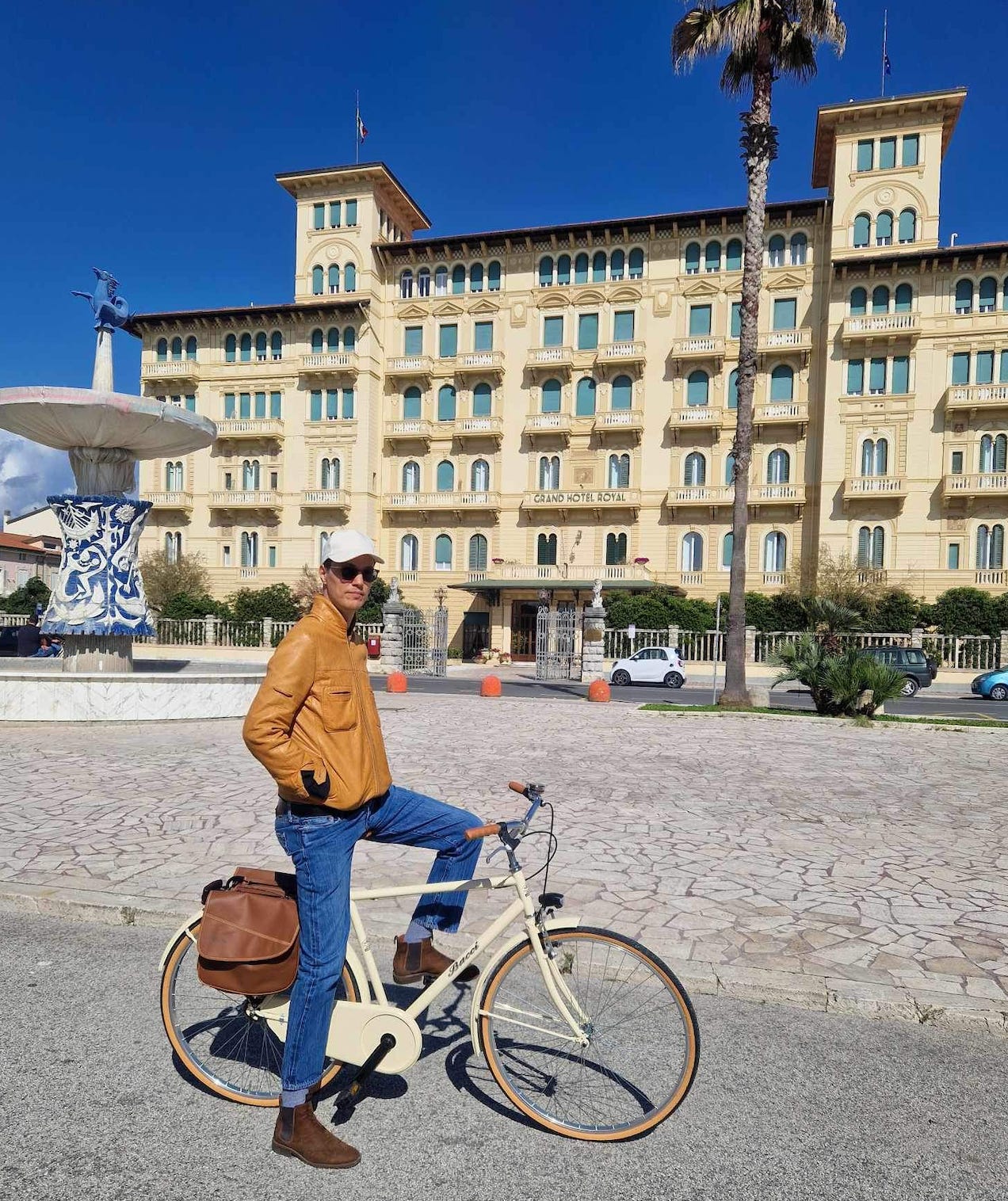
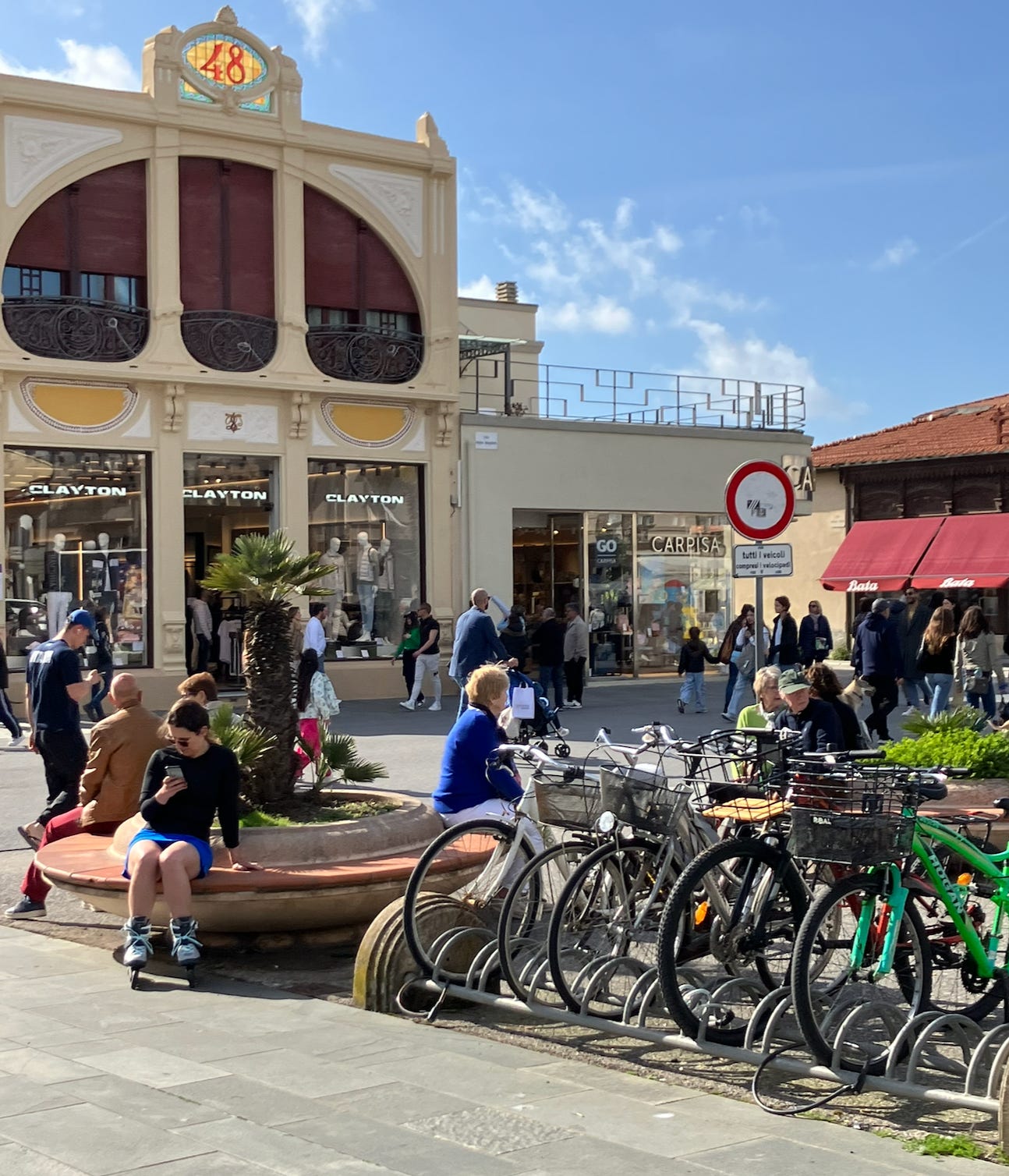
You leave Lido di Camaiore’s long family promenade, with its orderly parasols and its gelato queues, and within a few minutes the city changes around you. The buildings go taller. The palms thicken. The front row of hotels along the Viareggio seafront starts to arrive one after the other, the Principe di Piemonte with its wedding-cake façade, the Grand Hotel Royal a few hundred meters later, and then the row of Liberty shopfronts and cafés that somebody rebuilt after the fire of 1917 burned the old wooden passeggiata to the ground. The man who repainted it was Galileo Chini, who had come back from Siam with a head full of Bangkok temples and used that vocabulary to rebuild the seafront of a Tuscan beach city in onion domes and glazed tile. The Gran Caffè Margherita has two of them, yellow and green, shaped like something out of a Wes Anderson fever dream. The Bagno Balena has an entire rotonda shaped like the front of a ship. The Magazzini Duilio 48 has wrought-iron flowers running up its façade and an interlaced monogram above the door that the builder tied with a ribbon. None of this is modest. None of it was meant to be. Viareggio rebuilt itself after the fire as the place where the cosmopolitan bourgeoisie of the early twentieth century came to swim, and the architecture is the memory of that ambition, still doing its job a hundred years later.
From the bike lane, with the sea on your right and the villas going past on your left, the whole row is like a Gatsby party seen through the window of a passing train. Long white fronts, balustrades, a glimpsed garden, and a doorman on the steps. You keep pedaling. You don’t stop. The stopping is what ruins it. The stopping is when you’re suddenly one of three hundred people on the same square meter of sidewalk trying to photograph the same façade, and the building stops being a building and becomes a backdrop. From the bike, you get the whole row in motion, the way it was designed to be seen, the way the people in the open cars of 1928 would have seen it. Grandiose and slightly unreal, and not asking anything of you except that you pass through it.
Behind the seafront, there is another Viareggio that almost nobody who comes for a day ever looks at. The residential Liberty streets, where Puccini had his drunken fights with Toscanini at the Caffè Margherita, and where the architecture gets denser and more private. Chini’s ceramic putti under the eaves of the Villino Flora. A dozen other villini up and down the back streets behind the promenade, most of them still lived in. I’ve ridden up and down those streets too. I love the huge stretch of Parco Pineta, a pine tree park with kids’ playgrounds and minigolf courses. They’re worth the detour. But they are not, in the end, the Viareggio I come for.
I come for the cat. Ettore.
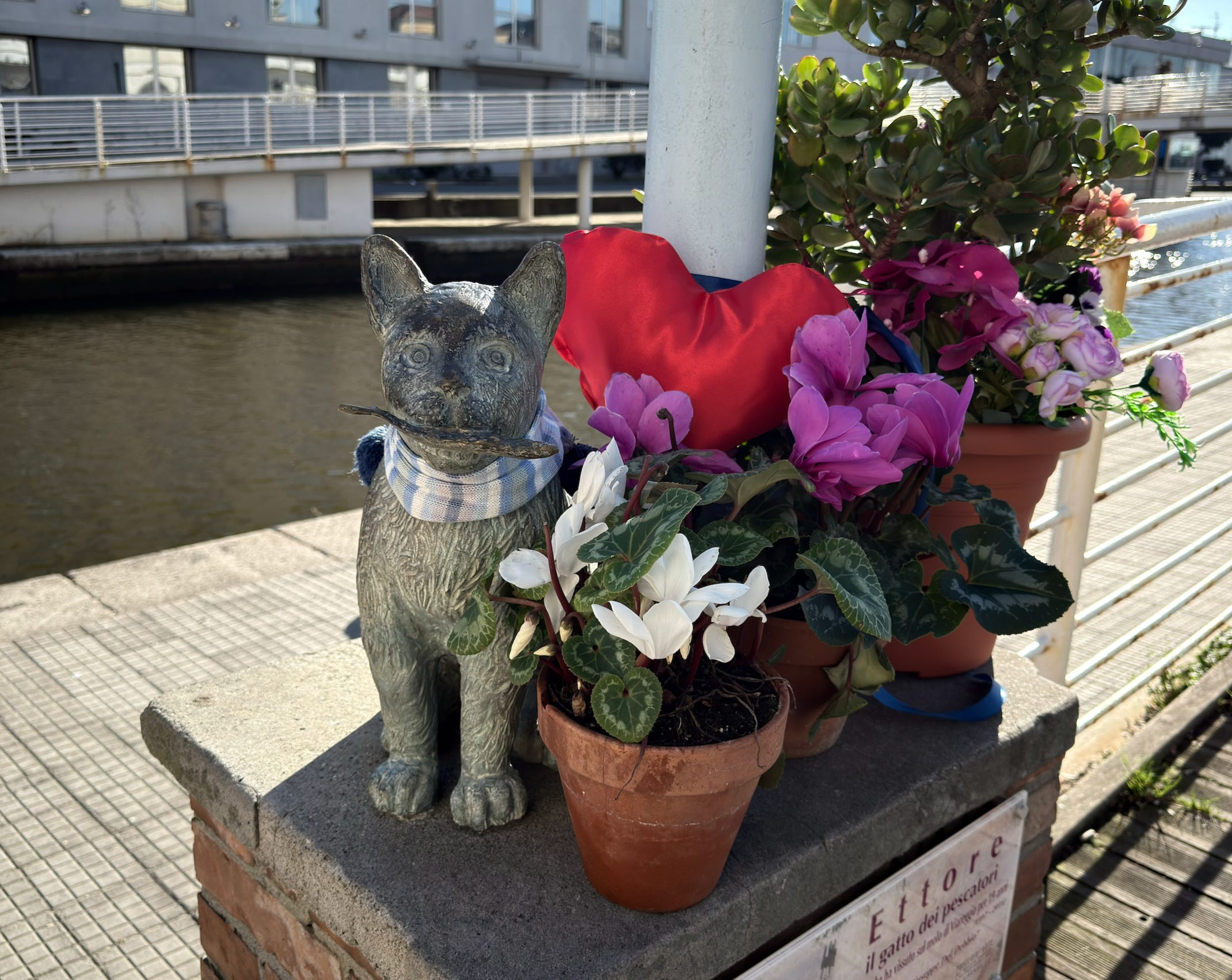
Gatto Ettore sits at the end of the pier on a low bronze pedestal, upright, looking out to sea. He is small. You could miss him if you weren’t looking, which is part of why I love him. Ettore was a real cat. He lived on the pier, was fed by the fishermen, wove between their boots in the morning and slept on folded tarps in the afternoon, and when he died a local sculptor made a statue of him and put it here, at the point where the land stops, and somebody always puts flowers on it, or a small plastic fish, or a cigarette stubbed out at his feet. Every time I’ve ridden past him, there has been something. Viareggio’s Hachiko, if Hachiko had been a cat and had never waited for anyone because he’d decided a long time before that the fishermen were his tribe.
The cat is the threshold. He marks the place where Viareggio stops being a promenade city and starts being a working port. Turn right at the cat, and you’re at the molo, the long stone pier that runs out into the sea. Turn left, and you’re on the Canale Burlamacca, the canal that cuts the city in half, with the Darsena and the shipyards on the far bank. Either direction, everything gets more honest.
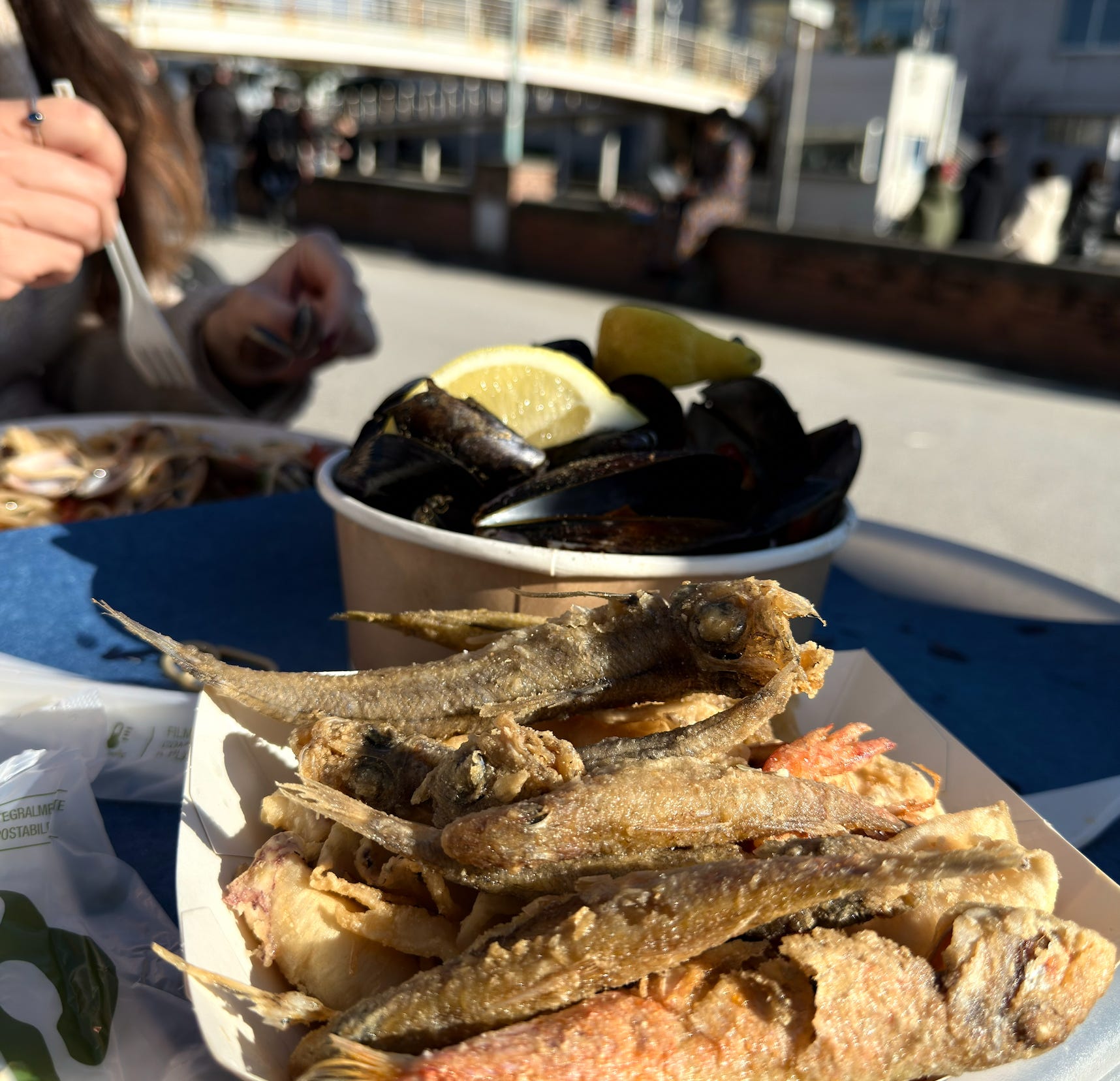
Along the short stretch of road behind the pier, there is a row of restaurants that all sell the same thing, which is the fish that came in that morning. My two are Tito del Molo and Il Delfino. Tito has a trick that is worth understanding before you go. It has two restaurants next door to each other, both under its name and run by the same kitchen, sharing, as far as I can tell, the same suppliers. One has white linen tablecloths, wooden chairs, and waiters in black shirts, and it costs roughly fifty percent more. The other has plastic chairs, plastic tables, no cloth, a counter where you order, a screen above the counter that calls your number when your food is ready, and a tray you carry to your own seat. The fish is the same fish. I cannot tell you loudly enough: get the plastic chair.
I had vongole there in March, and fried anchovies, and a small glass of white wine, and I ate them looking out at the boats tied along the quay. A pensioner was sitting at the next table with his wife, she had the calamari, he had the cacciucco, the Tuscan fish soup, and he ate it with the slow seriousness of a man who has been doing this once a week for forty years. Neither of them was in a hurry, nor was I.
This is the other great Viareggio rule: whatever is crowded on the promenade is not crowded at the harbor, because the two worlds overlap much less than a visitor would guess. The people at the linen tablecloth Tito are having dinner. The people at the plastic chair Tito are having lunch on the way somewhere else.
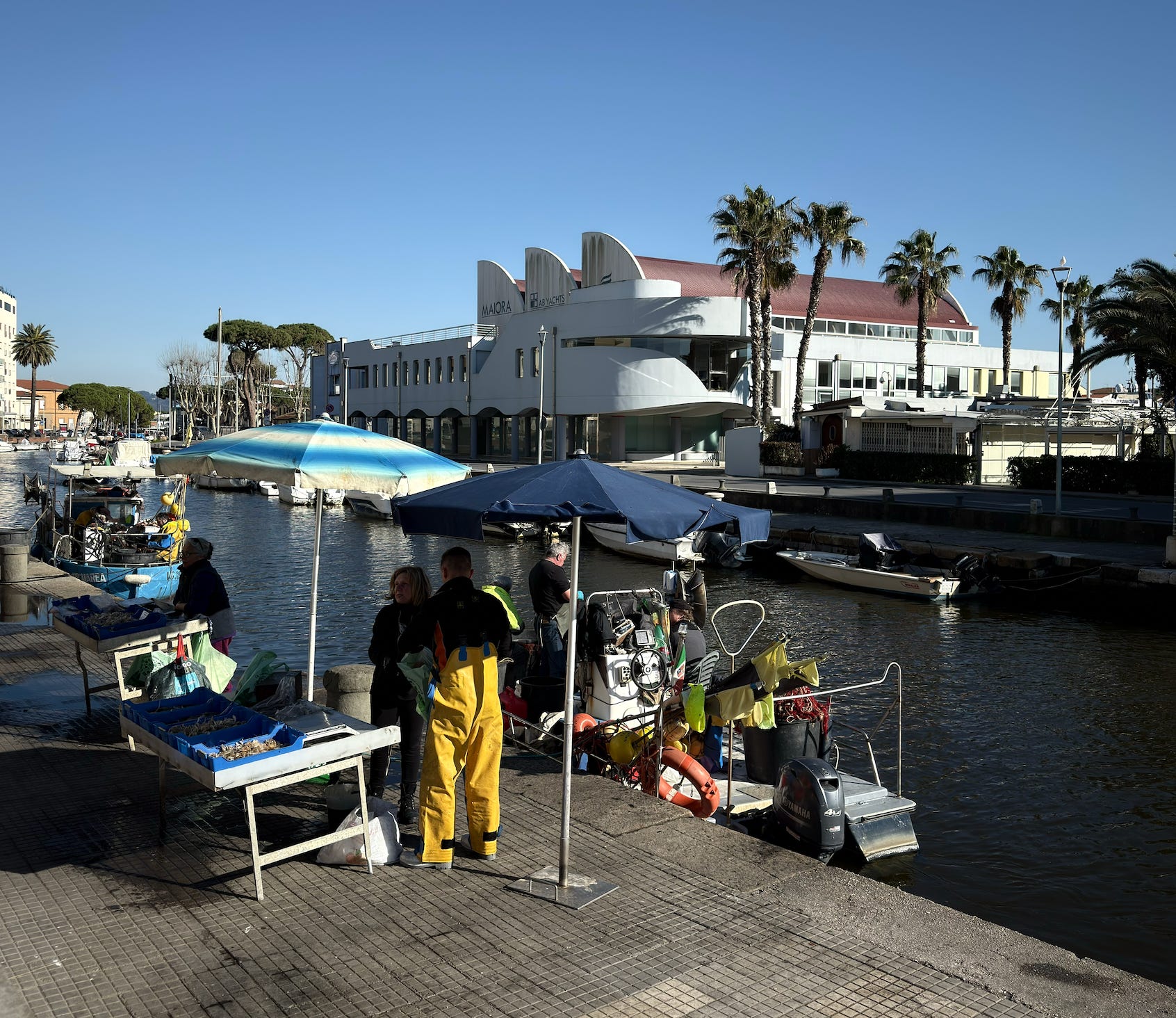
If you come to the pier before noon, you can still catch the fishermen selling their own catch. It’s not a market in any organized sense. It’s a boat tied up, a folding table set out on the quay next to it, a few paper trays of sardines and mussels and squid that are still moving, a hand-written price-per-kilo on a scrap of cardboard. A few euros a kilo for things that would cost four times that in a shop two streets inland. The fishermen do this for an hour, maybe two, and then the whole show is gone because the restaurants have already been down and bought up most of the good stock by eight, and the rest goes to whatever locals are paying attention to.
You can walk the molo afterward. It’s long, maybe half a kilometer, with the harbor on one side and the open sea on the other, and a lighthouse at the far end that turns out to be further away than you think. People walk it in the evening with cones of fried fish from one of the barchine del fritto, the small floating kiosks on the canal that sell a paper box of whatever came up that morning, squid rings, and small whole anchovies and a wedge of lemon, three or four euros. It is one of the genuine pleasures of this coast. You sit on a bollard at the end of the pier with the Apuan Alps lit orange behind you in the west, you unfold the paper, you eat a fried sardine with your fingers, and you understand, in a way that no restaurant ever quite teaches you, what the sea has to do with the kitchen.
But the best place in Viareggio is across the canal.
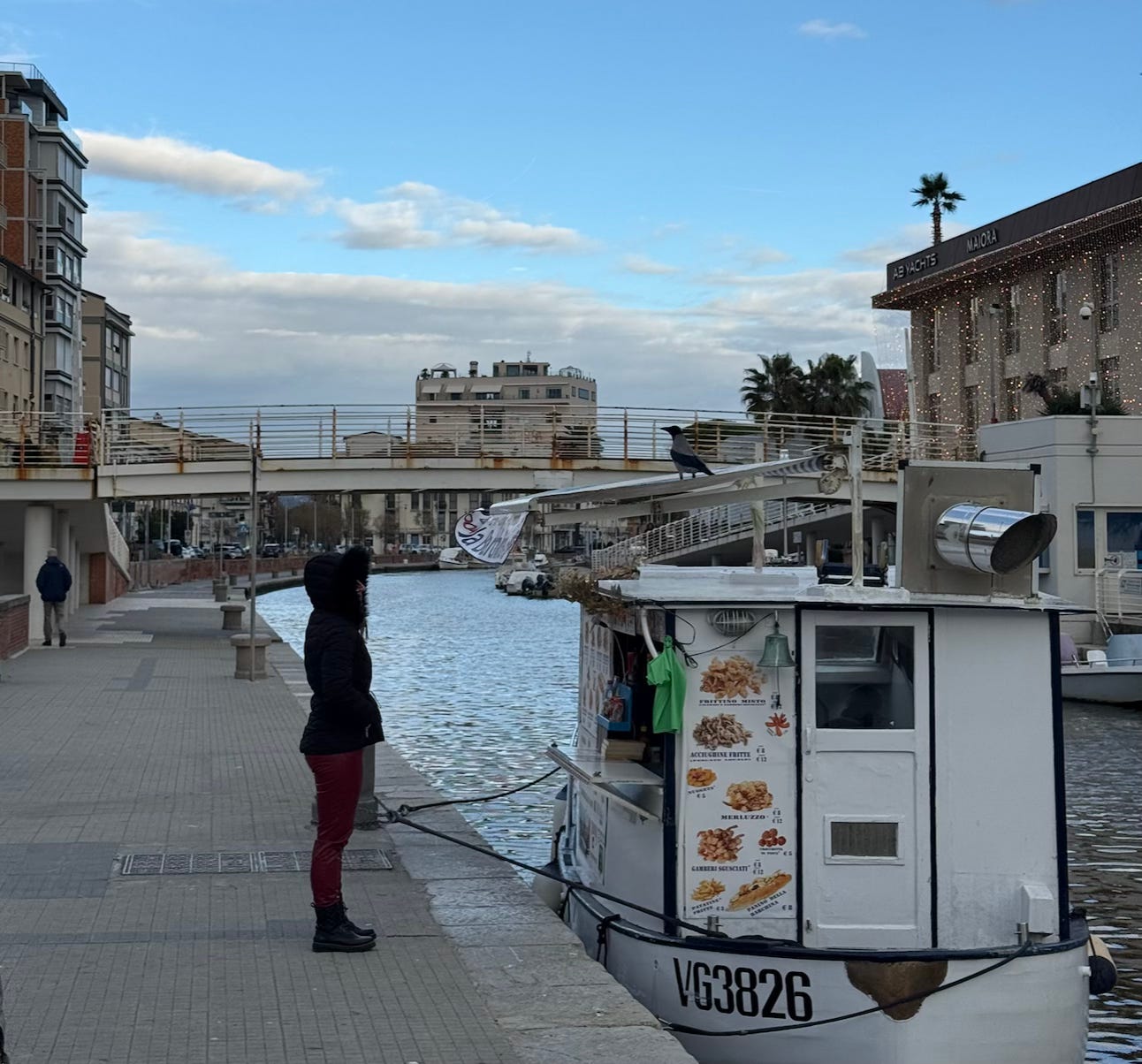
There is a pedestrian bridge at the far end of the molo that crosses the Burlamacca and drops you into the Darsena, the working industrial harbor. This is where the shipyards are. Viareggio builds yachts. It has built them since 1873, when the Benetti yard opened to build wooden fishing boats and, over the next hundred and fifty years, evolved into one of the four or five places on earth where people who can afford eighty-meter superyachts have them built. Azimut-Benetti, Sanlorenzo, Perini Navi, Overmarine, Codecasa. About a third of the world’s thirty-meter-plus yachts are built here, the vast majority of them for foreign buyers who will never set foot in the Darsena itself. If you walk the canal in the right stretch of afternoon, you can see them propped up on stilts inside the hangars with their hulls still raw, lit by the blue flash of welding torches, surrounded by men in overalls climbing ladders and talking on radios.
I like the Darsena more than the villas. It is rawer. It is still working. It is the part of Viareggio that doesn’t care whether you think it is beautiful.
And it is where my favorite restaurant in the city is: Il Capitano.
The drill at Il Capitano is the drill at all the good harbor places, which you only really understand after you’ve done it once. You walk in. There is a glass counter near the entrance with the day’s catch laid out on ice, most of it still twitching or at least still looking fresh enough that you believe it was alive two hours ago. Prawns, the color of a sunset. Mantis shrimp with their weird armored tails. Two or three kinds of bream. A small octopus. You choose by pointing. They weigh what you point at. They tell you the price. They cook it. You sit down. You drink the wine they recommend, which is almost always the house white by the carafe and which is almost always fine.
The best thing at Il Capitano is the cacciucco. It is the thing you should order if you order nothing else, which is not the advice I give lightly because there is a lot at the counter that is worth ordering. Cacciucco is the Viareggian fish soup, and it is built, correctly, out of the fish the market didn’t sell. The cheapest species, the ones with the most bones and the strongest flavor. Scorpion fish. Gurnard. Cuttlefish. Mantis shrimp. Mussels, if they’re good that day. The broth is heavy with tomato and chili and garlic and a bottom-note of something deeper, probably the shells, probably the things you don’t want to look at too closely. It arrives in a wide bowl, with a piece of toasted, stale bread sitting in the middle, because the bread is what originally turned a plate of fish scraps into a meal. You tear the bread apart and let it soak. You eat with a spoon. You do not speak for ten minutes.
Around me, the last time I was there, were four men in the navy-blue overalls of one of the yards across the canal, eating cacciucco at a round table near the door and speaking the dense, swallowed Versilian that almost nobody outside this strip of coast understands. They had come in on their lunch break. They had been welding all morning. They would go back and weld all afternoon. The soup was the fuel. One of them noticed me noticing them and nodded. I nodded back. Neither of us said anything. It was the most Viareggio moment I have had in years of living here.
You can buy a five-hundred-euro cashmere jacket in Viareggio. You can stay at the Principe di Piemonte for a price that makes my eyes water. You can have dinner on the promenade with a view of the Liberty domes at sunset and pay, very happily, a hundred euros a head. These are real things about the city, and I don’t want to pretend they aren’t. They are what most visitors come for, what gets photographed, and what ends up on the front of the travel sections in London and Milan.
But that is not the Viareggio I come for, and it is not the Viareggio that runs Viareggio. The Viareggio that runs Viareggio is on the other side of the cat, in the Darsena, and it is made up of yacht welders and fishermen, the men at the plastic-chair Tito, and the women who set up folding tables on the quay at nine in the morning.
There is a saying, I think, maybe it’s a saying, or maybe it’s something people who live on mountains believe and tell themselves at night, that the sea gives generously where the mountains demand work. That the hillsides make you break your back for a basket of grapes, and the sea just hands you its bounty for the asking. This idea was clearly invented by someone who has never been to Viareggio. The sea does not give you anything. The sea is where you go at four in the morning in a wet sweater to pull up a net that may be empty, and where the man on the next boat has been doing this for thirty years and will be doing it for thirty more, and where the woman at the folding table on the quay by eight has hands you can feel from across the quay. The sea is smelly, heavy, dangerous, and unsentimental. The sea is a job.
And what you get out of that job, on a good day, if everything in the long chain of wet work has gone right, is a bowl of cacciucco in a restaurant across the canal, made by people whose grandparents did the same work, eaten by people who do the same work now, for a price that anyone in a navy-blue overall can afford on a lunch break. The richest coast in Italy runs on that bowl. The yachts are real, and the villas are real, and the Carnevale is real, but the engine underneath all of it is the fish market at nine, the fried sardines in paper, the soup at the plastic table in the Darsena. You can see it, if you want to, but you have to cross the canal to find it, and you have to know how to go past the cat.
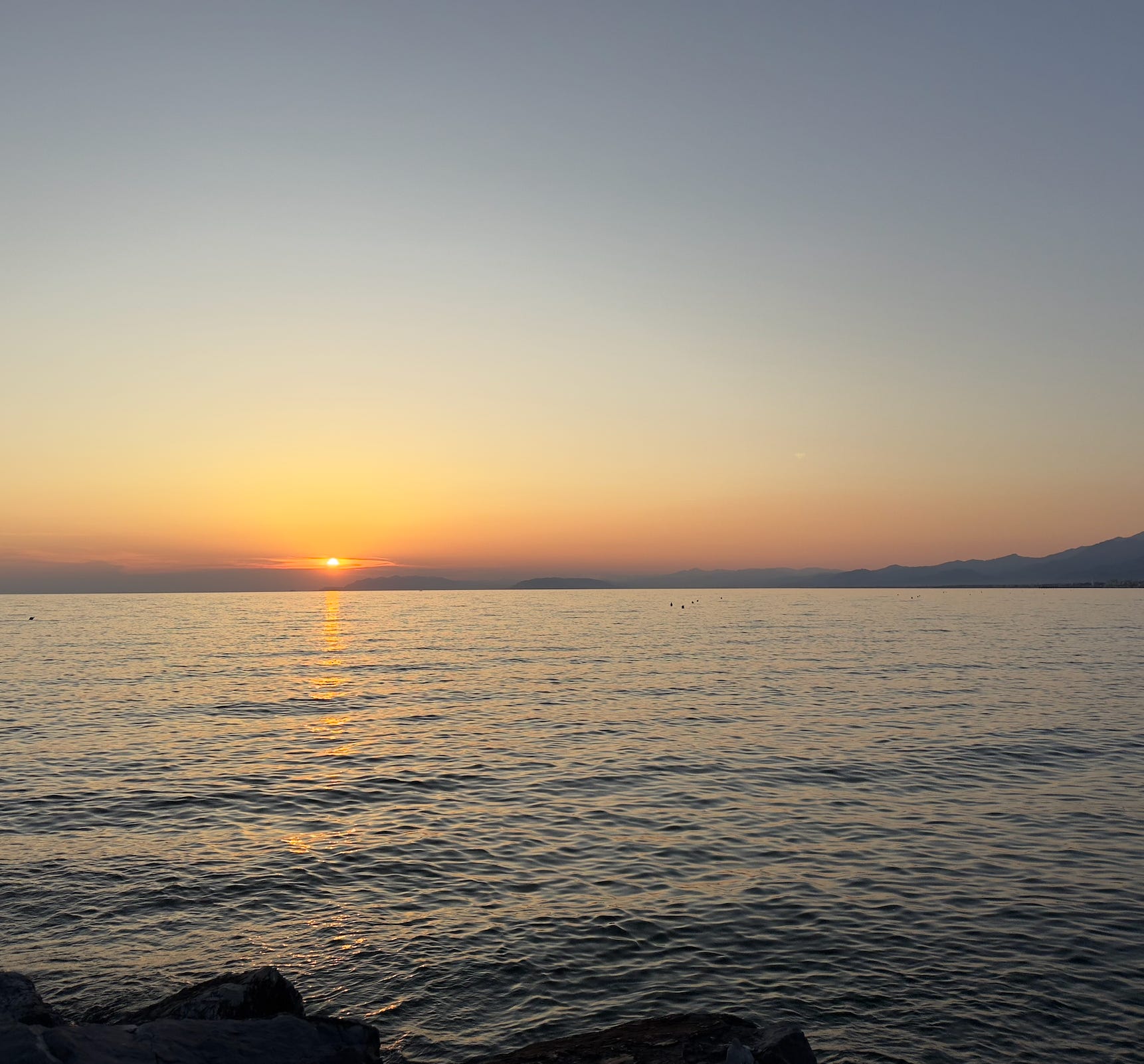
The sun was going down behind the Apuan Alps the last time I biked home. The pier was emptying out. Somebody had left a sprig of rosemary and a fifty-cent coin at Ettore’s feet. I rode past him on the way back up the coast toward Lido di Camaiore, and the crowd on the promenade was the same crowd it had been on the way down, and I didn’t feel the need to stop. The city I’d come for was already behind me, on the other side of a bronze cat, in a bowl of soup, in the hands of a man in overalls picking the last of the bread out of the broth.