Torre del Lago | The town at the end of the road
Where Puccini came to hunt and everyone else came to be left alone

We learned about Torre del Lago from the Paspartú magazine, which I’d picked up in a café in Pietrasanta, the way you pick up a magazine when you’re new somewhere and still trying to figure out where you’ve landed, and the article that summer was about Puccini, because it was the centenary of his death and everyone along this coast was publishing something about him. We had seen his birthplace in Lucca already, a narrow yellow house on a narrow street with a plaque on it, and we had filed him away the way I had filed away most composers in Italy, as a name attached to a city. What I didn’t know, and what the magazine told me, sitting over a coffee that was going cold in front of me, was that he had spent the latter part of his life in a town I had never heard of, twenty minutes south of where we lived, on a lake I had never seen. It was our first year in Versilia. We were still learning what we lived inside of.
I went home and looked at the map. Viareggio, then south along the coast toward Pisa, and there it was, a small dot sitting between a lake and the sea, with a road that went in and didn’t really come out the other side, except back onto the autostrada. We got in the car the next Sunday and drove down.
The drive from Viareggio is short and disorienting. You leave the promenade behind, the palm trees and the Liberty facades and the long row of identical bathing clubs, and within a few minutes, the scenery does something it isn’t supposed to do on this coast. It goes soft. The buildings thin out. The pines get taller and closer to the road. Canals appear on either side of the car, slow and green, then the canals widen and the road curves, and I realize we are driving on a causeway across something that used to be water. Which was because it used to be water.
The whole of Versilia was a swamp once, a long strip of malarial lowland between the Apuan Alps and the sea that the Romans called the Fosse Papiriane and that took almost two thousand years to drain, in phases, starting with the Medici in the 1600s and finishing after a catastrophic flood in 1996. Most of the coast doesn’t remember any of this. I can walk the Viareggio seafront and never once think of the word marsh. But in Torre del Lago, the drainage is still, somehow, provisional. I rolled down the window as we came into the town, and the air smelled different from it had five minutes back on the road. A faint mineral sweetness, half lake water and half rotting reed, that came and went depending on which way the breeze was running. The walls of the older buildings carried a mild green furring at the base, a bloom of mold the owners had given up repainting, because what would have been the point? Small rivers, or really canals, surfaced at the backs of houses and ran off between them as if they had just remembered they were supposed to be underground.
And then, a few minutes later, we came out onto the lake.
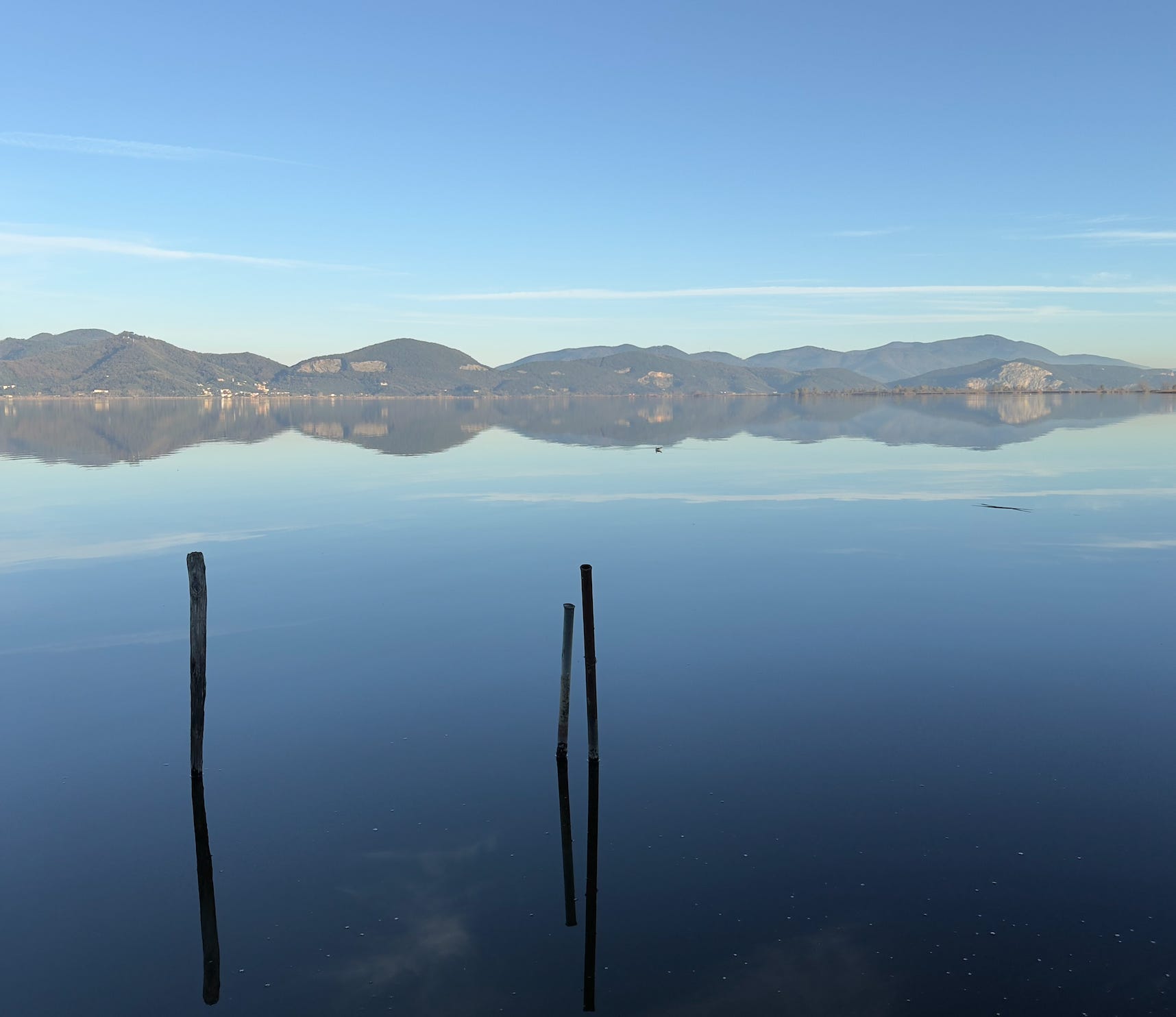
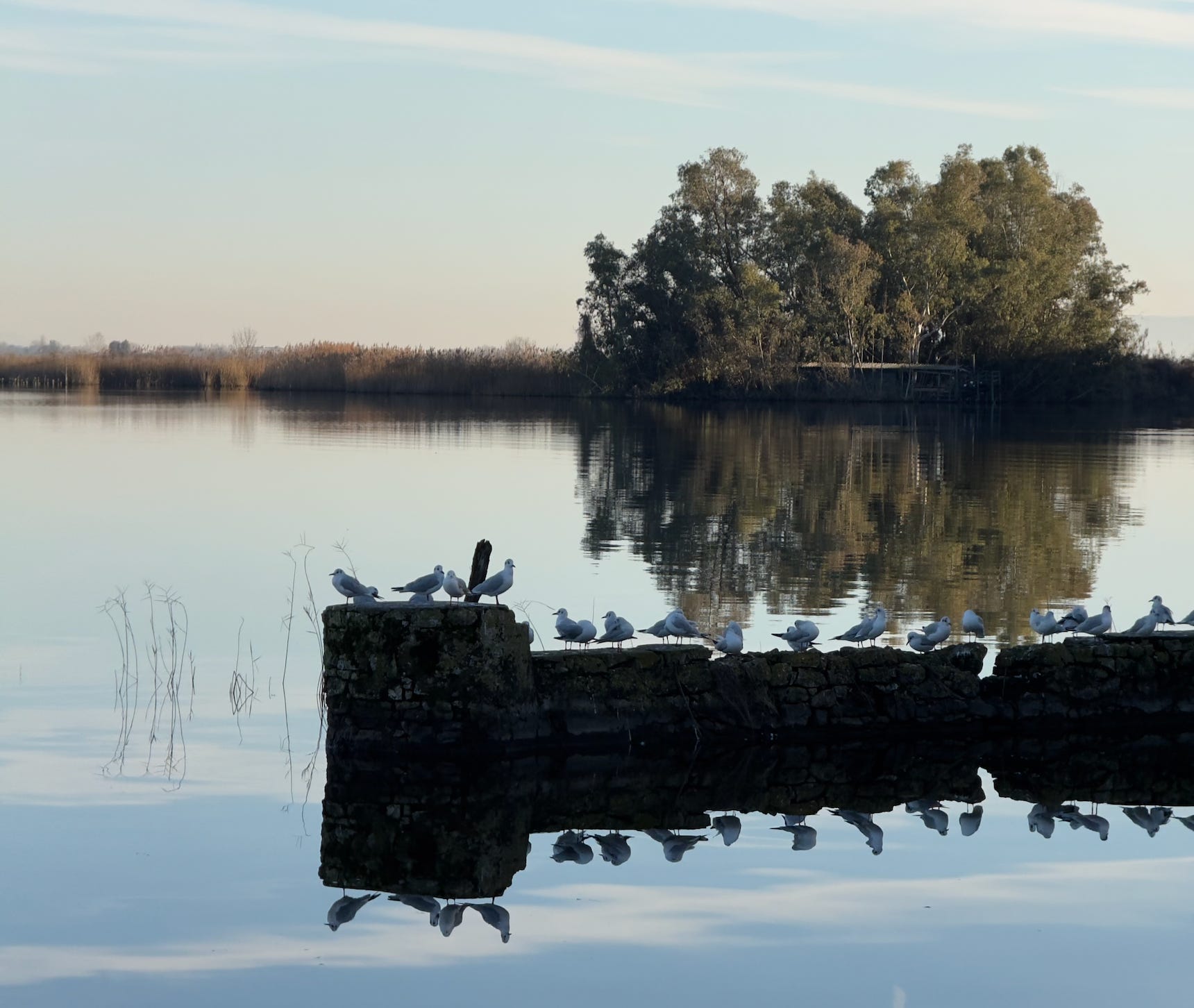
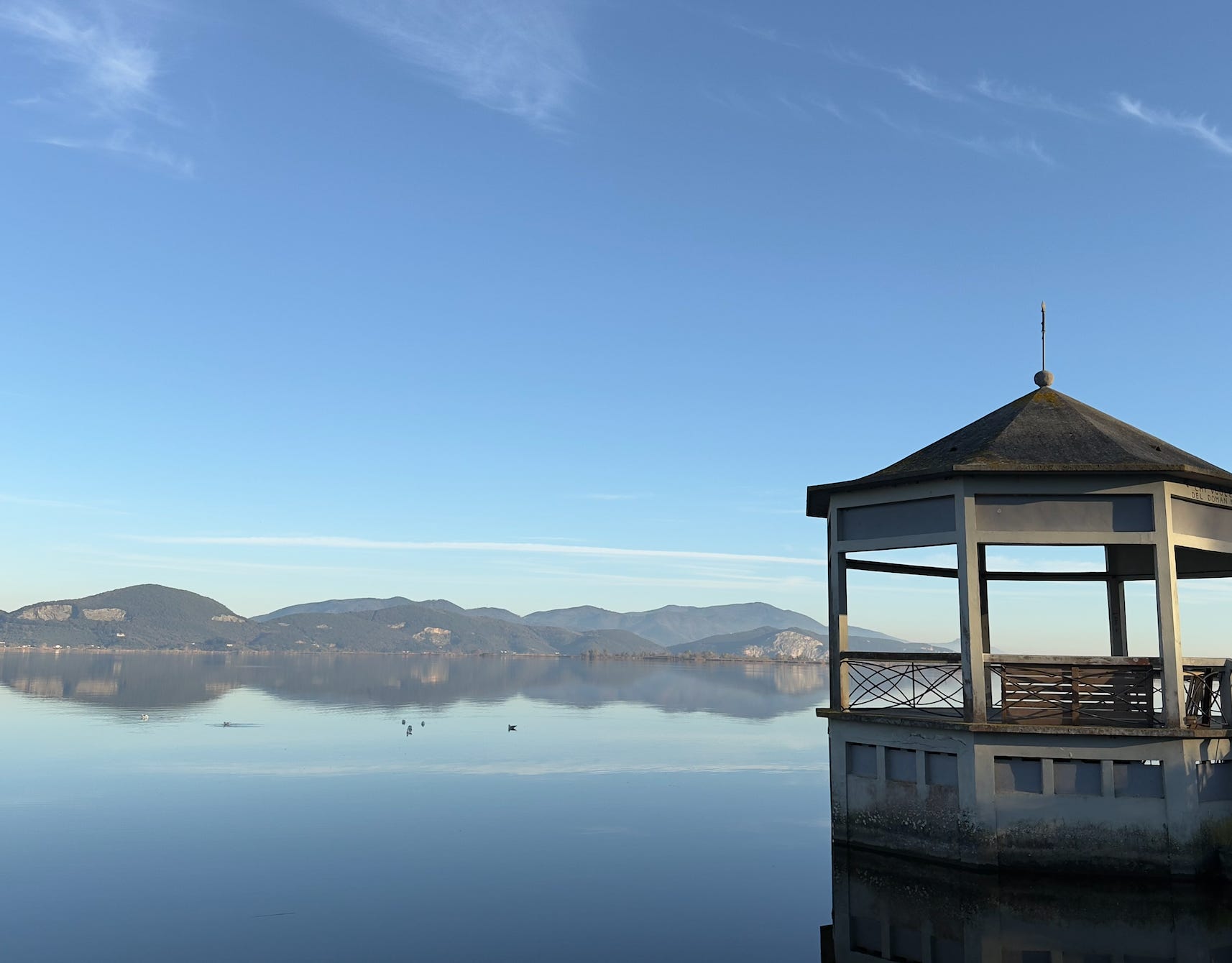
I parked the car at the belvedere in the middle of town and walked the last fifty meters to the water. The air changed again as I reached the railing, colder, more like stone. Lake Massaciuccoli lay in front of us, pale and almost still, and from where I was standing, I could see almost all of it at once, which is unusual for a lake. It covers seven square kilometers, and in most places it is three or four meters deep, a sheet of fresh water held in place by dunes and reed beds, rimmed by the largest stretch of Mediterranean wetland in Tuscany. Reeds leaned out from the near shore. Low wooden boats lay overturned on the grass beside the path. On the far side, a line of hills I could barely make out in the afternoon haze. A heron stood in the shallows fifteen meters from where I was and did not look up. The whole thing could have been a painting except for the bar behind me with its stereo playing, a scooter going past, and two men at a café table who were arguing about whether the espresso one of them had just been served was too cold.
Puccini had lived on this belvedere. His villa was across the inlet from where I was standing, a two-story Liberty-style building the color of diluted apricot, a wooden landing still out in front of it on the water where he used to hunt. He wrote most of Tosca in that house, and most of Madama Butterfly, and all of La Fanciulla del West, and in a letter I read later, he called the place, with the exaggeration of a man who meant it, “Torre del Lago, supreme delight, paradise, royal palace, 120 inhabitants, 12 houses.” When he died in Brussels in 192,4 his son had him brought back and buried in the chapel of the villa. The villa is a museum now. The lake stays the same.
We walked along the waterfront toward it. The whole front takes ten minutes if you don’t stop, and we stopped. I had an espresso at a café halfway along, and a cornetto whose edges had been sitting out slightly too long, and I watched a small wooden boat leave from the pontile with four people on it, headed out toward the reed beds on the far side where the herons live in a density that the biologists who monitor the place find astonishing. The reserve beyond the villa, the Oasi LIPU, runs unbroken for kilometers south toward Pisa, and is either one of the most important stopover points for migratory birds in Italy or just a very quiet place to walk for an hour, depending on who you ask. We didn’t go as far as the reserve that first day. The town held us.
Outside the reserve, on the other side of its boundary, the old Puccini arrangement still holds, and hunting goes on in a small but persistent way, which is why at Da Cecco, where we ate dinner later that same Sunday, the menu read like a meeting between two climates that shouldn’t really have been sharing a table. Seafood from the coast two kilometers away. Game from the marsh and the woods. I ordered pigeon, cooked with something dark and winey over soft polenta, and I can tell you it was one of the best things I have put in my mouth in this part of Italy. Sophia had the stoccafisso. The owner came past the table halfway through the meal and asked nothing about how the food was, because he already knew how the food was, and instead asked where we lived, and whether we had been here before, and when I said no, he said ma torna, allora, come back then, as if that were simply the obvious conclusion to draw. I have been back many times.
Between the belvedere and the dinner at Da Cecco, we did something we hadn’t planned to do. We went into a bar.
It was four in the afternoon, and we were looking for somewhere to sit for half an hour before deciding whether to drive home or stay. The place was called Bar Pagoda, a name that promises nothing and delivers on that promise, a cramped room with an espresso machine and a glass case of pastries going a little hard at the edges, a television in the corner showing a football match nobody was watching, three plastic tables on the pavement outside. We sat at one of the outside tables and ordered coffees and stayed longer than we had meant to, because within ten minutes of sitting down, I understood that we were watching something.
When you live in Italy long enough, you learn to read a bar the way a poker player reads a table. You can tell, almost immediately, whether a place has outsiders or doesn’t, who gets greeted by name, and who has to point at what he wants. In Forte dei Marmi in August, half the people in any bar are from somewhere else, and the Italian being spoken is being spoken in an accent from somewhere else, too. In Pietrasanta, most months of the year, the ratio is mixed. That afternoon at Bar Pagoda, Torre del Lago was not mixed. Everyone who came through the door knew everyone behind the bar, and the Italian in the room was the thick, swallowed Versilian that is sharp around the edges and takes an outsider months to hear properly.
The first wave was what I thought of at the time, and still think of, as the very local locals. Old men in short sleeves. Middle-aged women with shopping bags. A retired man whose conversation with the barista consisted almost entirely of complaints about the size of his cabbages this year, and whose concerns seemed genuinely and entirely to stop at the edge of his garden. I leaned over to Sophia and said they reminded me of the hobbits in the Shire, small kingdoms, careful about their vegetables, profoundly uninterested in the wider world, and I meant it as a compliment then, and I mean it as a compliment now. I have felt more at home in rooms of people like this than I have in almost any other kind of room in my life.
Around five, the second wave began to arrive. Men with long hair going grey at the edges, women in linen that had been washed too many times, one or two faces that looked like they had been at sea for a decade. The forever-artists, I started calling them in my head. The ones who came here in the seventies or the eighties and never quite left, or the children of the ones who did. Torre del Lago has been a bohemian town since Puccini turned his villa into a salotto for painters and musicians, and a hundred and twenty years later, the type was still walking through the door. Lorenzo Viani, the painter, drank in a bar not far from this one. Galileo Chini frescoed the villa across the water. Somebody at the next table was telling somebody else about a gallery opening in Lucca. Somebody at a table over was rolling a cigarette very slowly, the way you roll a cigarette when you have the entire evening ahead of you and no plans in it.
Around six, the third wave. Two men walking close together, then a group of four women, then a tall man in sunglasses who hugged the barista on the way in. By sunset, the bar was a mix of locals, lingering artists, and what a local magazine I picked up later described, with the particular bluntness of Italian journalism, as la comunità queer. I sat with my second Negroni and watched these three currents meet, and I slowly understood that what had at first looked like three unrelated populations was really one population. Not in the sense that everybody was the same. In the sense that everybody was, in their own way, here on purpose. Nobody ends up in Torre del Lago by accident. The road doesn’t pass through. You come in from Viareggio or from the autostrada, and either way, the road ends at the lake. There is no next town. There is the water, the reserve, the sea on the other side, and then the long empty coast running south toward Pisa with nothing on it but pines and dunes. This is the end of the line. The people who end up here over time are the people who want to be here, which turns out to be a very specific kind of person: the kind for whom the small, mildly musty, reed-smelling, mold-at-the-base-of-the-walls, hunting-and-opera, and now-also-rainbow-flag reality of this town is not a compromise but an answer.
The beaches are the same story told in a different register, which I only understood the second time we came down, a few weeks later, when we drove straight through the town and kept going west through the pine forest that separates the lake from the sea. The forest is dense and old, and the road through it passes campsites, and the occasional parked camper, and one stretch of viale where a handful of cyclists are always going somewhere, and then the pines open abruptly, and I was out at the coast.
The shipyards of Viareggio stood two kilometers to the north, a wall of cranes and hulls visible through the trees. To the east, the forest we had just come through. To the south, the reserve runs unbroken all the way down to the Serchio River at the edge of Pisa. Which meant the beaches here were geographically cornered. You cannot wander in. You cannot pass through on the way to something else. We parked in the sand lot at the end of the road, and I got out and walked up onto the sand, and what I was looking at was a strip of coastline that looked the way the whole Tyrrhenian must have looked a hundred years ago, before the bagno economy arrived with its color-coded umbrellas and its permanent wooden structures and its hierarchy of beach clubs by price point. Sand. Dune grass. Shade. A shower. A toilet. A makeshift bar. A few restaurants across the road, catering almost exclusively to the people who come to these beaches, which is to say almost exclusively to people who already know.
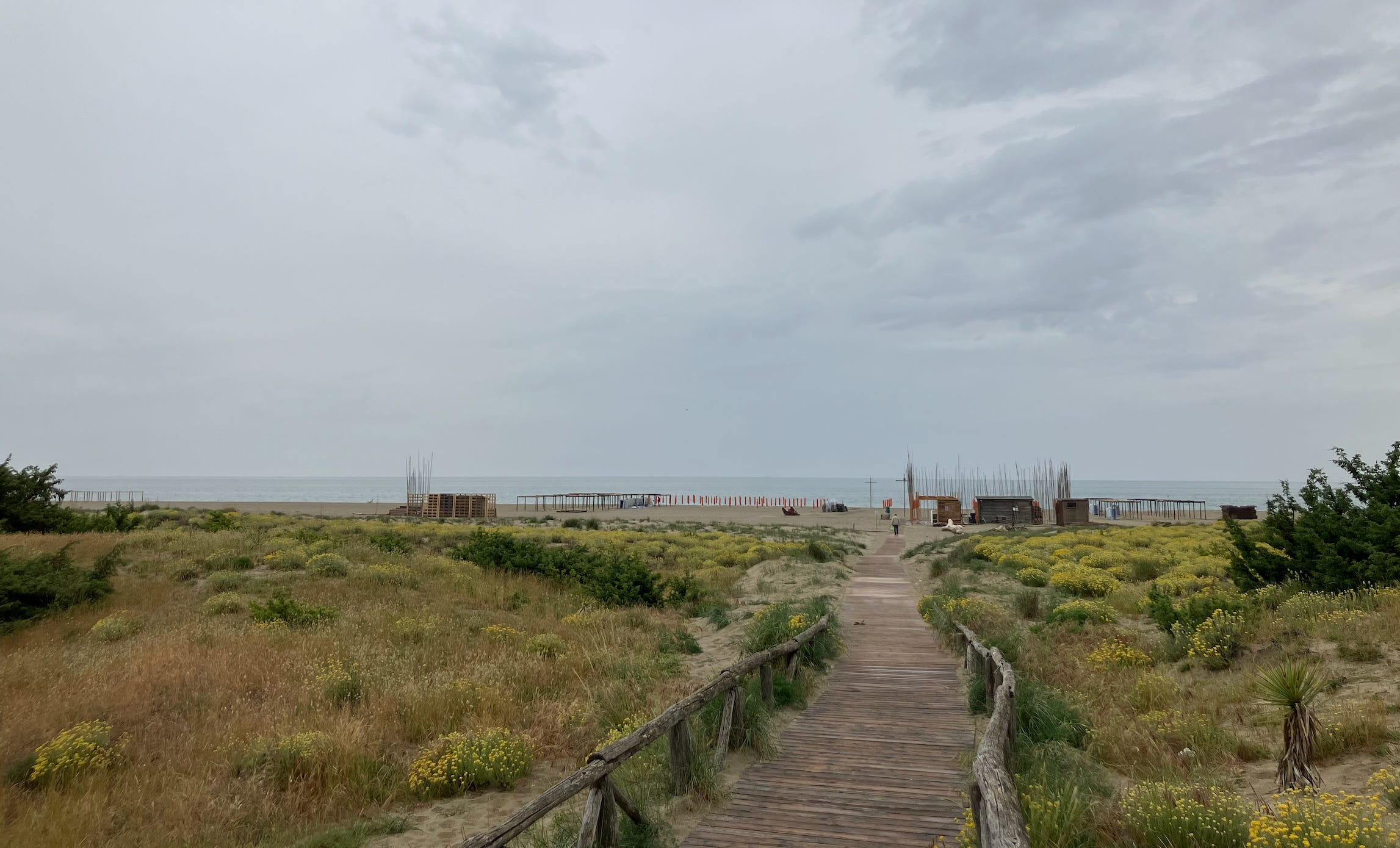
The northern stretch is the nudist beach. Further south is the gay beach. In between and around the edges, straight couples, families who had figured it out, old hippies with dogs, a retired German or two who had been tipped off decades ago by the right friend and had never left.
We had lunch that day at Adagio Sunset, a bar at the gay beach that tries harder than it needs to and is the better for the effort, with a menu of grilled fish and cold white wine and a crowd in its twenties, thirties, and forties that moved between the sand and the tables all afternoon without anybody being in a hurry. A man at the next table was reading a paperback in French. A woman at the table two over was braiding her friend’s hair. A waiter brought us a bottle of Vermentino without being asked to replace the first one, which we had drunk faster than I realized. After lunch, we walked next door to Mamamia, one of the older gay clubs in Italy and the center of gravity of queer summer in Tuscany since 1999, and it was two in the afternoon, and the club was already packed. Not packed the way a club is packed at two in the morning. Packed the way a good café is packed on a Sunday. People laughing too loudly at things that were not that funny, people taking their drinks out onto the sand, a drag performer in a bathrobe and sunglasses having an espresso at the bar, and arguing about something with one of the owners. Whatever else Mamamia is at two in the morning in August, in daylight, it is a living room. A living room that happens to have a dance floor and a set of speakers was tested for a much louder time of day.
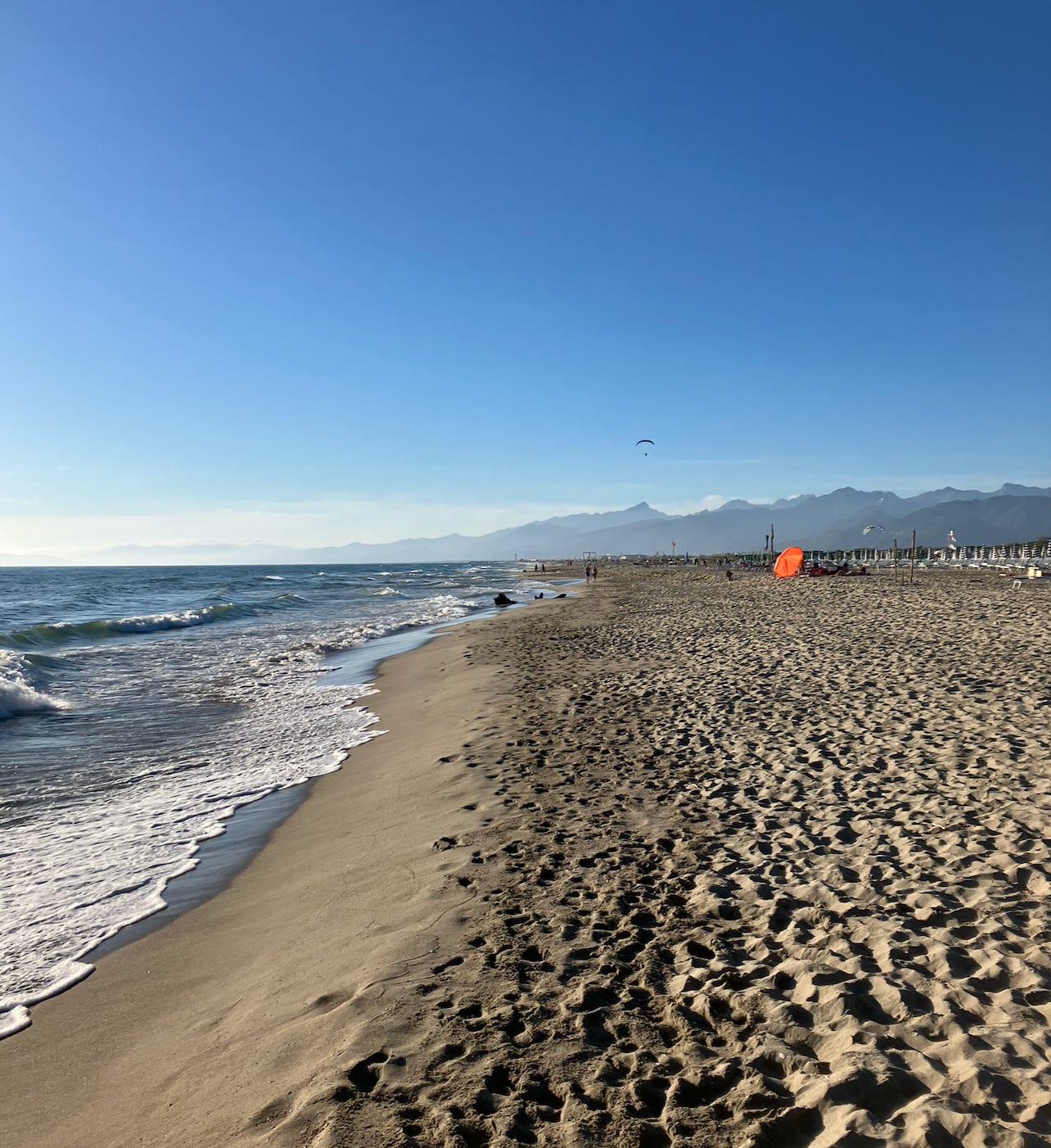
The other beaches of Versilia don’t feel like this. I have spent an hour in August at a bagno in Forte dei Marmi, where a single umbrella costs more than most of the people at Adagio Sunset had spent on their entire day, and I was inside a stage set. The promenade of Viareggio is a promenade. The family beaches of Lido di Camaiore are for families. The lidos of Marina di Pietrasanta are built out to the last millimeter, all matching wooden decking and matching cushions, and a DJ starting up at four. These places have their virtue,s and I go to them too. None of them feels the way this strip of sand feels, which is the way a beach is supposed to feel when nobody is performing. No Germans in socks. No British tourist,s the color of a cooked prawn. Just a few hundred people, mostly Italian, mostly from within two hours, who liked each other and liked the place and had come here on purpose.
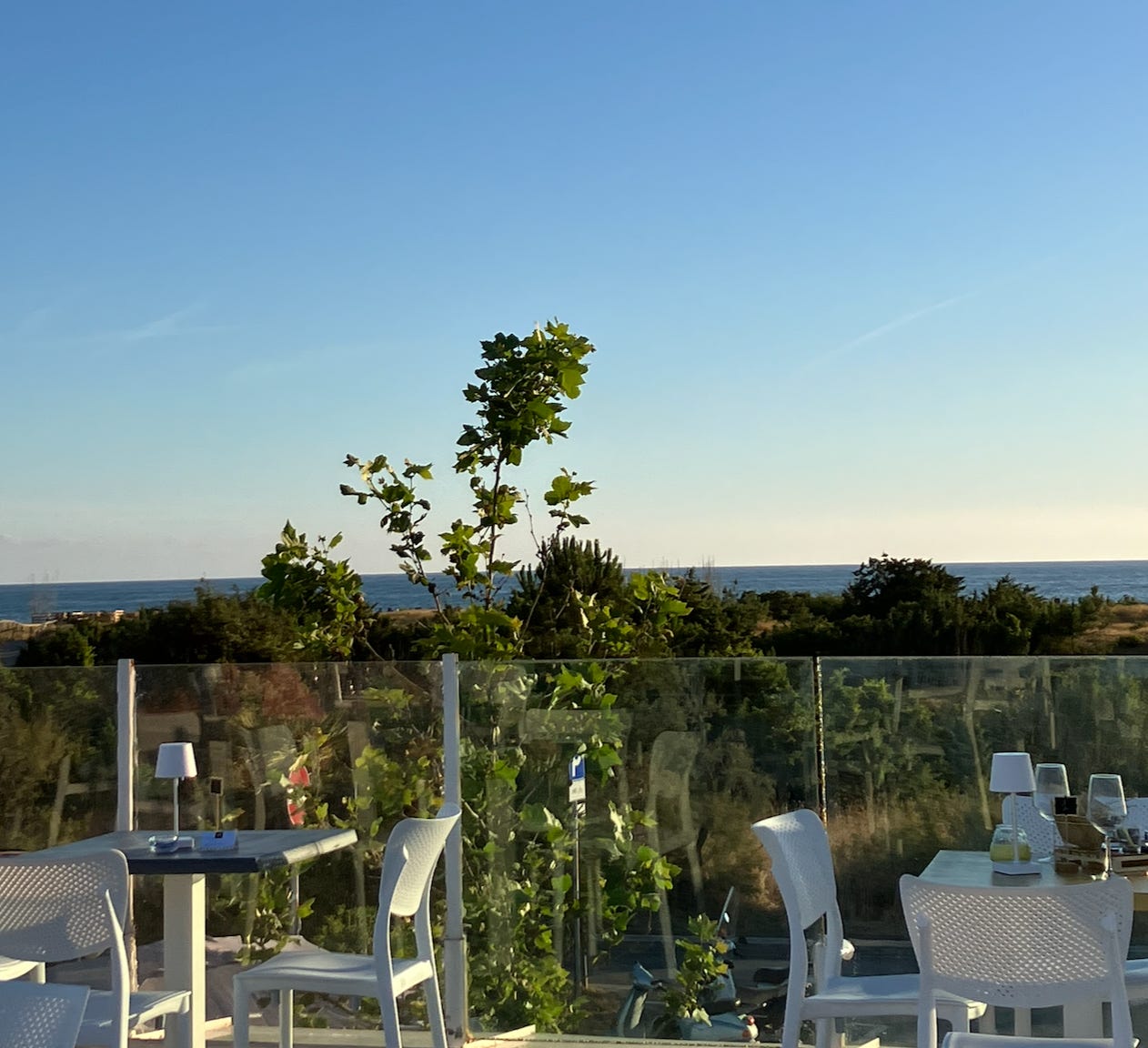
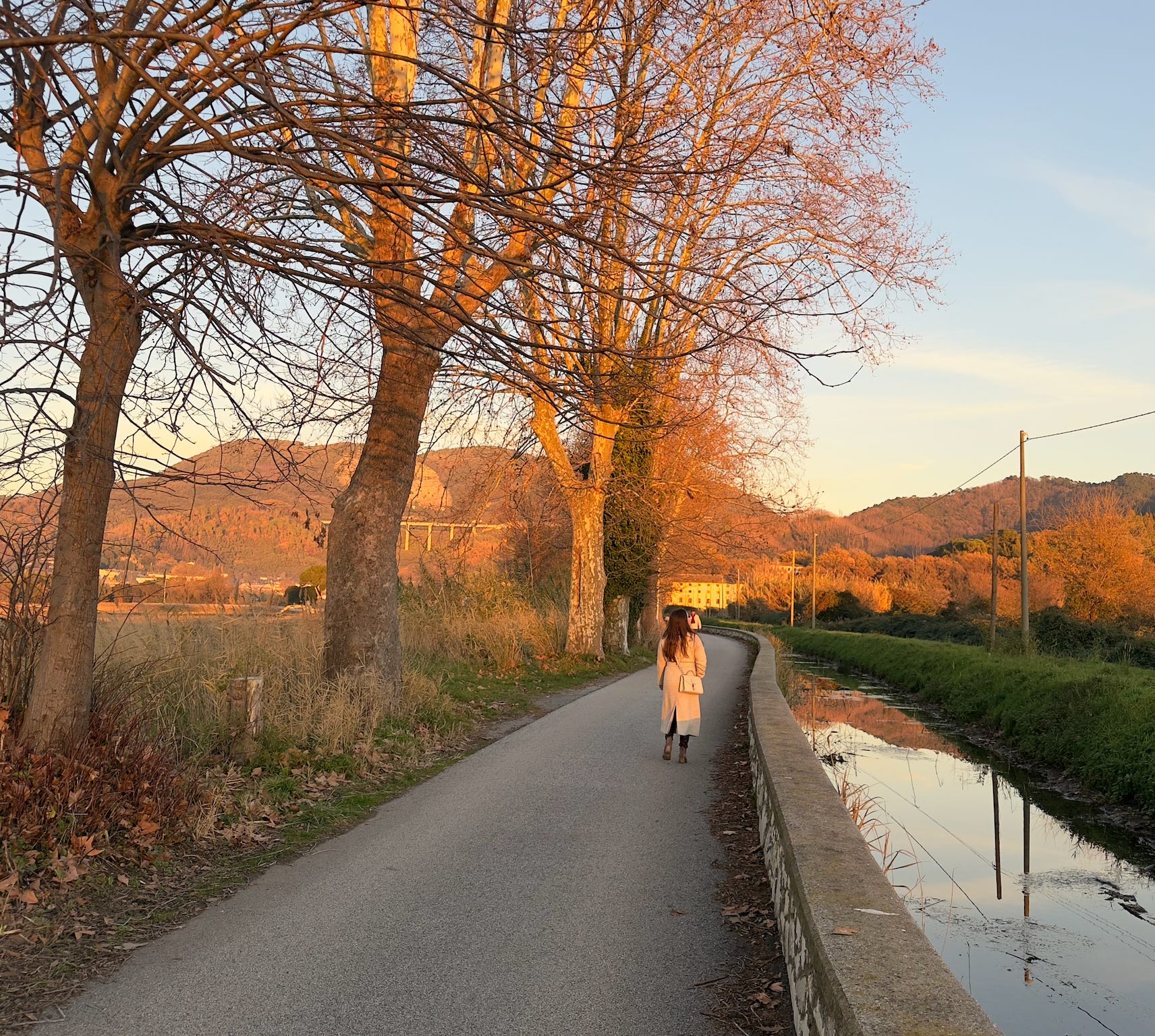
We drive back most often at dusk, and that first Sunday was no exception. The road out of town went east along the lake and then cut back through the pines. The water went pink, then grey, then a flat lunar silver. Somewhere out on it, a fisherman was pulling in a net, or a heron was standing in exactly the position it had been standing in when we arrived eight hours earlier. The villa at the waterfront was closed for the evening. The Gran Teatro, where every summer they stage Puccini’s operas with the lake itself as the backdrop, was dark. In July, the whole town would be full of people in linen jackets holding opera programs; that Sunday night, it was us and the mosquitoes and a bar on the corner where somebody had just put on a record.
Back toward Viareggio, the marinas took over again. The umbrellas, the lights, the long straight streets, everything the coast is supposed to look like. In the rearview, Torre del Lago was already out of sight behind the pines, which is exactly where it likes to be.