Casoli | The Village That Decided to Be Interesting
A mountain commune above Camaiore in the Apuan Alps, and the case for small places doing something

I grew up in a village in Hungary with a handful of streets, and I know what small looks like, and I know the specific silence of a place where nothing has happened for a long time and nothing is planned to, so when I tell you Casoli has maybe five streets, that you can walk all of them in under an hour, and that most of the houses belong to people who are not in them, I am not romanticizing, I am describing a kind of place I recognize from the inside. What I did not recognize, when we finally drove up one Tuesday in the spring of our second year on this coast, was everything else.
We had lived in Versilia for a year before we heard the name. A line in Paspartù, the free cultural monthly I picked up in a café in Pietrasanta one morning over a coffee I was letting go cold, mentioned a graffiti festival up in the mountains. I missed the festival that year. I kept the name, wrote it on the back of the magazine, and forgot about it until the following spring, when Sophia asked me on a Monday night what we might do the next day, and the magazine was still on the kitchen shelf with the word Casoli in my handwriting on the back.
The road up from Camaiore narrows and keeps narrowing. It is paved, which in this part of the Apuan Alps is not a given, and it climbs through chestnut woods in a series of tight hairpins that I took slowly because Sophia gets carsick on roads like this and because I wanted to see the trees. We went up for twenty minutes and saw no other cars. Then the chestnuts broke, and Casoli appeared on the ridge above us, a cluster of pale stone houses against the green of the mountain, and I pulled over into the small clearing at the edge of the village because there was nowhere else to stop. Cars do not go into Casoli. Casoli goes up into the mountain. Four hundred meters of elevation. Monte Matanna was above me as I got out of the car. The Tyrrhenian was a gray line somewhere behind my shoulder, and, because it was clear that day, visible. A wooden sign at the edge of the village read Casoli, paese degli sgraffiti.
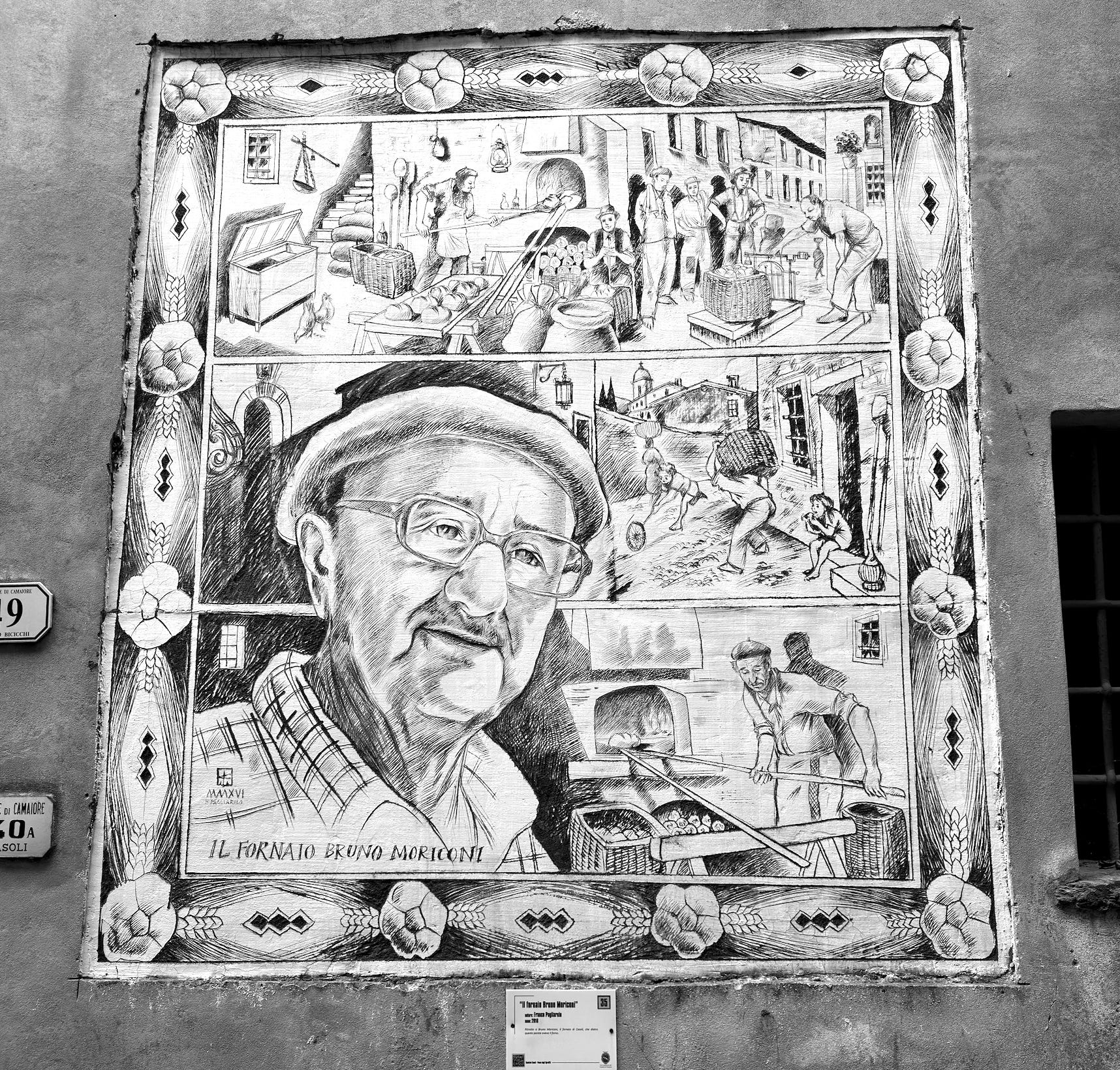
The first one is on the wall nearest the entrance, on the left side of the alley as you come in, and I almost walked past it because I was still looking at the view behind me. Sophia stopped first. A man leaning into his work, the posture so specific it had to be someone the artist actually knew. The image was not painted on the wall. It had been scratched into it, a darker color showing through cuts in the pale surface layer, red and ochre and a warm brown rising from beneath as though the wall itself were remembering the man rather than depicting him. I learned later from a small printed guide inside the one open shop that the man was the village baker, Bruno, and that the sgraffito had been placed on the wall exactly where his oven used to be.
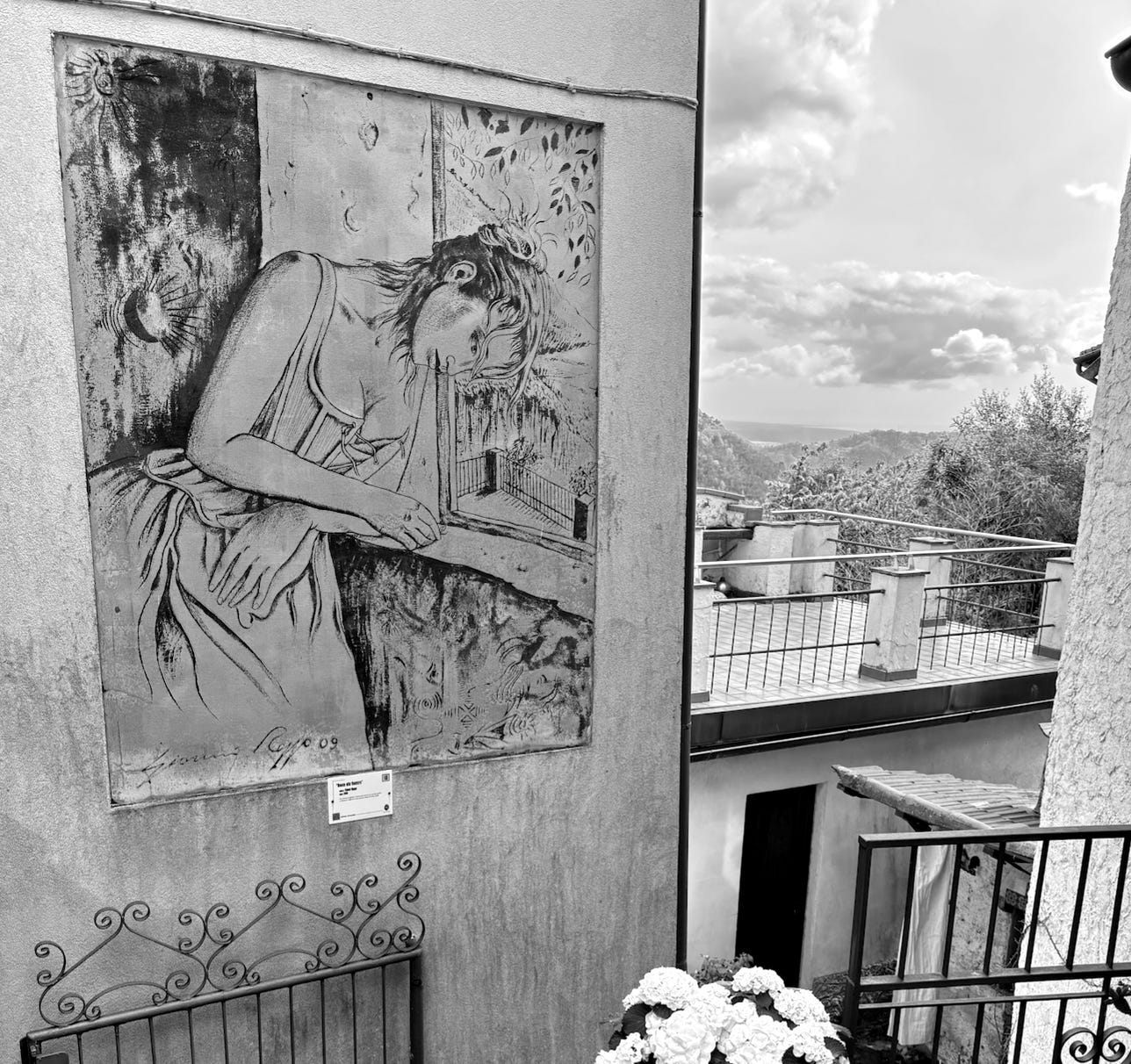
This turns out to be the rule in Casoli. We walked slowly through the village over the next two hours, and I watched the rule repeat itself. The postman Vincenzino appeared on a wall along the street he had walked for thirty years. The ropemaker Oreste was on the wall of the building where he had braided rope. The carpenter Fortunato was on the wall of the house he had lived in. The village is a ledger of its own people, scratched into plaster, each entry pinned to the spot it describes.
The technique itself is old, old enough that Giorgio Vasari described it in the 1500s as something the Florentines were using to decorate the façades of their noble houses. Two layers of lime plaster, a darker one laid down first, a lighter one on top, both applied wet. While the top layer is still fresh, the artist scratches through it with metal tools, and the color of the under-layer comes up through the cuts. No paint in the modern sense. No spray cans. The same process used in the fifteenth century to honor the Medici is being used here, seven hundred years later, by a few people on a mountain to honor a postman.
I read about the Vasari connection later. On the afternoon itself, I knew none of this. I knew only that the walls of this village were doing something I had never seen walls do.
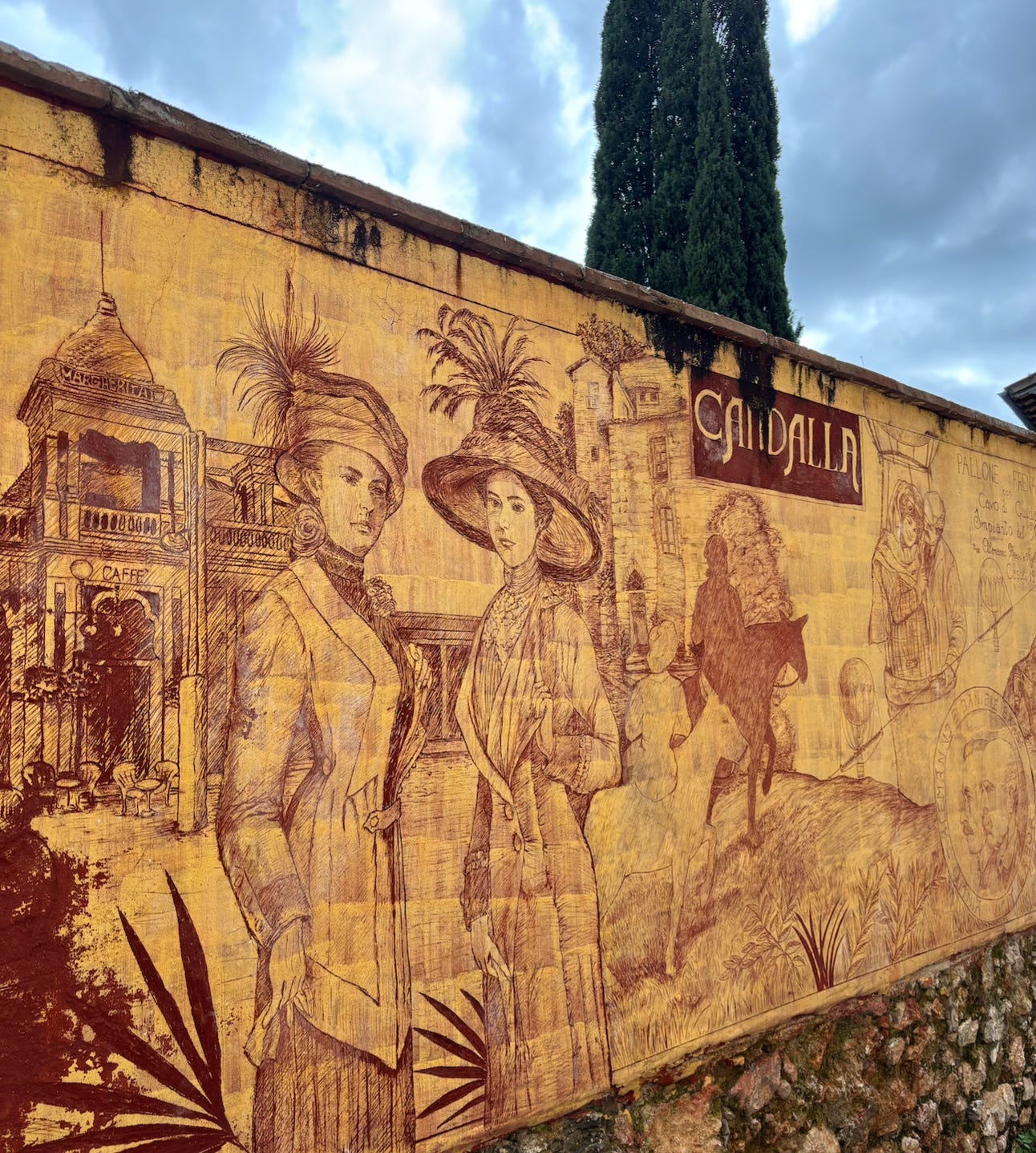
The whole thing started with a Sicilian. Rosario Murabito, a painter and sculptor from Siracusa, came up to Versilia in 1954 with his wife, Grace, an actress, and somewhere between working in the marble studios of Pietrasanta and looking for a quieter place to live, he ended up in Casoli. He stayed until 1972. His first sgraffito is on the main square, a thank-you to the village for letting him in. His house is now a casa museo, managed by the Comune of Camaiore, and the sign on the door when we walked past said it was open by appointment, which I read as open when someone felt like opening it. I didn’t knock. Murabito was the beginning, and after him, others came. Fausto Maria Liberatore. Tony Munzlinger. Adolfo Saporetti, who gave the village a fountain that we sat by for ten minutes while Sophia changed a lens. A hundred works now, roughly, spread across the walls of what is really a hamlet. Since 2006, the last week of May has been Sgraffiti a Casoli, the festival I missed the first year and then again this year because I had come up in April.
None of the individual works is a masterpiece. I want to say this plainly, because if you came to Casoli expecting each wall to stop your breath, you would leave disappointed, in the same way people are sometimes disappointed by the Mona Lisa. Taken singly, the sgraffiti are competent and affectionate portraits of ordinary people. Taken together, walking between them on a Tuesday afternoon in a village of five streets with Sophia’s shutter going every forty seconds beside me, they are something else. They are an argument a village has been making to itself, in plaster, for seventy years, and the argument is that these people were worth remembering, and that the remembering was going to happen on the sides of the houses where they had lived their lives.
I thought, walking, about the hundreds of similar villages I have driven past in my life, in Hungary and Italy and elsewhere, and how few of them have done anything like this, and how low the bar actually turns out to be. A Sicilian sculptor shows up in 1954, falls in love with a mountain, and makes a gift. The village picks it up, and the village does not stop picking it up. That is the whole story. It requires no money, no grant, and no master plan. It requires someone who starts, and enough other people who do not stop.
We walked down the alley past the small chapel. Sophia stopped often. She was looking for the angle where a sgraffito sat half-hidden behind a narrow stone corner, the kind of frame where the art and the architecture refuse to separate, and she found one near the old washhouse: a Narcissus leaning over water, looking at himself. The washhouse is the low stone building where the women of the village used to do the laundry, bent over the basins for hours at a time, looking down into the water. The artist had put Narcissus there as a joke, or a prayer, or both. I stood beside Sophia while she worked, and I thought it was probably both.
In the church piazza, a border collie was sitting in a first-floor window, chin resting on the sill, watching the few people pass. He did not bark. Border collies do not usually do this. He watched us with the calm of someone who has seen worse things on a Tuesday than a Hungarian and a photographer. I nodded at him. He did not nod back.
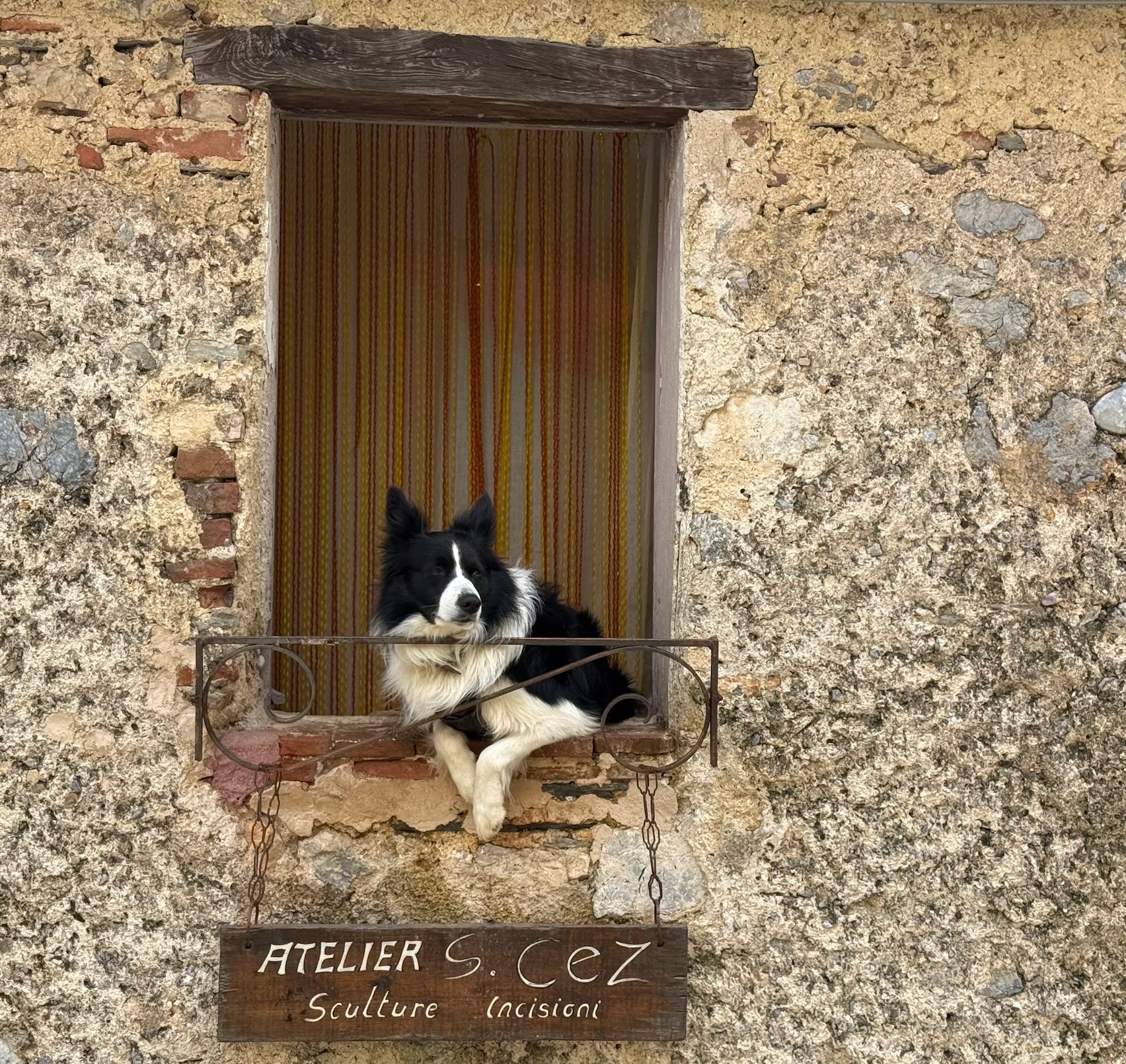
There were almost no other people in the village. A German couple with a guidebook moved past us at one point, heading toward the Casa Museo. Two Italian women with shopping bags came up the alley in the opposite direction, talking fast, walking faster, on their way to somewhere they actually had to be. An old man sat on a bench outside the grocery store, which is also the café, which is also the meeting place, and which opens whenever the owner feels like opening it. Buongiorno, I said to him as we passed. Buongiorno, he said. That was the whole conversation, and I understood, from the way he said it, that this was the whole conversation I was supposed to have, and that another sentence would have been wrong.
I think about Florence sometimes, and I thought about it that afternoon, sitting on the stone ledge by the fountain Saporetti built and watching Sophia work her way around the piazza. I think about the hours we have spent in the Duomo trying to see something we could not really see because of the bodies between us and it, and the specific exhausted quality of being a tourist in a famous place, the feeling that the city is performing a version of itself for you while you perform a version of yourself back at it. Casoli does not perform. Casoli has five streets, a hundred sgraffiti, and a border collie in a window, and nobody asked me to come. The baker was on a wall where he used to pull bread from the oven. The ropemaker was on a wall where he used to braid rope. The postman was on the wall of the street he used to walk, and the man who painted him was on the main square, and the village had been doing this, patiently, without anyone important watching, for seventy years.
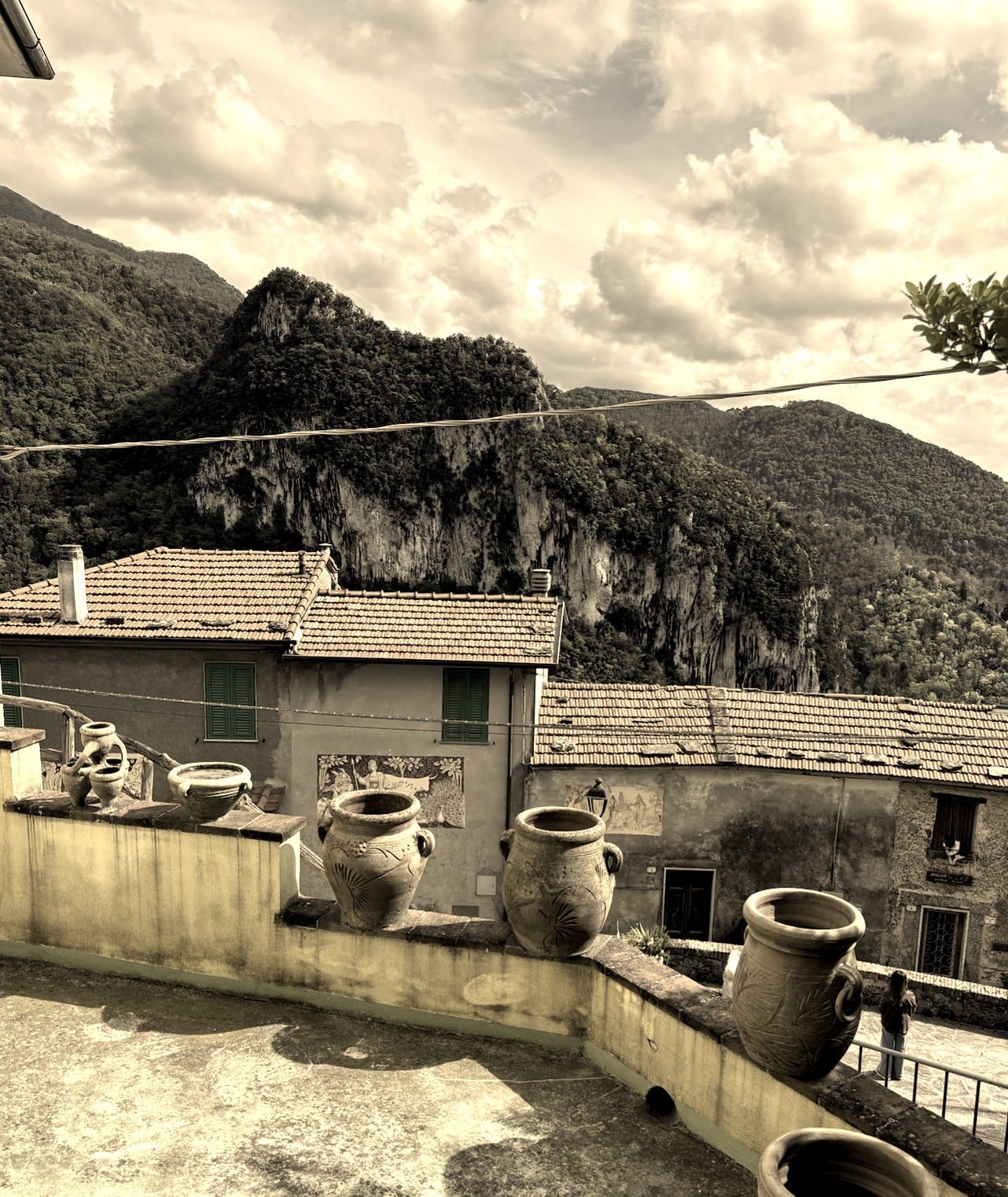
When the light started to go, around half past six, the lime on the walls turned warm, and the cuts in the plaster caught shadow, and for about ten minutes the whole village looked like a drawing of itself. I stopped walking and let it happen. Sophia stopped working. The old man on the bench had gone inside at some point without my noticing. The two Italian women were gone. The German couple was gone. The border collie was still in the window.