
Arezzo | The City That Ignores You
Arezzo, in July, and the working town that forgot to perform

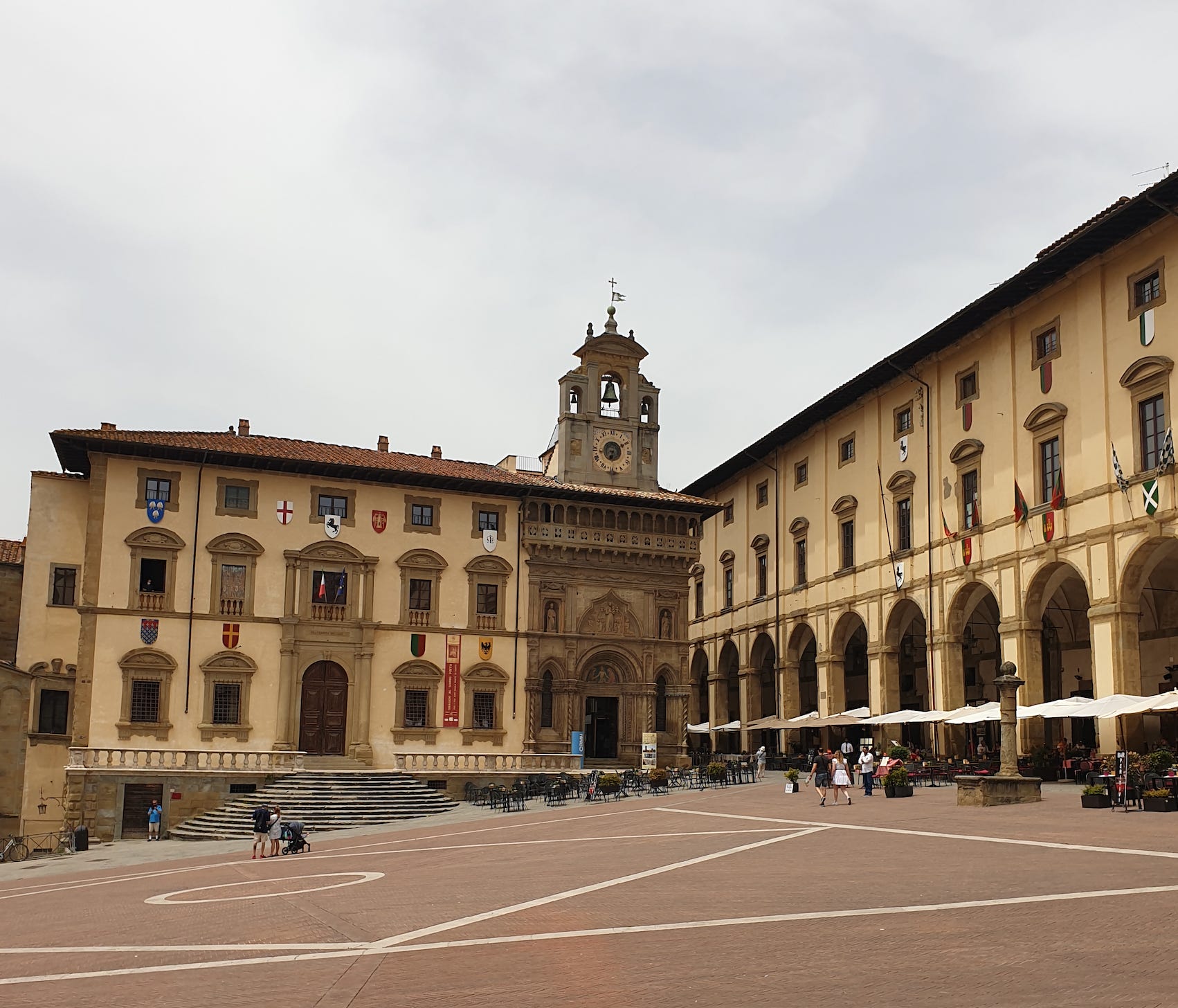
We were sitting in the middle of Piazza Grande in the middle of July, in heat that had stopped being weather and become a physical fact, and banners were hanging from the upper windows for some festival, heralds’ colors, long drops of cloth down the old facades. We had come that morning from Florence, where the crowd is no longer a crowd but a current you are carried in, the kind of density where you stop seeing a city and start seeing the backs of other people’s heads. And here was this enormous sloping square, the Vasari loggia running along one side, the brick going gold in the sun, and on it, almost nothing. A few tables, none of them full. Two small clusters of tourists with cameras, circling, photographing. And the square was so vast that the two groups looked like children chasing a ball across a soccer field, tiny, lost in the middle of all that space. The city swallowed them whole. It swallowed us too, and it did not care that we were there. That indifference is why Arezzo is my favorite city in mainland Tuscany. If I did not live where I live now, I would live here, and I think that says more than any list of monuments could.
Here is what it means for a Tuscan town to not care whether you visit, because it is rarer than it should be. Most of the hill towns near Florence have become, functionally, theme parks. The old agriculture is dying. The handcraft that made these places, the leather, the metal, the jewelry, is dying with it, and into the vacuum has come the tourist economy, which asks only that a town be photogenic and sell things. And the things it sells are mostly a lie. If you buy Italian leather off a stall in Florence, the odds are very good that it is neither fully Italian nor entirely leather, because the label is gameable: finish a bag abroad, in a sweatshop in Asia, attach the last buckle or stamp the last logo in Italy, and you may legally call the whole thing made in Italy. Most buyers cannot tell a real artisan object from a fast-fashion one, so there is no reward for the artisan and every incentive for the fake. The little towns near Florence have followed this incentive, abandoning what they used to make to sell what tourists will buy. Real craftsmen still exist in Italy. They cost a fortune because they are the last ones doing the actual work. And the town that did not make this trade, that kept making the real thing, is Arezzo.
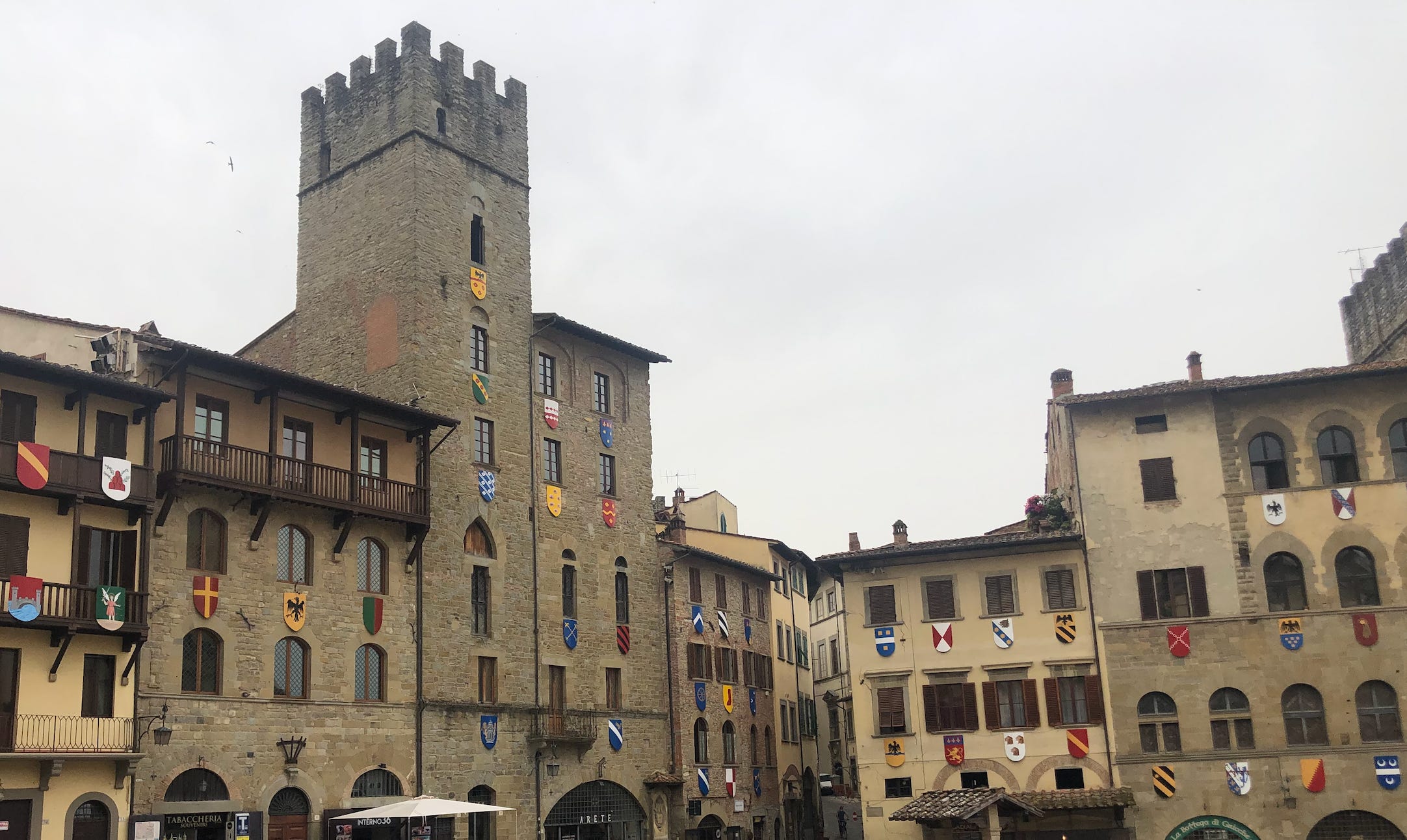
Arezzo makes gold. It has made precious metal for the better part of three thousand years, since the Etruscans cast the bronze Chimera here, through the Romans, who shipped Aretine pottery across the empire, through the Renaissance workshops, down to now, when it is one of the largest gold-working districts on the planet, the place where a great share of Italy’s jewelry is physically manufactured. The shops you pass are not selling ten-euro souvenirs. They are the storefronts of a real industry that still does the thing it claims to do. And this is the quiet pattern of the whole region if you drive it the way I have: down on the coast, Populonia smelted iron for the Etruscans, and Piombino still makes steel, and up here at the top of the interior, they have been working gold since before Rome.
For the price of a glass of Chianti, unlock the full Anywhere Italy experience. All of our articles, private stories, and access to our chat travel community.
Start your free 7-day trial.
It helps that there is almost nothing here to photograph, which I mean as the highest compliment. Arezzo has no river, no famous bridge, no leaning tower, no dome you can climb. The center is steep, and the walking is harder work than in Florence’s flat lanes. There is the great square, a few churches, and that is the visible inventory. Even Piazza Grande, the best thing in the city, defeats the camera, because it is too large and too sloped to fit in a frame the way the Pisa tower or the Florence dome obligingly does, the kind of image a person can hold up at home so everyone nods and says yes, I know that place.
Almost no one knows the angles of Piazza Grande. It is the same quality I loved in Lucca, a city with nothing to sell the camera and everything to give the person actually standing in it. The one famous film shot here, Benigni’s, does not even help the tourist trade, and the reason is grimly funny: it is a film that turns the Holocaust into its subject, not a sun-drenched fantasy of careless Italian happiness, so nobody comes to Piazza Grande to reenact a bicycle scene.
Look at the map from Arezzo and it seems to sit at the center of everything: half an hour east and you are nearly at the Marche and the Adriatic, half an hour north and Romagna begins with Bologna an hour on, southeast drops you into the Umbrian forests, west is Florence, a short run southwest is Chianti and Siena, twenty minutes finds the lake at Trasimeno. It is the hinge of four regions. But that is precisely the trouble, because being the hinge of four regions means being central to the borderlands and peripheral to your own. Arezzo faces outward, away from the Tuscan heartland, toward everywhere else. It is the city you come to if you work here or have business here, the place the expats in their restored Chianti farmhouses drive to for the real shops, the international schools, and the services a working city provides, and a theme park cannot. It is a city for living in, not for being photographed in, and every other town near it, except Florence, is half its size.
So why is it not the capital. Why Siena and Florence and not this older, prouder, better-positioned-looking place. The answer is that the position only looks central. The power in medieval Tuscany flowed along two things: the Arno, as it widened toward Florence, Pisa, and the sea, and the Via Francigena, the great road that carried pilgrims and money down to Rome through Siena. Florence had the river and the broad fertile basin that fed a huge population and the Guelph banking houses that lent to popes. Siena had the road, the toll, and the bank.
Arezzo had the hills and the edge, and it backed the Empire when the future belonged to the cities backing the Church, and in 1289 at Campaldino the Florentine cavalry, a young Dante riding in it, broke the Aretine army in an afternoon, and the trajectory bent for good. By 1337 Arezzo was selling itself to Florence for ready money, and by 1384 it was a subject city with a Medici fortress planted on its high ground to keep it that way, the same fortress they built over every town they meant to hold down. It lost for the oldest reason in this guide: it was off the road, off the river, off the money, and out at the edge.
That is the whole of it, and it is why I would live here. Arezzo is the last of this region’s losers, the cousin of Siena, beaten and absorbed and left behind, and like all of them, it kept what the winners spent. The same edge that cost it an empire is the moat that keeps the tour buses in Florence. It does not perform. It does not sell you a lie about itself. It works its gold, runs its schools, and lets the heat sit on the great empty square, and it will not notice whether you stay a day or a life. We sat there until the worst of the afternoon broke, two more small figures the square did not register, and I understood that this was the thing I had been looking for the entire time I had been writing about Tuscany, a city grand enough to ignore me, doing perfectly well without my attention, asking nothing, selling nothing, waiting for no one. You could love a place like that for a long time. I already do.


Planning a slow trip? My planner builds it for you. Free, no paywall, no email gate. Answer five questions (hub town, interests, travel month, days you want for slow discovery, and fitness level, because some of these towns make you climb), and you get a personalized route from my handpicked list of the 1,000 towns most travelers skip, with festivals, drive times, and a line on what each place is. Don’t like it? Refine it, swap towns, or browse the whole database by region.