

Bagni di Pisa | The Tuesday Cure
You do not have to be rich, or even stay the night, to take the waters where the Shelleys did.

By the sea, cold hits differently.
We had colder winters in Hungary, real ones, the kind that go well below zero and stay there for weeks, and I thought I knew what cold was. Then we moved to the marina and learned the other kind. It is only ten or twelve degrees here in the depth of winter, nothing a Hungarian should respect, but the wind comes off the water with nothing to stop it, and the sky goes the flat grey of a closed shop, and the damp gets into you in a way the dry Budapest freeze never did. When that sky arrives, it means two things in our house. A big pot of bollito, or any soup that takes the whole afternoon. And a thermal bath.
The problem is finding one. We are surrounded by hotels, because this is Italy and because we live on the coast, but a hotel with a real thermal operation is a different animal: not one sad pool, but the whole apparatus, multiple pools at different temperatures, the salt pool, sauna, steam room, mud therapy, massage, the entire game. We wrote about Montecatini Terme, but that is more like a museum than an actual functioning thermal spa.
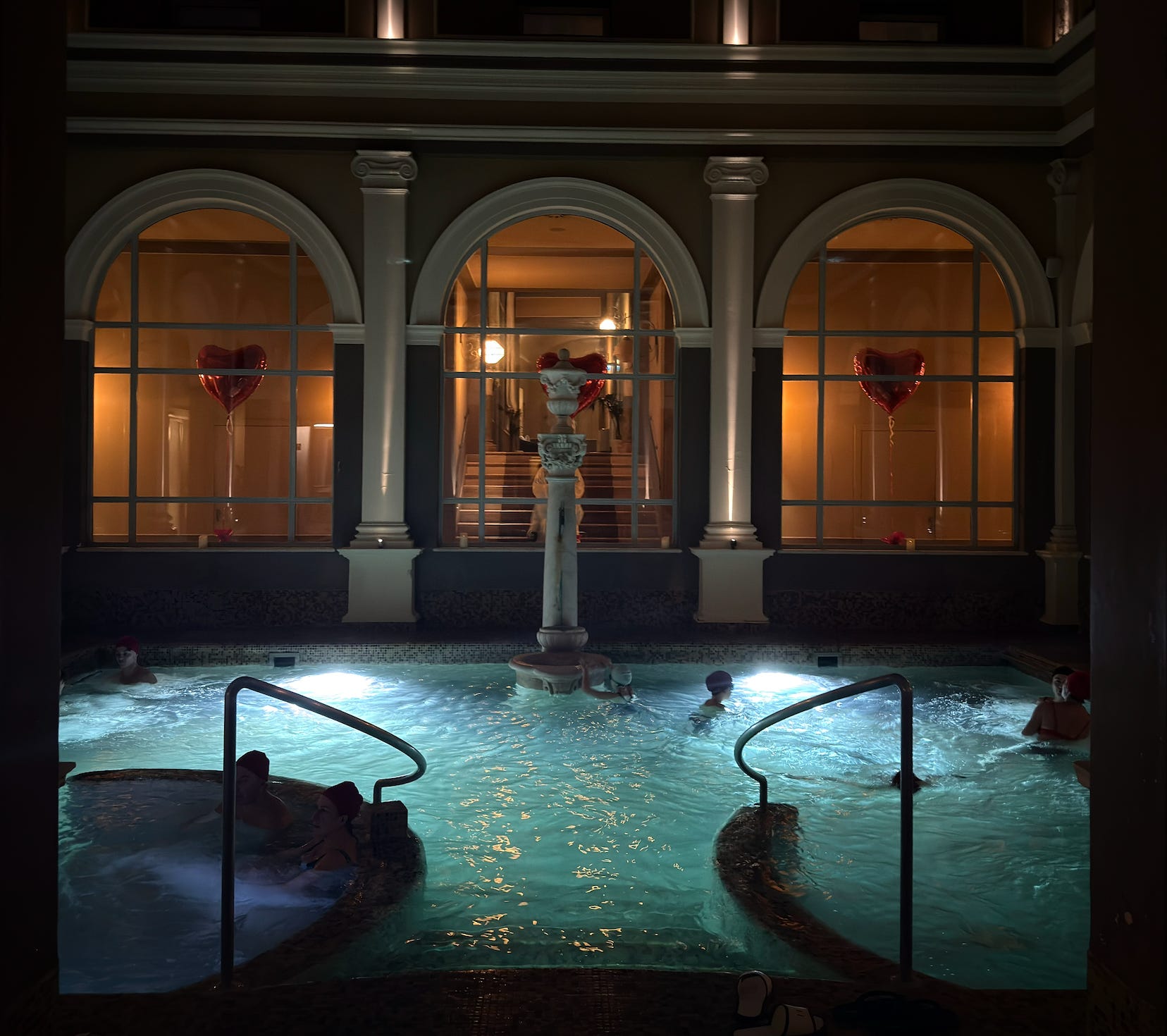
Most places near us have a piece of it and not the rest, and most of them close in winter anyway, because nobody comes to the seaside in January to sit in hot water. So you have to drive inland a little, toward the mountains, to where the water actually comes out of the ground hot. For us, that means San Giuliano Terme, at the foot of Monte Pisano between Pisa and Lucca, and the Bagni di Pisa. It’s essentially a palace converted into a spa hotel.
You do not have to sleep there, or eat there, or be the kind of person who stays in a five-star palace at all. Day spa tickets exist. You pay for access to the baths, and sometimes there is a deal that throws in a treatment, and the whole thing runs us around fifty euros each.
The hotel is genuinely grand, the old summer residence of the Grand Duke of Tuscany, the place where the Shelleys came to take the waters and half the crowned heads of eighteenth-century Europe passed through, and you can use the heart of it for the price of a decent dinner. You just have to know how to ask.
And you have to pick the right day. This is the real secret, the one that matters more than the price. We go on a Tuesday, or a Wednesday, never a weekend. People are working. Anyone taking a spa weekend takes it on a Saturday, and the children are in school, so a midday Tuesday in February gives you the place nearly to yourself: quiet, no kids running the wet stone around the pools, no crowd, no drama. We have a big breakfast at home and arrive around noon, pay at the desk, and then comes the small good moment that never gets old, the locker and the robe and the slippers, the switch out of street clothes and street self into someone with nowhere else to be for six hours.
The ritual is fixed, and the fixedness is the point. We start in the hot pools, thirty minutes, long enough for the shoulders to come down from wherever the winter has pushed them. Then the salt pool, hotter, where you float more than you sit. Sauna, then the steam room, then the mud, which you apply yourself, mud and salts smeared on by hand and left to do whatever mud does, then showered off. A cooler pool to bring the body back down. By then it is time for the massage we booked, and after the massage the rooftop pool, heated, where you lie in hot water in the cold air and wait for the afternoon sun to find a gap in the grey, which some days it does and some days it does not, and either way is fine.
For the price of a glass of Chianti, unlock the full Anywhere Italy experience. All of our articles, private stories, and access to our chat travel community.
Start your free 7-day trial.
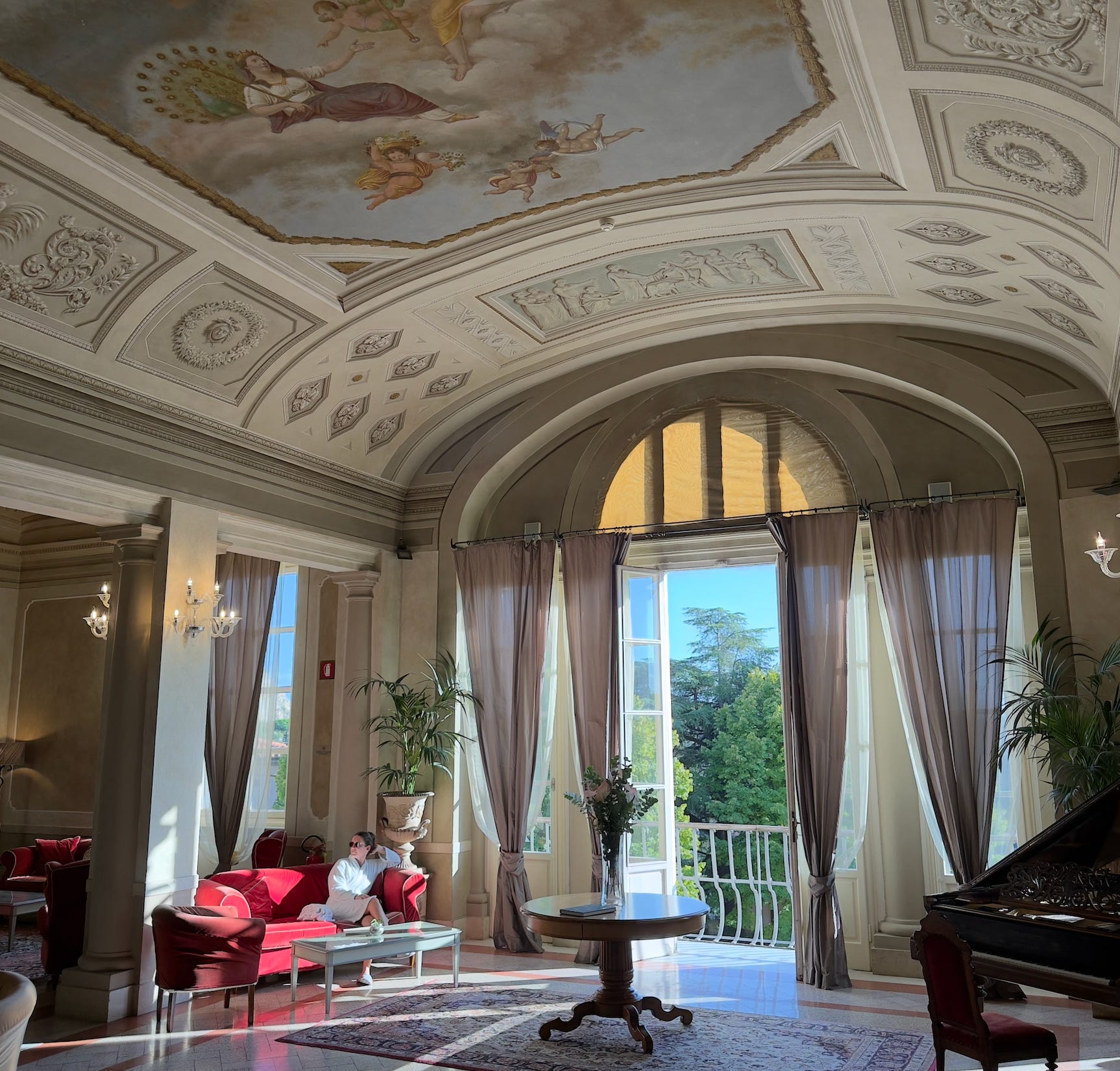
Around four or five, the hunger arrives, the specific clean hunger of a body that has been in and out of hot water all day, and we go up to the Shelley bar. It is a beautiful room, and they know how to make a drink, and we have a cocktail and a plate of tramezzini, those soft triangle sandwiches that Italians do better than anyone has a right to for something so simple, and we sit in our robes among the old paintings like minor aristocracy who happen to be paying day rates. Then one last run in the hot pools until six, because you always want one more, and at half past we close it out, shower, dry the hair properly so the cold drive home does not undo the whole day, and find somewhere good to eat on the way back to the sea.
That is the entire day. We do it every other month, always here, always the same drill, and the sameness is exactly what we go for. The pools are old and glamorous and also completely practical, which is a hard combination to find, and walking back into them after two months away feels less like a visit than like coming home to a house that happens to be a Grand Duke’s.
I will say only one thing about who else is there, because I said the rest of it about Montecatini, and I do not want to say it twice. They are older than us. They are always older than us. We are, most Tuesdays, the youngest people in the water by a wide margin, and I have stopped expecting that to change. But here, unlike the great empty ballroom up the road, the water is full and warm, and someone is actually in it, and for one grey afternoon a month that is enough to make me think the thing I love is not finished yet.
