Erbe | The Greens on the Side
How a heap of wet leaves rewrote my idea of a side dish

The wild boar arrived black-red in a shallow bowl, slick with the wine it had cooked in for half a day, and on the side of the plate sat what looked, at first glance, like an accident. A pile of greens. Wet, dark, undressed in any obvious way, a little spinach-like but coarser and more varied, with stems among the leaves. I had ordered the ragù, and that was it. The greens were just there, presented without explanation, the way a fork is presented. This was Todi, in Umbria, on a Tuesday dinner I do not otherwise remember, and I sat there for a moment thinking I had failed to order properly. I had been in Italy long enough to know better, but the Anglo-Hungarian wiring takes time to rewire. Where, I thought, were the potatoes?
This is something I want to say about side dishes in Italy before I go further. The list is short. Four things, five at most, and the same four or five everywhere from Pietrasanta to Perugia: roast potatoes, beans, fried vegetables in season, and a pile of boiled greens called variously erbe, erbette, verdure lesse, depending on who is writing the menu and whether they feel like committing. That is it. This was a culture shock for me when I arrived.
I come from a tradition where the meat sits on a mountain of fried potatoes, and the vegetables, if they appear at all, are decorative. Hungarians, Brits, Germans, and Americans all share this in some form. We love our food piled together on one plate, the carbs doing serious structural work, the meat enthroned on top. A schnitzel on a hill of crispy potatoes is a perfectly reasonable Tuesday across Vienna to Budapest.
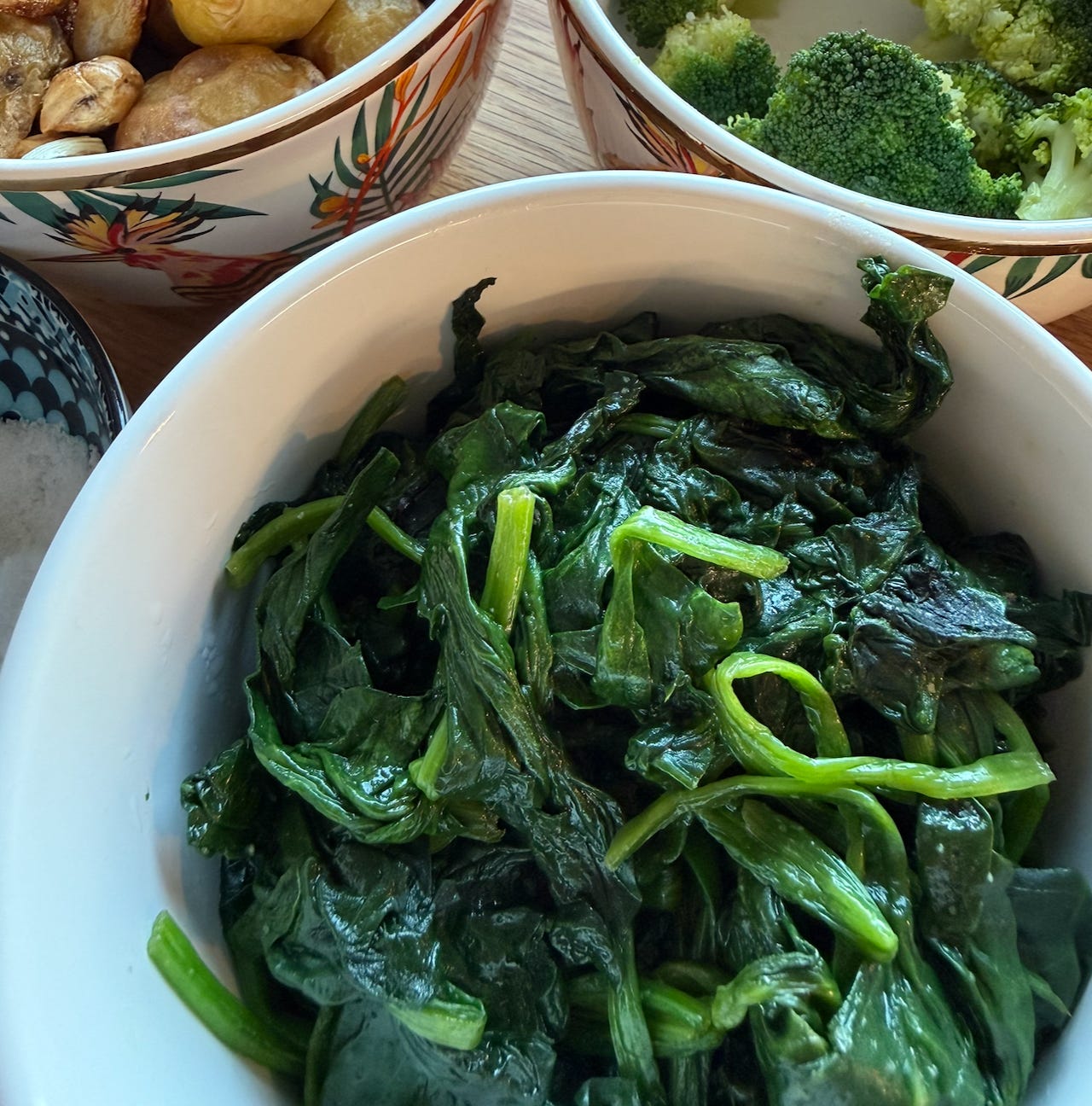
The Italian secondo arrives almost naked. A piece of fish, a slab of meat, sometimes a slice of lemon, sometimes nothing. The carbs were already eaten, in the primo, as pasta. The meal has a different architecture, and the meat is not asked to share its plate with anyone. The contorno, when ordered, comes on its own little dish, a small republic.
Back to Todi. I reached for the greens with mild suspicion. They were warm but not hot, dressed with olive oil and salt, perhaps a squeeze of lemon, nothing else. I took a bite of the ragù, dark with pepper and reduced wine, almost the consistency of beef bourguignon but somehow more direct, no carrots or pearl onions softening the argument, just meat and time. Then a forkful of the greens. Then both together.
It was an immediate conversion. The bitterness of the leaves cut the fat of the boar in a way I had not understood was a thing one might want a vegetable to do. The oil on the greens was the same oil I would have poured on the meat. The lemon, if it was there, lifted everything by half a degree. I ate the entire plate exactly as it was given to me, including the greens I had been about to leave for the kitchen. I did not order potatoes. I have, to be honest, mostly stopped ordering potatoes in Italy unless pork is involved, and that is a separate British (and Hungarian) loyalty I cannot quite extinguish. Ribs need their freakin’ chips. I will die on that hill.
For everything else, the greens.
The dish I had in Todi is not, I have since learned, exclusively Tuscan or Umbrian, and it is not particularly complicated. Boil the greens, drain them, dress them, eat them. A child could do it. What changes from region to region is what goes into the bowl. In the Veneto, they boil bruscandoli, the wild hop shoots that come up in spring, alongside carletti, pissacani, and young poppy plants called rosole, sometimes finished with butter or lard rather than oil. In Salento, they make foje rasse, a mix of wild chicory, dandelion, borage, and asparagus shoots, sometimes cooked together with pork rind, which is its own particular argument about flavor. In the alpine north, in Alto Adige, the same logic produces something different again; the greens are often folded into knödel or ravioli rather than served plain. There is a study from a few years ago that counted 219 wild species used as cooked leafy greens in Tuscany alone. Two hundred and nineteen.
The dish, in other words, is not the dish. The dish is whatever was growing within walking distance, boiled and dressed simply. Italians, being Italians, do this by the kilometer rather than by the country. A Versilia mix is not a Salento mix, and a Friulano mix is not a Versilia mix, and to suggest otherwise to anyone here would earn you a long, slow look. The combination is local because the combination is always local. This is true of almost everything Italian. The pasta shape, the salume, the dialect, the bread. People who think Italian cuisine is one cuisine have not been paying attention.
What is particularly Tuscan, I think, is the restraint of the dressing. Other regions add lard, butter (not like Gordon Ramsay's level ‘a knob of butter!’), pork rind, and sometimes garlic fried in oil. The Tuscan version is olive oil and salt, and a finish of lemon, if anyone remembers. That is a choice. It is the same choice the Tuscans make about almost everything. Strip it back. Let the ingredient sit there in its own truth. A Frenchie would build a sauce. A Brit would make a gravy. An American would do a dip. A Tuscan will not insult the meat or the greens with any of these.
We have a woman near here, in Querceta, just outside Pietrasanta, who makes erbe in jars. There is no shop. You go to the place, she sells the jars, you know the lady and the address, or you do not. This is how a great deal of food works in this part of the country, beneath the surface of the supermarket where I can also, perfectly well, buy decent erbe at the Esselunga whenever I want. Both things are true, and they coexist. When I cook a steak at home, which I do more than Sophie probably wants to admit, I prefer the lady’s jars. The greens taste of someone’s specific morning rather than of an industrial average.
There is one more thing about erbe, and I will admit, it borders on the medicinal. My stomach is not what a Hungarian stomach is supposed to be. I rely on amaro at the end of a heavy meal, the way some men rely on their phones. What I have noticed, and others have noticed long before me and built whole regional cuisines around the noticing, is that bitter cooked greens make a fiorentina sit lighter. Whether this is pharmacology or psychology, I do not know and do not particularly care. Old people here will tell you the bitter ones, the cicoria, the tarassaco, the borage, are good for the liver. Maybe they are. What is certain is that you can eat a kilo and a half of beef cooked rare over olive wood, drink most of a bottle of red, and walk home afterward feeling, against all reason, like a person who has made responsible choices. The greens convert the meal. They do not detract from it. You eat the steak, you eat the greens, and you walk out of the trattoria into the evening feeling like a member of Greenpeace.
A monstrous meal becomes, somehow, a virtuous one. Italians have known this for a very long time. I learned it on a Tuesday in Todi, by accident, with a bowl of black-red boar on one side of the plate and a heap of dark wet leaves on the other, and I have not eaten my meat the same way since.