
How the Italian bar works
A field guide for travelers who want to keep their car, their money, and their morning.

Italy has a thing called the riposo, which the rest of the world calls the siesta, and it shapes the day more than any travel guide will tell you. Around one in the afternoon, the country starts to fold up. The shops drop their shutters at one or one-thirty, the supermarkets pull half their lights, the post office locks the door, and a woman walks past my window in Marina di Pietrasanta carrying a string bag and a baguette, heading home for lunch and the long pause that follows it. By two-thirty the piazza is hers. By three the whole town has gone somewhere else.
This is reversed for the places where you eat. The trattorie and ristoranti and cantine are open exactly when the shops are closed: lunch from one to three or four, then dinner from seven or eight to whenever. The two systems interlock like teeth. Nothing is open all day. You learn to plan around it, or you go hungry, or you stand on the wrong side of a closed door at three-fifteen and wonder what is wrong with this country.
The further south you go, the more rigid the schedule gets. In a Calabrian mountain village at three in the afternoon you could fire a cannon down the main street and hit nothing. In Greece, I once tried to take an elevator at three-thirty, and I am still not sure it was working. In the bigger Italian cities the rules loosen, but the rhythm holds.
There are two exceptions to the riposo. One is McDonald’s, which is American and a franchise, and contractually obliged never to close. We will leave McDonald’s alone.
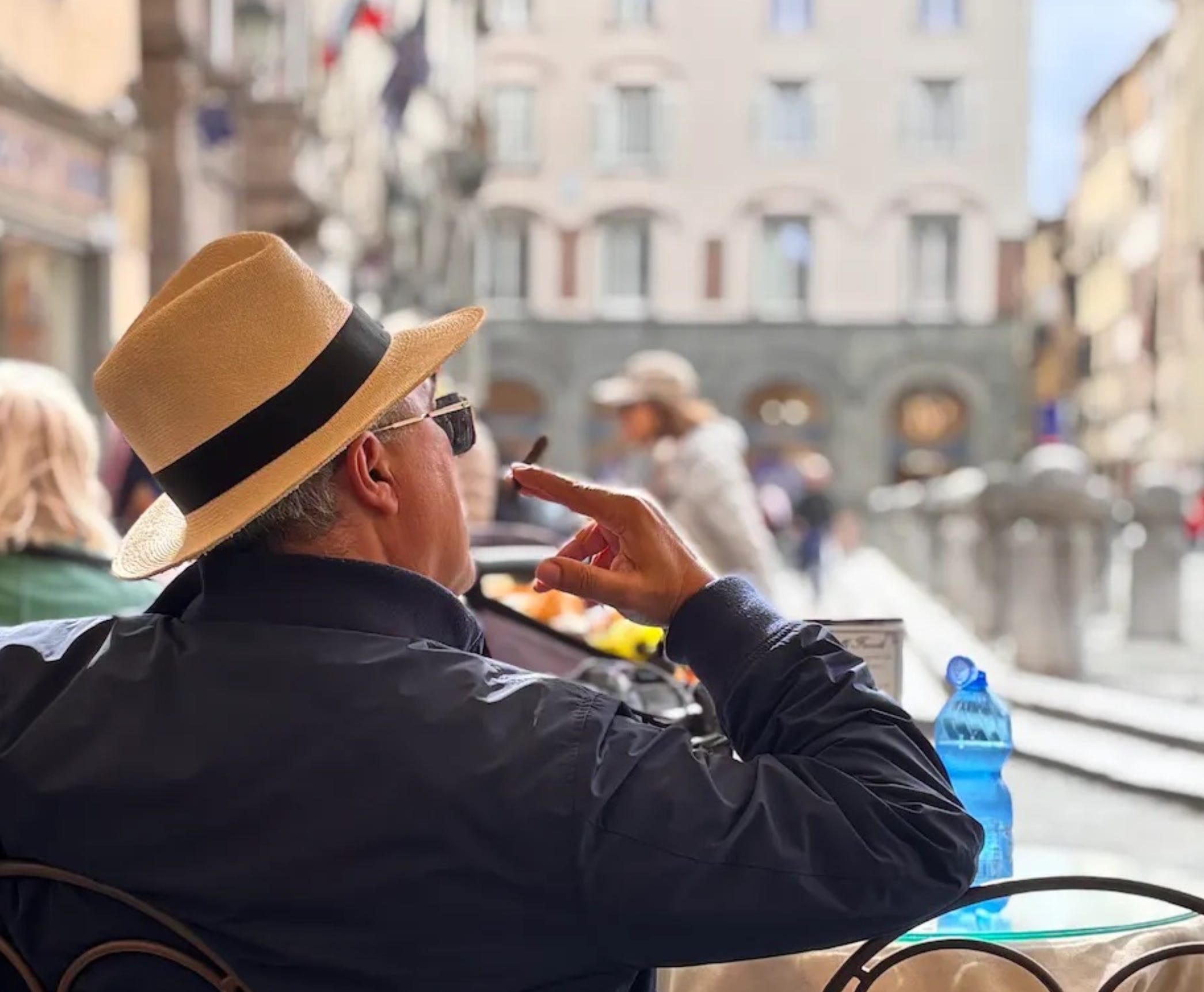
The other is the bar.
The Italian bar is not a bar. Or it is, but it is also a café, and a breakfast counter, and a lunch spot, and an aperitivo venue, and a dessert place, and a community living room, and the place where two old men play cards every afternoon at four. It is the most flexible institution in the Italian day. While everything else closes, the bar stays open.
You have to understand what this word means before any of it makes sense.
In English, bar is the place you go in the evening to drink, to socialize, and, often enough, to get loudly drunk. In Italian, bar is the place you go in the morning to drink coffee. The drinking-and-getting-drunk part is a small evening note inside a much larger institution that begins at seven in the morning and runs for fifteen hours. Italians, in my four years here, do not really go anywhere to get drunk. They drink, certainly, sometimes a lot, but always inside a meal, or alongside food, or as part of a sequence that ends with espresso and a walk home. The bar is not a drinking establishment. It is a public room.
Most cultures have a version of this. The German Bierhalle, where you sit on a long wooden bench, and the same place serves you a coffee at eleven, a sausage and a beer at two, and a stein at nine. The Austrian Kaffeehaus, the kávézó in Hungarian, where the same room is a writer’s office in the morning, a businessman’s lunch at one, a pensioner’s reading room at four, and a couple’s evening at eight. The British pub, which opens at eleven and feeds you, gives you the football, holds the village quiz on Tuesdays, and pours the last pint at eleven. The American small-town bar that does the same thing on a different scale. The Japanese izakaya, where the same five regulars have been drinking at the same counter for fifteen years, where the cook knows what they want before they ask, and where the food, the sake, and the talk all run together until late.
What all these institutions share, when they work, is roughly five things. They are open all year round, every day, no seasons, no long closures. They flex their service through the day, from breakfast to lunch to afternoon to evening, the same room reshaping itself for each. They serve food, coffee, and alcohol from the same counter, without splitting those functions across separate establishments. They are anchored in a single community, with the same regulars and the same staff for years. And they make their margins on volume, not on premium pricing: a coffee is a euro, a glass of wine is three, lunch is twenty, the aperitivo is six, and nothing is overpriced because the model only works if the same people come back every day.
The European and American versions of this institution tend to hit all five. The Italian bar, the British pub, the German Bierhalle, the Austrian Kaffeehaus, the Hungarian kávézó, the American small-town bar and diner: different in tone, different in what they sell, but all open across the whole day from breakfast onwards, all flexible, all serving the full range, all community-rooted, all priced for daily use. The Asian and Arabic cousins hit four of the five, and which one they miss tells you something about the culture. The Japanese izakaya is essentially a British pub by function, but it opens in the late afternoon and runs into the night, so the morning is missing. The Chinese teahouse keeps the all-day rhythm, serves as a community anchor, and maintains affordability, but does not serve alcohol. The Arabic café, in Cairo or Beirut or Marrakech, does the all-day thing brilliantly, with regulars, shisha, backgammon, and small coffees served until late, but the alcohol is missing there, too. Each one shows you which of the five basics you can drop and still have something useful, and which one is the load-bearing wall.
The Italian bar happens to keep all five at once, from seven in the morning until eleven at night. That is the whole institution.
The word itself is a small piece of misdirection. There are several theories about where it comes from, and the one Italians tell each other is that BAR is an acronym for Banco A Ristoro, the standing-up counter, and that a man called Alessandro Manaresi opened the first one in Florence in 1898. He may have. The cleaner answer is probably that it came from English along with so much else in the late nineteenth century, bar meaning the brass rail at a counter, and Italy adopted the word and bent it to fit its own institution. Either way, by 1900 the older sign reading Caffè was being painted over with Bar, and the bar replaced the café as the lead actor on the Italian street. The actual oldest cafés are still standing. Caffè Florian opened in Venice in 1720, the Pedrocchi in Padua in 1722, the Greco in Rome a few decades later. They are now beautiful museums where a cappuccino costs eight euros. The real life of the bar happened elsewhere, in the smaller rooms, in the working neighborhoods, in the morning rush after the war when the country was rebuilding itself one espresso at a time.
For the price of a glass of Chianti, unlock the full Anywhere Italy experience. All of our articles, private stories, and access to our chat travel community.
Start your free 7-day trial.
The clearest way to explain how a bar works is to walk through one. So let me describe ours.
The Margherita is on the piazza in Marina di Pietrasanta where Sophia and I live. It is not a famous place. There is no plaque on the wall. It is just a bar, the way every Italian town has a bar, and it is open three hundred and sixty-five days a year. Renovations happen on a rolling basis: half the room gets new chairs while the other half keeps serving. Christmas, the bar is open. On the fifteenth of August, the bar is open. On the morning Italy plays Argentina in the World Cup, the bar opens at six. It is the most reliable thing in our life here.
Mornings start around seven. The bar at seven is a coffee bar. The cornetti come out of the oven, the espresso machine begins its slow constant hiss, and the people who work at the post office and the farmacia and the school come in for a quick coffee at the counter, un caffè e via, a coffee and gone. The standing-at-the-counter coffee in Italy is its own subject and I will write about it separately, but the short version is that you stand, you drink the coffee in three sips, you say grazie ciao, and you leave. It costs about a euro twenty. If you sit at a table, the same coffee costs three or four euros, sometimes more. This is not a tourist trap. It is the system.
By eight, the morning has settled into a slower rhythm. The retired men have come down for their cappuccino e cornetto, the table closest to the door has been claimed by the same three women who claim it every morning, the dog under their table is asleep on a folded jacket. People who have already had their morning coffee at home come in for a second one, because in Italy you do not have a coffee, you have many. Five a day for the average Italian, four spread through working hours and one after lunch, sometimes a sixth after dinner. The bar at eight in the morning is doing five different things at once. Behind the counter, a man named Luca is moving fast and not appearing to.
By eleven the morning is winding down. The cornetti are gone, the cappuccinos slow, the bar shifts towards its midday face. This is the moment when, somewhere in the world, a tourist orders a cappuccino at quarter past eleven and the barista does not refuse but does, in the small set of his shoulders, register the offense. After eleven, milk in coffee is a foreign drink. Italians switch to caffè macchiato if they want a touch of milk, or to a marocchino in the north if they want something dressier, or to plain espresso which they will drink for the rest of the day. Joe Bastianich, an Italian-American restaurateur, has gone on record arguing that this rule is silly and Italian bars should serve cappuccino at any hour. He is right about the economics and wrong about the culture, and the rule has not moved.
At one o’clock the Margherita transforms. Half the tables are reset for lunch. White napkins go down, cutlery comes out, a small printed menu of about ten dishes appears, and the kitchen, which until now has been making toast and warming pastries, switches into full operation. Two pastas. A fritto misto. A tagliata. A salad or two. Nothing fancy. Everything cooked fresh, made by the same hands that made my coffee at eight, served by the same waiter, drunk with the same house wine that fills the small carafes on every table. Lunch at the Margherita runs about twenty euros for a plate of pasta and a glass of wine. The other half of the tables, the smaller ones near the bar, stay in coffee mode for the people who already ate at home and want to come down for an espresso and a digestivo. Both functions run side by side without colliding. Italian bars are good at this.
By three, the lunch service ends. The kitchen closes for two hours. The bar quiets, the way the whole town quiets, and for a little while the only people in the place are an old man witha newspaper and a couple finishing their second coffee. This is the hinge of the day. The morning is done, the lunch is done, the evening has not yet started. In Versilia the riposo is real but soft. The bar stays open even though the kitchen is closed. You can still get a coffee. You can still get a glass of water. The owner is still behind the counter, doing the books, watching the door.
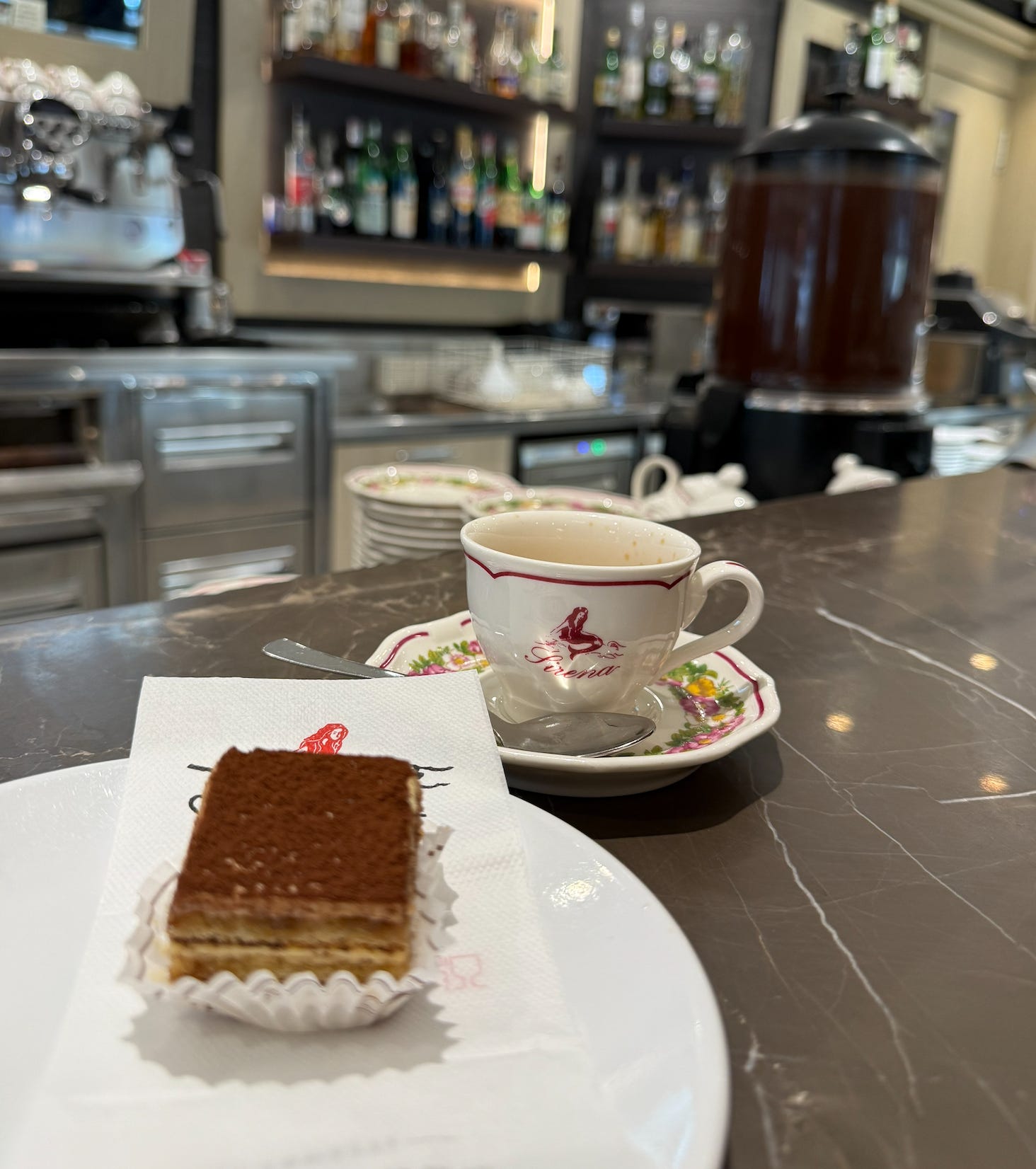
Then around five-thirty, six o’clock, the bar wakes up again for the aperitivo. This is the central social ritual of Italian evening life and the second thing the bar does that has no real equivalent abroad. Aperitivo is not happy hour. It is not pre-dinner drinks in the American sense. It is a structured hour or two between work and supper in which Italians drink something bitter, eat something salty, and reset. The classic order is a Negroni or a spritz, Aperol or Campari depending on your taste, served in a stemmed glass with a slice of orange, with a small bowl of olives and another of crisps and another of small focaccia squares laid out in front of you. None of this costs much. A spritz with all the snacks is six or seven euros. The point is not to eat dinner off the snacks, though tourists try, and in Milan whole bars have built their economic model around tourists trying. The point is to drink slowly with friends in the hour when the light is good, and then go home and have dinner.
The Margherita does aperitivo the simple way. A bowl of olives, a bowl of crisps, sometimes a small plate of focaccia. People who live in our piazza begin to drift in around six. They claim their tables and stay for two hours. By seven the bar is full. By seven-thirty, on a summer evening, the small tables outside have all been pushed together and there are three generations of one family sitting at them, drinking spritz, talking over each other, and the youngest grandchild is asleep against his grandmother’s arm. This is the bar at its peak.
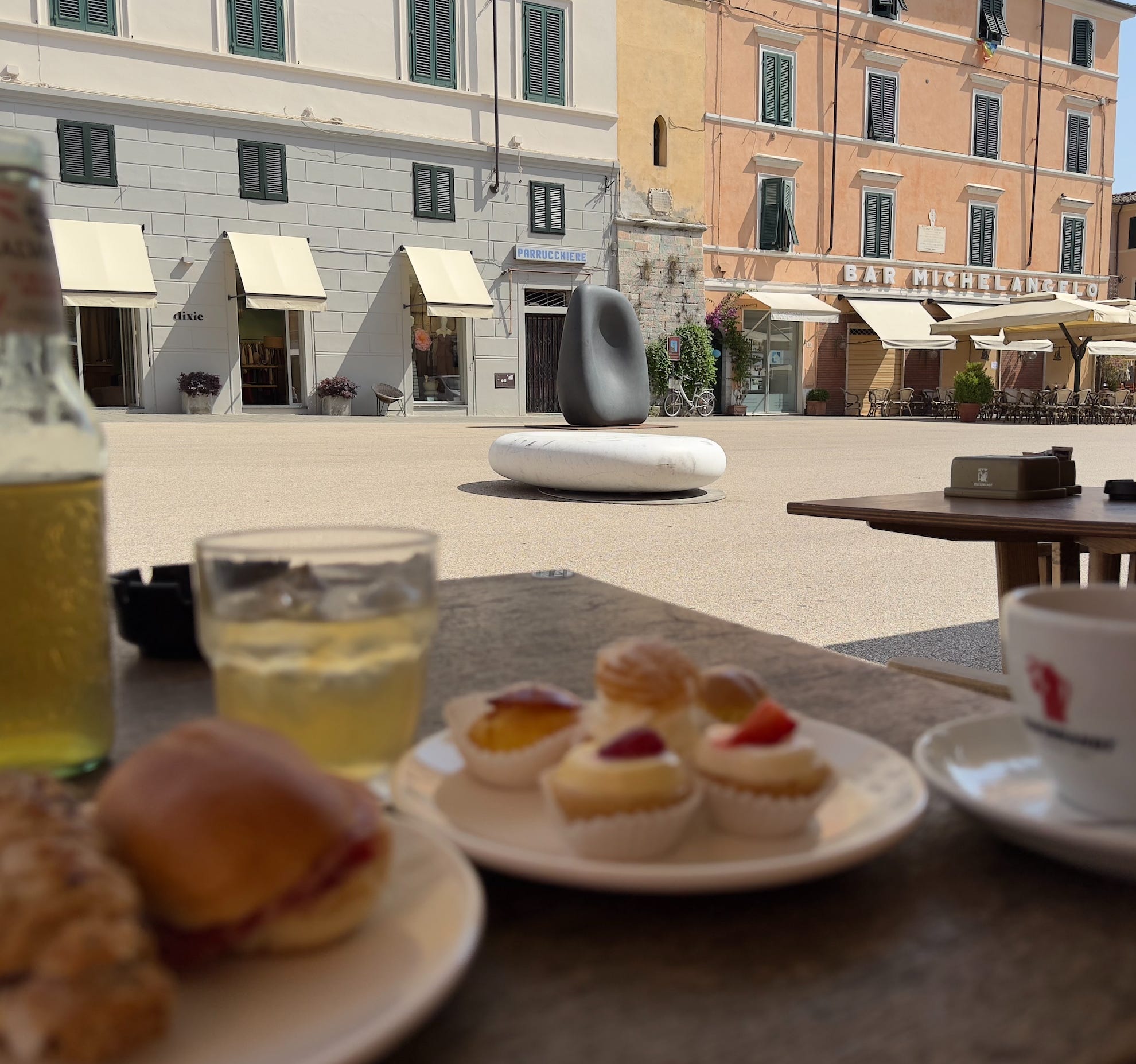
After eight the bar empties out as people walk home or to a restaurant for dinner. From eight to ten the Margherita is quieter, doing dessert and digestivi for a smaller crowd. People who have eaten at home come down for a limoncello or an amaro. Couples coming back from the passeggiata stop in for one last coffee. Sometimes the bar puts on a small dinner of its own, a few set dishes, and competes for the evening trade with the trattorie on the next street, but most nights it just stays in its lane. By eleven the lights are dimming, the chairs are stacked, Luca is wiping down the counter, and the bar is closing. Tomorrow at seven the cornetti come out of the oven again.
The reason this institution matters is that nothing else in Italian life is this open. The trattoria is open four hours a day and closed on Mondays. The farmacia is closed on Sunday. The post office takes a two-hour lunch. The bar is open every day from seven in the morning until eleven at night, and inside that window it shape-shifts to be whatever the moment needs. It is the place where the town keeps its appointments with itself.
When Howard Schultz, the founder of Starbucks, came to Milan in 1983, this is what he saw and tried to copy. He built one of the largest companies in the world out of his half-misunderstanding of it. The bar is what he was reaching for, and the thing he produced was not the bar. The bar requires that the same five baristas have worked at the Margherita for ten years. It requires that the woman who comes in every morning for her macchiato senza schiuma has been doing this for twenty years and Luca knows her order and pours it before she sits down. It requires a piazza with the same people walking across it every day. It is not a chain. It is the opposite of a chain. It is a single room, in a single town, that has been serving the same neighbourhood for long enough that the neighbourhood considers it part of the architecture.
If you visit Italy and want to understand the country in one sitting, do this. Pick a small town. Pick the busiest bar on the main square. Sit at a table outside, order a coffee in the morning and a spritz in the evening, and stay for two hours each time. Watch who walks in. Watch who is greeted by name. Watch the rhythm of the place across the riposo. You will see the whole town’s social structure in one room: the postman at eight, the mothers at ten, the tradesmen at lunch, the retirees at four, the families at six, the couples at nine. The bar is the town’s central nervous system, and unlike the trattoria or the farmacia or the church, it never closes its doors.
Marble in the counter, brass on the rail, an espresso machine that has been there since 1978, and a sign above the door that says Bar.
That is the institution.


Planning a slow trip? My planner builds it for you. Free, no paywall, no email gate. Answer five questions (hub town, interests, travel month, days you want for slow discovery, and fitness level, because some of these towns make you climb), and you get a personalized route from my handpicked list of the 1,000 towns most travelers skip, with festivals, drive times, and a line on what each place is. Don’t like it? Refine it, swap towns, or browse the whole database by region.