

Pesto | The Sauce of Having Nothing
A jar at the Chiavari market, the arithmetic of Italian sauces, and why Liguria's most famous export

At the farmers market in Chiavari, under the porticoes where the town has been selling vegetables every working morning for the better part of eight hundred years, we bought a jar of pesto from a local producer for pennies. Not figurative pennies. The jar cost less than the focaccia and coffee I was holding while I paid. And standing there with both in my hands, I remembered the shop windows of Portovenere, where we had lived a few weeks, and where jars half that size sit behind glass for tens of euros, next to flyers for pesto-making classes in which tourists pay three figures to be handed a pestle and made to crush basil with garlic and nuts, which is to say, to perform for money the single cheapest act in Italian cooking.
Both of those prices are telling the truth about something. Just not about pesto.
Here is the thing about Italian sauces that nobody explains to you, because to an Italian, it does not need explaining. They are machines for eating carbohydrates, and they are small machines. Almost all of them are built from the same four positions. One ingredient gives the color and the body, and this is the star, the thing you need in quantity. One gives the depth, and you need only a handful of it. One gives the spice or the sharpness, a clove, a rind, a pinch. And one binds it, and in ninety-nine cases out of a hundred, the binder is olive oil. Salt, if you count it, mostly arrives already dissolved in the pasta water. That is the whole architecture. A traditional tomato sauce: tomato, garlic, oregano, oil. Four. A pesto: basil, pine nuts, garlic, hard salty cheese, oil. Five, and the fifth is there because the sauce is never cooked, so something has to carry the salt. When you watch a chef build an Italian sauce with more than five ingredients, you are allowed to conclude, safely and out loud, that what he is making is complicated for its own sake, and that whatever it is, it is not Italian.
For the price of a glass of Chianti, unlock the full Anywhere Italy experience. All of our articles, private stories, and access to our chat travel community.
Start your free 7-day trial.
The four positions are a form. What fills them is a map. Italian food is regional in a way that goes past preference into geology: the star ingredient, the one you need in bulk, must be the thing your land produces in bulk, because for most of history, nobody was shipping bulk anywhere. Campania has hills of volcanic soil that grow tomatoes the way other places grow weeds, and so the south’s sauces run red, and a ragù can afford to simmer kilos of them down to nothing. Now look at Liguria on the same map. A wall of mountains falling into the sea. No plain, no field, no room. You cannot grow bulk anything on a fifty-degree slope.
Except that the slopes are covered in pines, and pines drop pine nuts. And a terraced alley two meters wide, too small for any crop that feeds a family, is exactly the right size for garlic. And basil, the one thing the sauce needs in quantity, is the botanical equivalent of a squatter: it grows in a pot, on a sill, on a roof, in the corner of a courtyard, anywhere a Ligurian could not fit anything more serious. The most famous basil in the world today grows in small greenhouses at Prà, on a hillside in western Genova, directly above one of the largest container terminals in Italy, the DOP herb and the port cranes sharing a postcode, which is the whole region in one image.
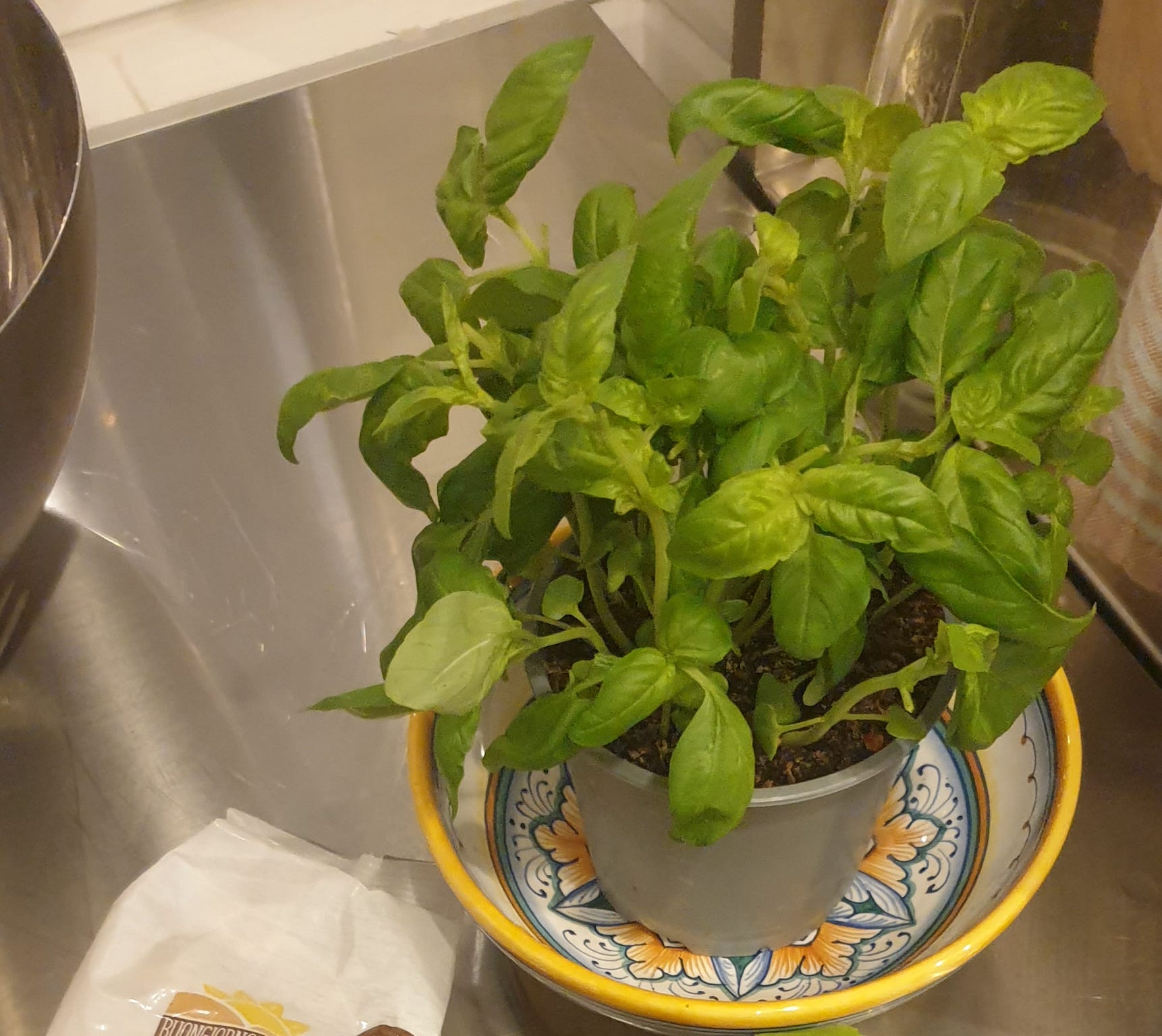
And the cheese, the position basil cannot fill because an uncooked sauce needs its salt from somewhere, is the confession at the heart of the recipe. There is no room in Liguria for cows, and not much for sheep. So the cheese came the only way anything bulky ever came to Liguria, which is by water: Fiore Sardo, sheep’s cheese from Sardinia, an island Genova’s merchants treated as a warehouse for centuries, split with Parmigiano hauled over from Emilia. The first written recipe for pesto, Giovanni Battista Ratto’s, in the Cuciniera Genovese of 1863, calls for Dutch cheese with total serenity, because that is what a port city’s pantry held in 1863. The sauce that now has a consortium, a DOP, and a world championship with marble mortars in the Palazzo Ducale is younger than the unification of Italy and was codified with cheese from Holland. The mountains grew the herb, the pines dropped the nuts, and the sea brought the rest.
So pesto is not Ligurian because Ligurians are geniuses of flavor. Pesto is Ligurian because nothing else could be. It is what a vertical, landless, frugal coast could produce without buying anything, and the frugality is not my joke. It is the region’s own reputation, lovingly maintained by the rest of Italy: the Genovese do not part with money. Pine nuts are expensive everywhere else on Earth. In Liguria, they fall out of the sky. Walnuts, the cheap nut of the flatlands, are what the sauce’s own ancestor used, the medieval agliata, garlic and walnuts pounded to a paste, and inland grandmothers went on using them whenever pinoli were short. The versions with pistachio or hazelnut mean that somebody paid Sicily or Piemonte, and a proper Genovese would quietly ask you why you would do such a thing. Even the famous red cousin obeys the arithmetic: pesto rosso swaps the star for sun-dried tomatoes because drying is how a region with no tomato fields makes a few tomatoes act like many. You need a hillside of fresh ones for a ragù. You need a windowsill’s worth, dried on a roof in August, for a jar.
Which brings me back to the two prices. The jar in Chiavari, from a producer at a market stall, pennies, is the honest price of pesto, because pesto is honestly cheap: it is the sauce of having nothing, made from what fell, what fit in an alley, and what grew in a pot. The jar in the Portovenere window, and the hundred-euro class where a stranger crushes basil for an hour and is photographed doing it, is the price of the story about pesto, and the story is what the coast sells now, the way it once sold cheese landed on the quay. I do not even resent it. A region that spent a thousand years making do will not apologize for finally charging the visitors for the making.
But you should know which one you are buying. If you are anywhere in Liguria, walk past the window with the lit shelves, find the weekly market, find the table with jars bearing handwritten lids, and pay what the town pays. It should cost about as much as your focaccia and your coffee.


Planning a slow trip? My planner builds it for you. Free, no paywall, no email gate. Answer five questions (hub town, interests, travel month, days you want for slow discovery, and fitness level, because some of these towns make you climb), and you get a personalized route from my handpicked list of the 1,000 towns most travelers skip, with festivals, drive times, and a line on what each place is. Don’t like it? Refine it, swap towns, or browse the whole database by region.
I don’t understand this sentence: “The versions with pistachio or hazelnut mean that somebody paid Sicily or Piemonte,”