
Pistoia | Mini-Florence with Better Pastry
A Tuscan town we went to for the zoo and stayed for the coffee culture nobody else in the region has

We went to Pistoia for the zoo. This is a slightly embarrassing admission for a publication that talks mostly about architecture, food, and culture. But, hey, if you live in Italy, another Italian piazza with a pizzeria won’t give you that kind of excitement, and you just need something new.
We had had a heavy breakfast, the weather was the kind of weak Tuscan sun that promises a good afternoon and threatens an evening of rain, and Sophia and I had reached the point when we literally said: “We are bored by the sea. This is obviously not true. I couldn’t imagine myself living anywhere else, but we needed a change in scenery so much.
We did not want the mountains again. We did not want to fight for parking in Pisa, which is what fighting for parking in Pisa is. We wanted to walk somewhere that was not the sea, was flat enough for shoes that should not get muddy, and was an hour from home. The Pistoia zoo is in the hills a few minutes outside the town. The town was forty minutes from us. We went for the zoo and stayed for the town. Both turned out to be worth the drive, for entirely different reasons.
A note on the zoo… We do not particularly like the concept of zoos. We had a dog for many years, and we know how much a fenced run does to an animal that wants more space, and we understand the standard objections better than someone making them in the abstract. We went anyway. The reason, which Sophia named honestly some years ago, is that the kind of nature walk we actually enjoy is the kind that lets her keep her white shoes white at the end of it. This rules out most of what people mean when they recommend a walk in nature. Botanical gardens qualify. Zoos qualify. Cities qualify. Forest paths, mountain trails, anything involving mud, do not. The list of available activities for a sunny Saturday in our part of Tuscany, when you have already done the sea three times that week and would like to walk somewhere on flat, clean paths, is short. The Pistoia zoo is on it.
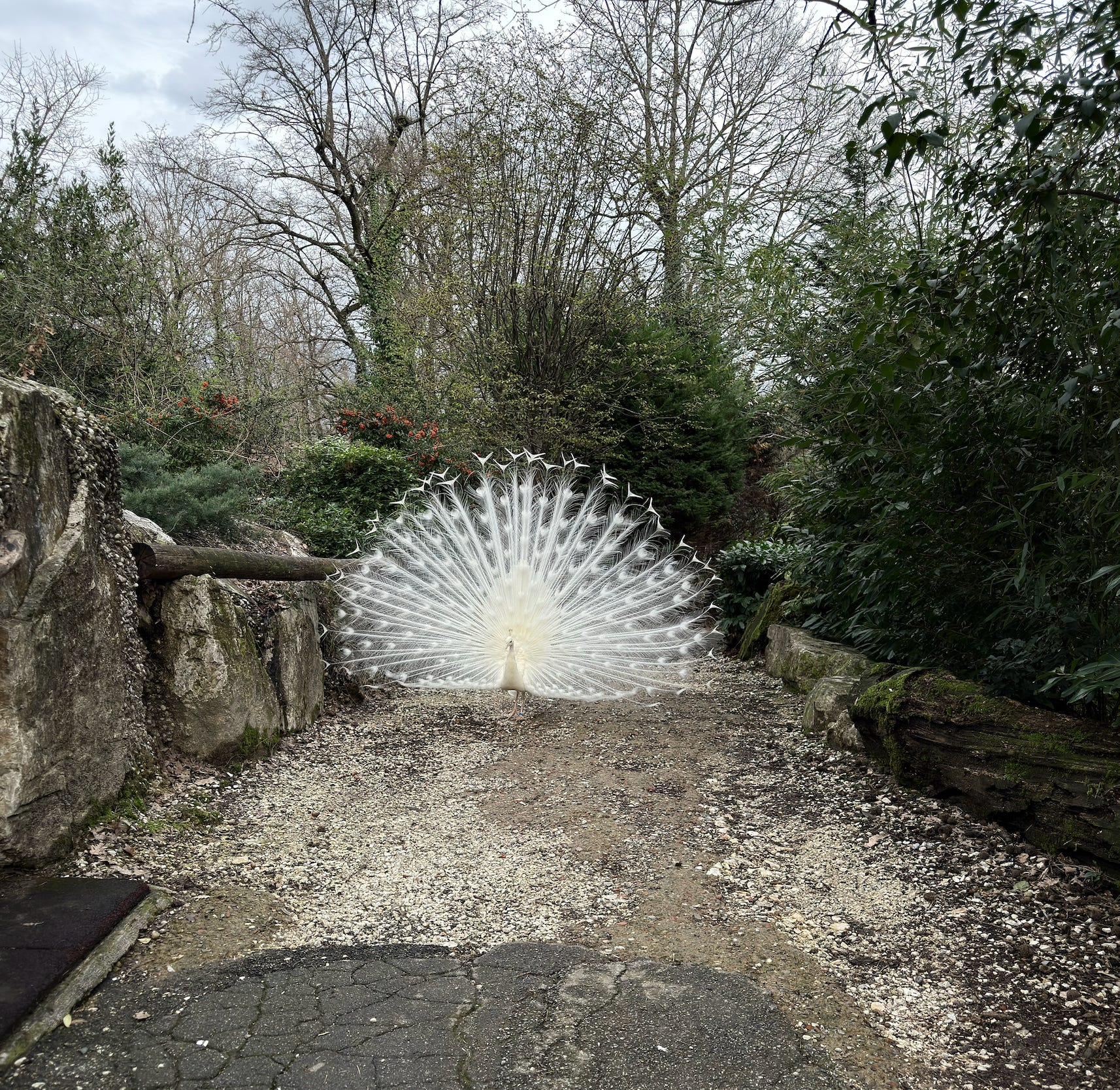
The zoo was founded in April of 1970 by a Tuscan animal enthusiast named Raffaello Galardini, has been in the same family more or less ever since, and has spent the last twenty-some years converting itself from the original kind of zoo (animals exhibited to a paying public, which is the model the twentieth century invented and which has aged badly) to the current kind of zoo (a conservation park with rescued animals from circuses and private collections, breeding programs for endangered species, large naturalistic enclosures, the EAZA programs for things like the leopard and the red panda and the lynx). The bears live in a wooded enclosure that gives them genuine room. The big cats have similar space. The wolves have new enclosures built since 2005 that resemble the woods they would otherwise live in. The most striking thing, on the day we visited, was the birds. A great many of the large birds are not in cages at all. They roam the gravel paths along with the visitors. We met a peacock at a bend in the path that did not move for us. We stood and waited. The peacock waited longer. We eventually went around it.
It is a small zoo. It is seven hectares on a wooded hill. It has, depending on the year, around four hundred to five hundred and fifty animals across a hundred species, and you can walk the whole thing in two hours at a comfortable pace. It is not a safari. It is not a Berlin Zoo. It is, in the honest sense, a park with animals, organized around the principle that some of the animals here would otherwise be dead, and the ones that were born here are getting the best version of captivity that a small Italian zoo can build them. You do not need to enjoy zoos to enjoy this one. We did. We came out of it ready for lunch and looking for a walk on something other than gravel, which is where the town comes in.
For the price of a glass of Chianti, unlock the full Anywhere Italy experience. All of our articles, private stories, and access to our chat travel community.
Start your free 7-day trial.
Pistoia is forty minutes from us by car and twenty-five minutes from the center of Florence. The train runs, and if you are in Florence and the August crowds and the noise have begun to feel like the inside of a not-quite-clean drum, Pistoia is one of the easier escapes from the city that does not require a serious day’s commitment. We parked without difficulty in a normal city lot near the center, which is the first detail that distinguishes Pistoia from the larger Tuscan cities and a meaningful one for anyone who has spent a day trying to park in Pisa or Lucca or central Florence. The whole town walks easily from a single parking decision.
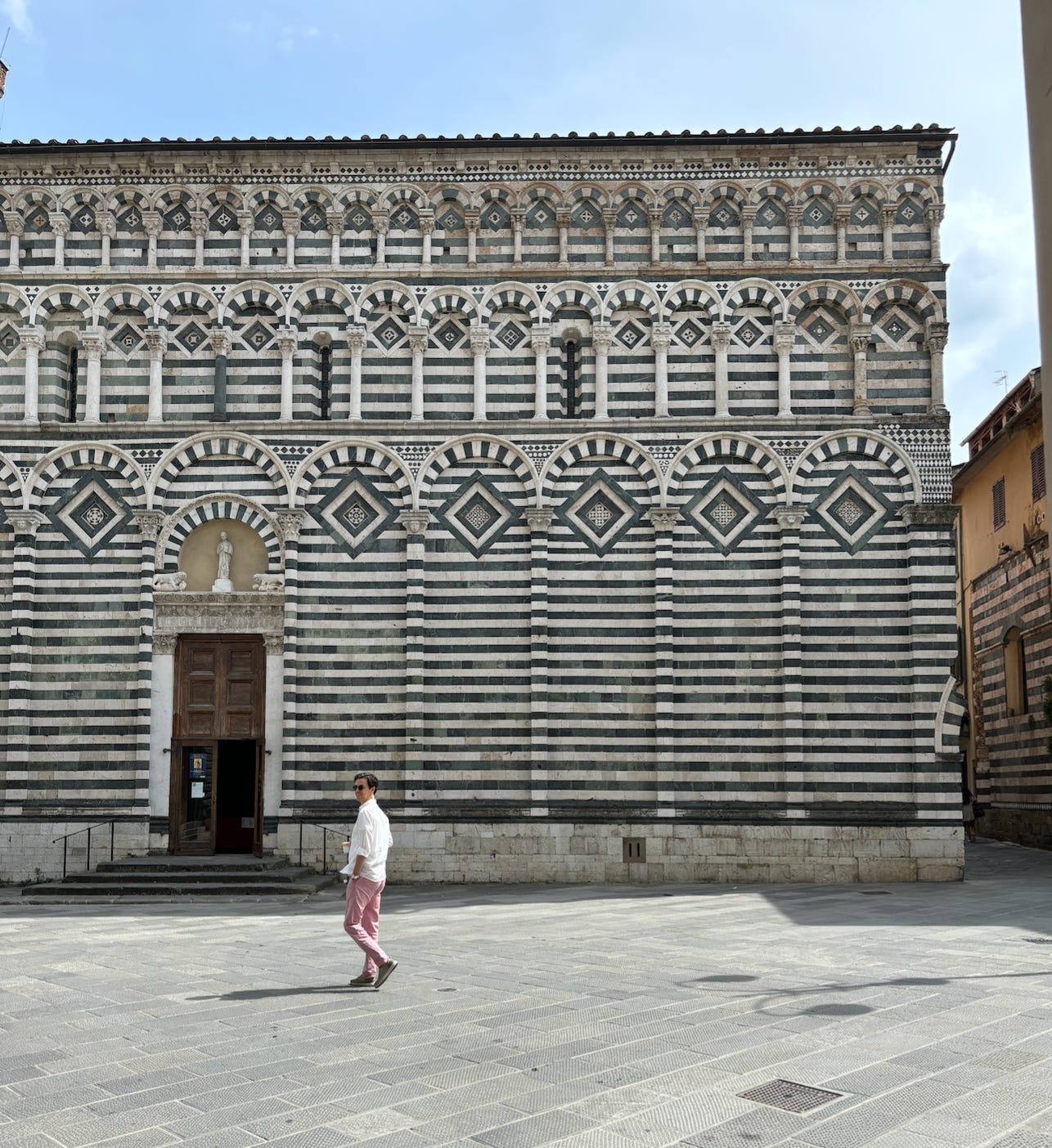
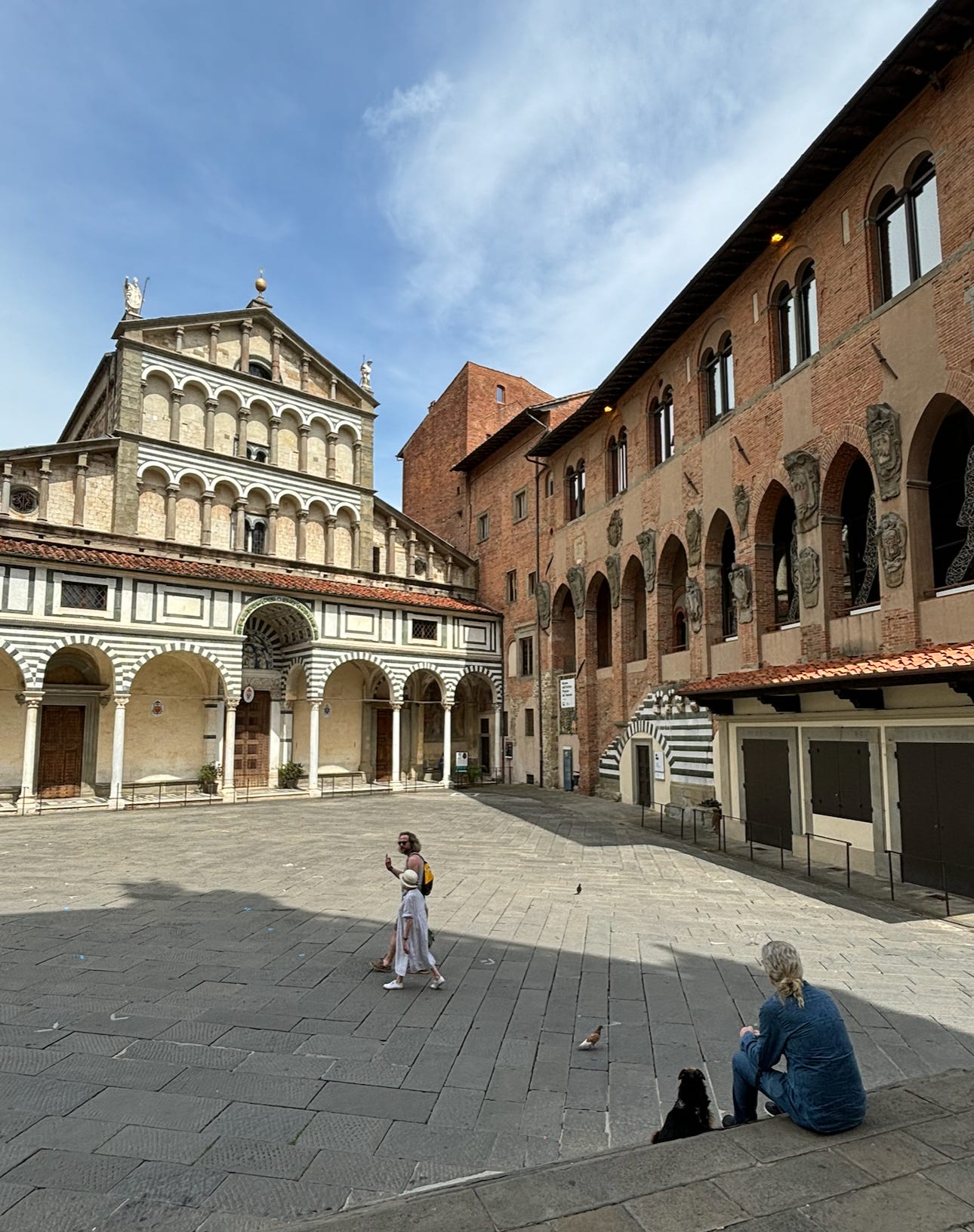
The city itself is, structurally, a small Florence. This is the read I would give it after a single afternoon, and it is the read I would defend on a second visit. The Piazza del Duomo is a Florence-style square, anchored by a Romanesque cathedral with a separate bell tower that began life as a Lombard watchtower, with a fourteenth-century octagonal baptistery sheathed in bands of Carrara white and Prato green marble across the square from the cathedral, and the medieval Palazzo Comunale and Palazzo Pretorio on the long sides. The piazza is anomalously large for the town it sits in, designed centuries ago for a city Pistoia thought it would be and never quite became. The cathedral inside holds a silver altar of Saint James that is, by the quiet consensus of people who think about Italian goldsmithing, one of the great pieces of medieval European silverwork.
The streets running off the piazza are narrow medieval, the way Florence’s streets are narrow medieval, with the same pattern of stone palaces and ground-floor shops that the central Florentine grid has, and most of the same shop-front architecture. What Pistoia does not have, which Florence has and which is the single largest reason Florence is Florence and Pistoia is not, is the Arno. The river runs through the outskirts. The old town is dry. No bridges, no riverbank, no Ponte Vecchio reflected at golden hour. This subtraction is most of the explanation for why one of these towns is on every Italian itinerary, and the other is on almost none of them. The other part of the explanation is that Pistoia spent most of the fourteenth century being absorbed by Florence after losing the kind of internal war the medieval Italian comuni were particularly good at losing, and once you are absorbed into Florence, the next eight hundred years are spent being a small town outside Florence rather than a small republic of your own. The town never recovered the momentum.
Which is, for the visitor, fine. What Pistoia is now is a working medium-sized Tuscan town with a well-preserved historical center and almost no tourists for most of the year, in which the architecture and the food and the streets are the architecture and food and streets of any other well-preserved Tuscan town of its tier, and which earned the title of Italian Capital of Culture in 2017 essentially because someone in the relevant ministry finally noticed all this and gave it a designation. The honest version of the recommendation is this. If you have not seen Florence, see Florence. If you have been to Florence and you have seen one or two other mid-sized Tuscan towns, Lucca or Arezzo or Cortona, you can skip Pistoia and not miss something the others are not giving you in fuller form. Pistoia is not, in this sense, a destination. It is a town. Which is a fine thing for a town to be. It is also, on a sunny Saturday between a zoo and home, exactly the size and shape of city walk we had come out for.
What does distinguish Pistoia, and what we would now drive back for on its own, is the food culture in the cafés. I am going to set this up carefully because the observation matters, and the way it arrived matters more.
We noticed it because we live here. Not in Pistoia, but in Tuscany. For years now, in Versilia, an hour west of Pistoia by the road that runs along the foot of the Apuane. After enough time in any country, you stop seeing the things every town shares and start seeing the things specific towns do that the others around them do not. The architecture of two Italian medium-sized towns of the same tier is, at the level of an afternoon visit, 60 to 70 percent the same. The food and the daily customs are the same percentage. What you learn to read, after enough Saturdays driving an hour to walk through the next medium-sized town along, is the 30 to 40 percent that differs. In Liguria, you can tell which town is the pesto town, the focaccia town, and the anchovy town. In coastal Tuscany, you read them to see which one does its own version of cacciucco and which one has the better frittura. The reading happens fast once you are in it. It is invisible to most outside writing because it does not have the time on the ground.
We walked into a café in the late afternoon. It was four o’clock or close to it. We had had a heavy breakfast, skipped lunch, and were now hungry, the way you are when you have walked through a zoo and a town on a single coffee and a glass of water. The case in the front of the café was full of savory things. Not the standard Italian bar arrangement, where the case is roughly eighty per cent sweet pastries and twenty per cent savory bits to graze on alongside the espresso. The other way around. Slabs of torta salata of three or four kinds. Small focaccia stuffed with vegetables. A wedge of schiacciata with rosemary and onion. A short row of tramezzini on the bottom shelf, the soft white-bread triangles you find in every Italian café from Trieste to Palermo, looking, in this case, like an afterthought rather than the main act. The sweets were a small section on one side.
We ordered sandwiches. Sophia ordered the torta salata. I ordered something I thought would be a tramezzino, but it turned out to be a different category of object entirely. The standard Italian tramezzino is a soft, crustless, white-bread triangle, lightly filled, the snack you eat standing at a bar between two real meals. What arrived at our table was a long sandwich on proper crusty bread, halved on the diagonal, filled with cured pork and an actual salad of greens, tomato, and pickled vegetables, the kind of thing you would not eat standing because it would not let you. It was a meal. It was the kind of sandwich a German or a British café would build for the lunch trade, where the bread is the main player, and the filling earns its keep. The tramezzino tradition is that the bread is a vehicle for the filling. The Pistoiese sandwich tradition, if I can call it that on the basis of a single afternoon and the half of a second one we have done since, is that the bread is the thing and everything else cooperates.
Don’t get me wrong, I love the Italian pastry section of cafés and bars. But if I put my hands on my heart (or belly?), I pick British or Germanic savory, salty sandwiches, or even their cultural-legacy version of American sandwiches, without even a second's hesitation over Italian sandwiches. A melted cheese sammy, a ham-relish, an eggs-mayo, and I even deep down anytime with the cucumber-only sammies. In a British sandwich shop, I don’t really look for choices, I pick something up, knowing it will be amazing anyway. I get the crisps as well (vinegary ones, obviously). Standing at an Italian bar, I look twice at the salty options of tramezzinis and crostinis. Maybe that’s because I am coming from a Germanic culinary tradition, or because I lived in London for years, but even in the Netherlands, I have higher trust in sandwich culture than in Italy. And no one would blame the Netherlands for having a world-famous cuisine (unrelated, but Dutch readers, how on Earth can I not use proper cards in Albert Heijn? What’s this insane obsession with Visa Electron and Mastercard Maestro cards-only?! Anyway… :)
I do not know, sociologically, why Pistoia does cafés this way. I have looked. The Italian-language sources I checked do not write about it, which is consistent with the rule I described above: locals do not write about the things they take for granted, and outside writers do not get close enough to register the difference. There is a thin historical thread you can pull on if you want to. The Roman name for Pistoia was Pistoria, which derives from the Latin root for baker, as the town began in the second century BCE as the bakery supplying the Roman troops moving along the consular road from Lucca to Florence. Two thousand years of bakery identity might still be doing some work in the modern café case. It might not. The historical resonance is too tidy to be conclusive, and it is the kind of explanation that gets reached for when you do not have a better one.
What I can say with confidence, because we were there and we saw it, is that the Pistoiese cafés are not Italian cafés, in the way that almost every other café in Tuscany is. They are closer to the cafés you walk into in Vienna or in a French provincial town, where the savory tradition runs as deep as the sweet one, the cases are stocked accordingly, and the sandwiches are real food. We left two hours later with the rest of the torta salata in a paper bag, the way you leave a German bakery in the late afternoon, not the way you leave an Italian bar.
We drove home along the road that runs from Pistoia to Lucca to Pietrasanta, past the foot of the Apuane. The promised rain had not arrived. The sun was low. Sophia’s shoes were still as white as they had been when we left the house in the morning. We talked, mostly, about the bread.
