

Pontedera | The Museum That Is More Than the Vespa
The takeaway counter on the Viareggio pier

We had watched a film called Enrico Piaggio, un sogno italiano, the TV biopic of the man who turned a bombed-out bomber factory into the company that made the Vespa, and we had decided over the closing credits that we wanted to see where the thing had been invented.
Pontedera, the town, we knew nothing about. The brain-dump version, which I will give you now and defend in a moment, is that Pontedera is a working factory town in the Valdera, and we have nothing in particular to say about it. Yes, there is a piazza, with a church, and some restaurants around it in an old town. But that is true to almost all Italian towns. We were there for the museum. The museum is the reason to go. The museum, it turns out, is also not the museum we thought we were going to see.
The Museo Piaggio sits on the edge of the Piaggio factory, in a long, low brick building called the ex-officina attrezzeria, the old tool shop, which is the oldest building of the industrial complex Piaggio raised around itself starting in the 1920s. The factory is still working, sort of. Nowadays, it is spread across continents, of course, but as far as I know, some manufacturing is still going on here.
For the museum, entry is free. There is a donation box near the door, and the staff who run the place are good enough at their jobs that you will want to drop something in it on the way out. Drop something in it on the way out. Please.
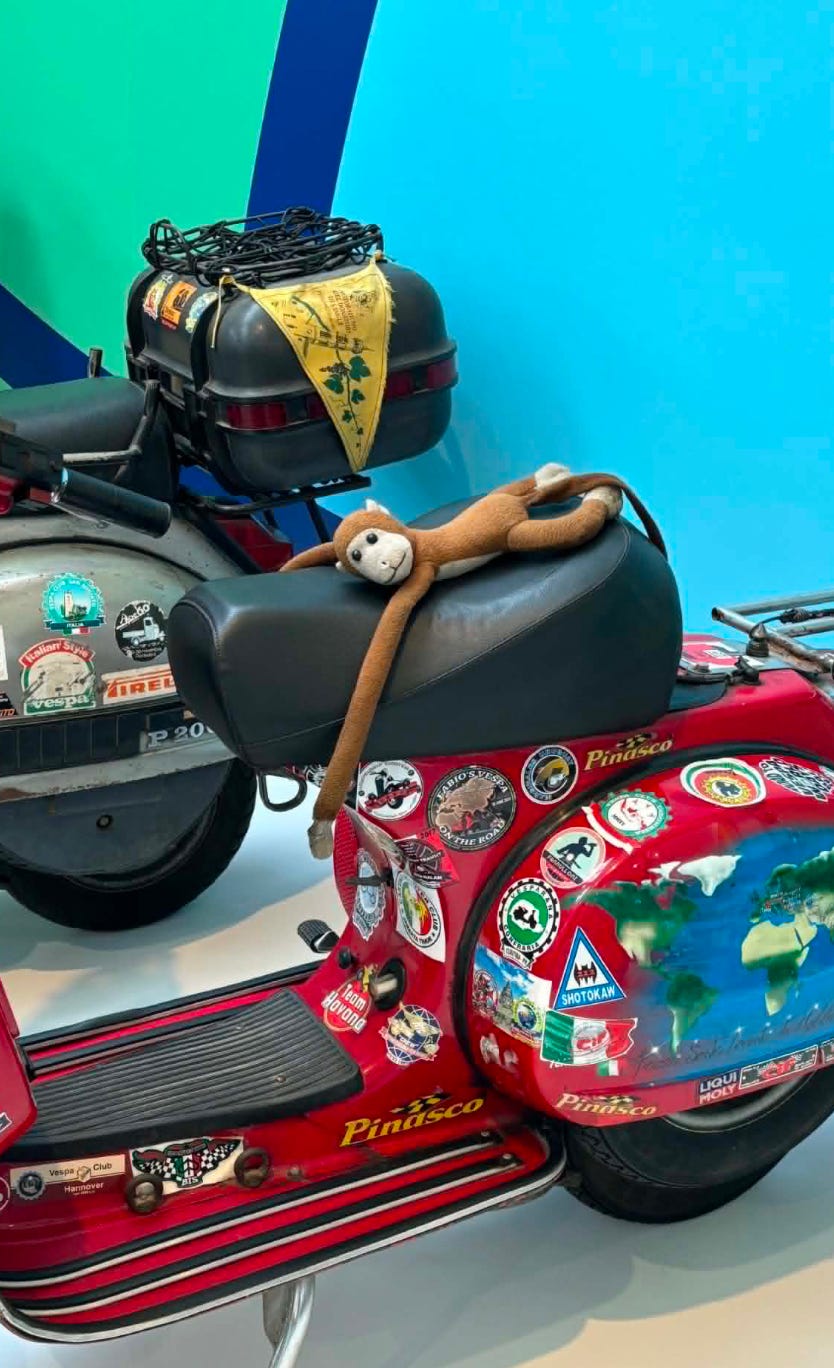
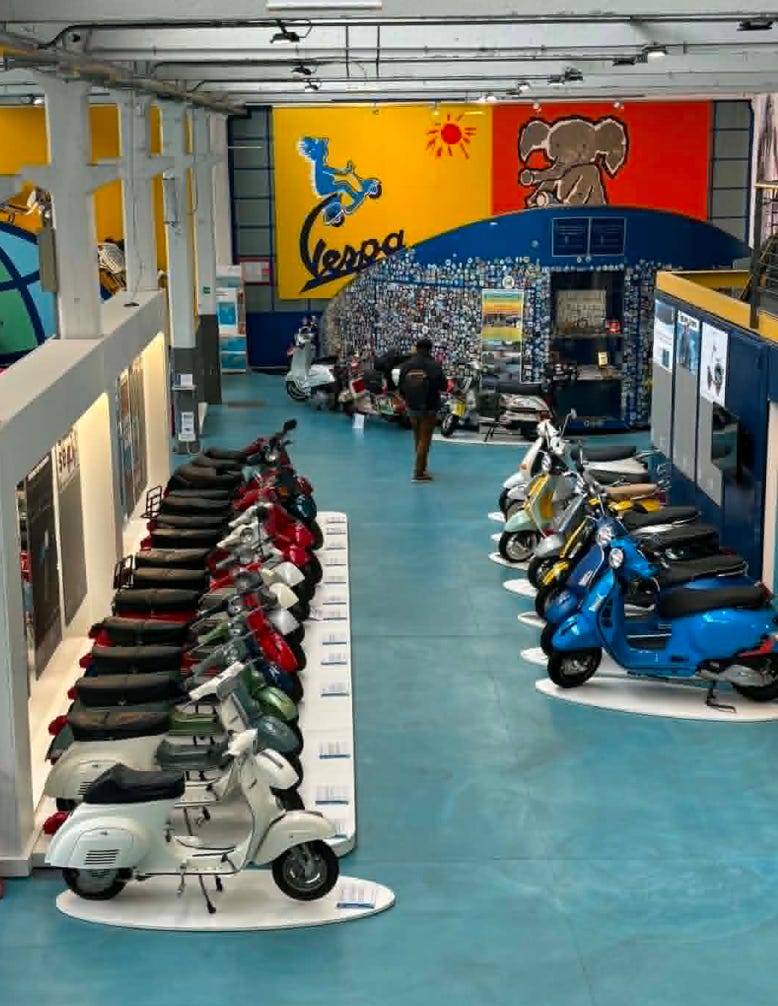
The museum has three rooms, or really three parts. The Vespa room is the famous one. It is the room every visitor walks into first, and, in its own right, it is well done. From the 1944 prototype called the Paperino, the rejected first attempt, to the MP6. From there to the 1946 Vespa 98, the first production model, to the GS 150 of the mid-1950s that is, by quiet agreement among people who think about such things, the most beautiful scooter ever made. The Vespa Siluro, the torpedo, built for speed records, looking like a dragster on two wheels. The Vespa Alpha, amphibious, built to look like a vehicle James Bond would steal in 1965. A hundred small variations of the same wasp shape, each one a small adjustment to a 1946 design that has barely needed changing in eighty years.
The Vespa room is also where the museum stops being about the brand and starts being about the people who did things with the brand, which is the part of it I liked most. One wall has a long display of the world travelers who, over the last eight decades, have ridden a single Vespa around the globe. The photographs are uniformly excellent and uniformly improbable. A man in 1962 who rode his Vespa from Milan to Tokyo with everything he owned strapped to the back of it. A couple in the 1970s who rode two of them from Italy to South America via Africa. A small wall of recent ones, where the Vespa is the same as it was and only the photographers have got better. None of these people were paid by Piaggio. They just decided one morning to do the thing and then they did it.
For the price of a glass of Chianti, unlock the full Anywhere Italy experience. All of our articles, private stories, and access to our chat travel community.
Start your free 7-day trial.
Around the corner is a small, darkened room with a video library of every film and music clip the curators could find featuring a Vespa. Roman Holiday is the famous one, the Audrey Hepburn sequence everyone has seen. Quadrophenia is the other famous one. Around them are forty other clips you would not have known to look for. The Vespa appearing in 1960s French and Brazilian films. The Vespa in 1980s music videos.
The Vespa in animation, the Vespa in commercials shot in countries that never had Vespas until the commercial said they should. You sit on the bench in the dark room for fifteen minutes longer than you meant to. The clip you eventually leave on is the one where someone in a city you have never been to is riding a Vespa down a street you have never seen, doing something the Vespa is now doing in a place the Vespa was not designed for, and the design from 1946 is holding up exactly as well there as it does in Pontedera.
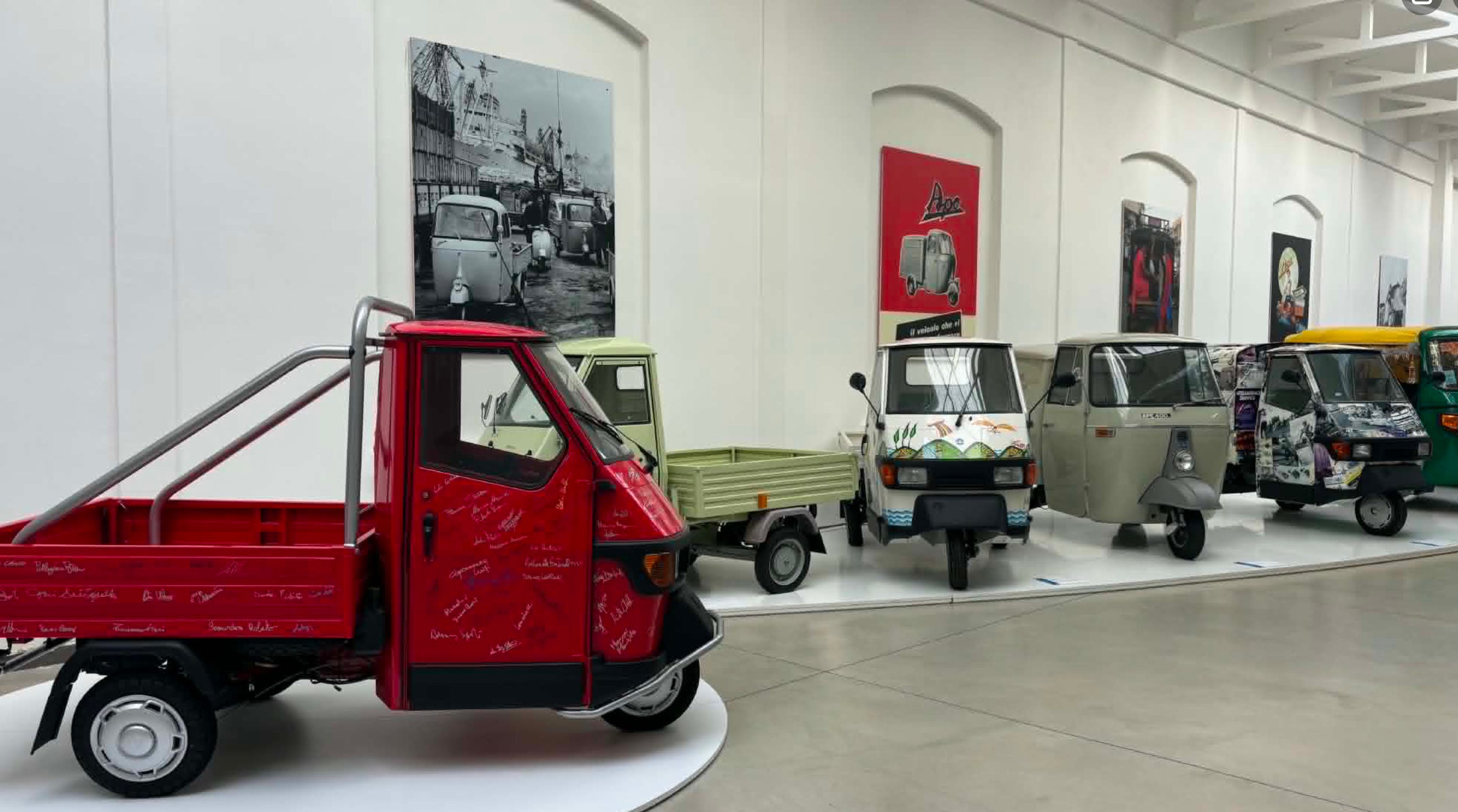
The room I will defend as the actual reason to come here is the Ape room. The Ape is the three-wheeled utility vehicle Piaggio designed in 1948, two years after the Vespa, on the same logic: cheap, small, functional, designed for the narrow streets of an Italian borgo that no normal truck could turn around in. The Italian word ape means bee. Vespa is wasp, Ape is bee. The naming is consistent. The bee carries things. The wasp does not.
The Ape room is full of them, in all of their variations. Open-bed Apes for hauling vegetables to market. Closed-cab Apes for delivery. Apes converted into street-food vans, into mobile flower stalls, into small fire engines, into one I think was a postal van and another that may have been a 1950s ambulance. They are tiny. They have one cylinder. They smell. They go thirty kilometers an hour on a good road. They have made it possible for an entire layer of the Italian economy to function for almost eighty years inside the medieval-street footprint that Italy built itself on top of.
I had been to Japan once, a few years before we got to Pontedera, and the thing that struck me there was the kei car, the small narrow car built specifically for narrow Japanese streets and the high cost of urban land. The kei car is what Japan invented when it needed to move people and goods through cities with no room for normal vehicles. The Ape is what Italy invented for the same reason, twenty years earlier, for streets that were even older and even narrower. The two countries arrived at the same answer from different histories. Same logic, different machines. The Ape room is the room where you understand this without anyone having to explain it to you. You walk past forty small functional three-wheeled vehicles and the argument arrives on its own.
The argument also comes up every time we drive through any village inland from where we live. Apes are not historical objects. Apes are still working. The further you get from the coast and the closer you get to the older Italy, the more Apes you see. A pale-blue Ape pulled over at the side of a road outside Camaiore last spring with two old men sitting on the back step eating sandwiches. A mustard-yellow Ape with a wooden side panel in a borgo in the Lunigiana, loaded with chestnuts in October. A bottle-green Ape full of olive crates outside a mill in the hills above Lucca in November. Apes parked in the side streets of every village in the country, with the engine running and the driver inside the alimentari, picking up something for lunch. We have seen, by my rough count over the last four years, several hundred Apes still in active service in the part of Tuscany where we live. The deeper inland you go and the more medieval the village, the more Apes there are. The Ape was designed for the medieval Italian street, and the medieval Italian street still exists, so the Ape still exists, and the museum room in Pontedera is therefore not a historical exhibition at all. It is the showroom for a vehicle that the rest of the country is still using.
The third room is the one that surprised me most and which I had not expected, because the gap between what Piaggio publicly is and what Piaggio actually owns is wider than a visitor walking past the factory would guess. Piaggio also owns Moto Guzzi, the historic motorcycle manufacturer from the shores of Lake Como, in business since 1921. Piaggio also owns Aprilia, the racing brand that has been winning Superbike titles for thirty years. Piaggio also owns Gilera. The four brands together have, according to the small plaque I read three times to be sure I had the number right, won 104 world titles across the racing disciplines they compete in. The room is a long hall of motorcycles from those collections. Wartime racing bikes from the 1940s. The 1990s Aprilia superbikes from when superbike racing was a working sport rather than the marginal one it has become. The 1970s Moto Guzzi tourers that look, sitting still, like they are going somewhere serious.
I do not, normally, like motorcycles. They feel unsafe to me. I am the kind of person who likes cars more. I left the racing room, considering whether to buy a motorbike in Italy, because the small streets, narrow lanes, and short distances in our part of the country make the case for one stronger than anywhere else I have lived. The thought left me by the next morning. The point is that the room was good enough to put the thought in my head.
Outside the museum, in the courtyard, are two more pieces that visitors walk past and probably ignore. One is a small early-1950s propeller-driven airplane called the Piaggino. The other is a railway locomotive in the colors of the Ferrovie Calabro-Lucane, a small private railway in southern Italy that Piaggio supplied with rolling stock in the 1920s. The two pieces together are the part of the museum that tells you that Piaggio was an aircraft and railway manufacturer for 50 years before becoming a scooter manufacturer, and that the Vespa is the youngest thing in the company’s portfolio. The factory across the courtyard, the one currently making three thousand people work reduced hours, was a bomber factory in the war that came before the war that gave us the Vespa. The history beneath this museum is older, and stranger than the famous room suggests.
The whole museum is two hours if you take it seriously. Free entry. Fifteen minutes from Pisa. On the corridor between Pisa and Florence for anyone driving the road.
