

Ristorante La Posta | The Panigacci Dinner
An accidental Saturday night in Equi Terme

We had not planned to be there. We had planned to go to Da Remo, our usual place down in Monzone, twenty minutes away at the bottom of the valley, where the wild boar stew is dark and slow, and the bread is hot, and the bill embarrasses you. But Da Remo was closed for renovation, or for a death in the family, or for one of the reasons small Italian restaurants close, and we had not driven all the way down from Marciaso for nothing. So Sophia opened the Fork app on her phone and worked through the few options inside fifteen kilometers, and the only place in Equi Terme that came up as bookable for that night was an Albergo Ristorante La Posta, which we had passed a hundred times and never been into, on Via Provinciale, opposite the parking lot where we left the car at seven o’clock on what I think now was a Friday in early November.
The first thing we saw before we got to the door was two men cooking bread over a fire in a small open hut next to the restaurant. They were not what I would call bakers. They had the build and the bearing of men who fix tractors or quarry marble for a living, two big bodies in dark jackets, hands like gloves, working a contraption that looked like a stack of small terracotta plates being fed into and pulled out of a fire pit, with what looked like dough being slipped between the discs. The whole apparatus seemed enormously complicated for what came out of it: a flat, round of bread, slightly charred, slightly puffed, the size of a small pizza. The two men noticed us watching, smiled, waved, and kept working. We waved back and walked into the restaurant. I said to Sophia, whatever they’re making, that’s a lot of effort.
Inside La Posta, our first conversation was about convincing the staff that the online reservation does count as a reservation, even though they had not heard about it, like ever, and kindly asked, "Why didn’t we just call?” But I got used to this by now. We work online, and when we explain to Italians that we do, they shout out, "Ah, smart working," like it means anything, and treat it as some sort of magical thing to do.
The woman at the door looked at us with frank confusion. She was about sixty, in a blue cardigan, holding a clipboard with names handwritten on it. She turned to a younger man behind her and said something I did not catch, and he came over and looked at us with the same expression. She said, non importa, it does not matter how we booked, and led us to a table at the side of the room. The room was filling up. There were balloons in one corner, gold and white, and a long table being set for what I gathered later was an eighteenth birthday. We sat down.
The young man came back with menus and asked, panigacci?
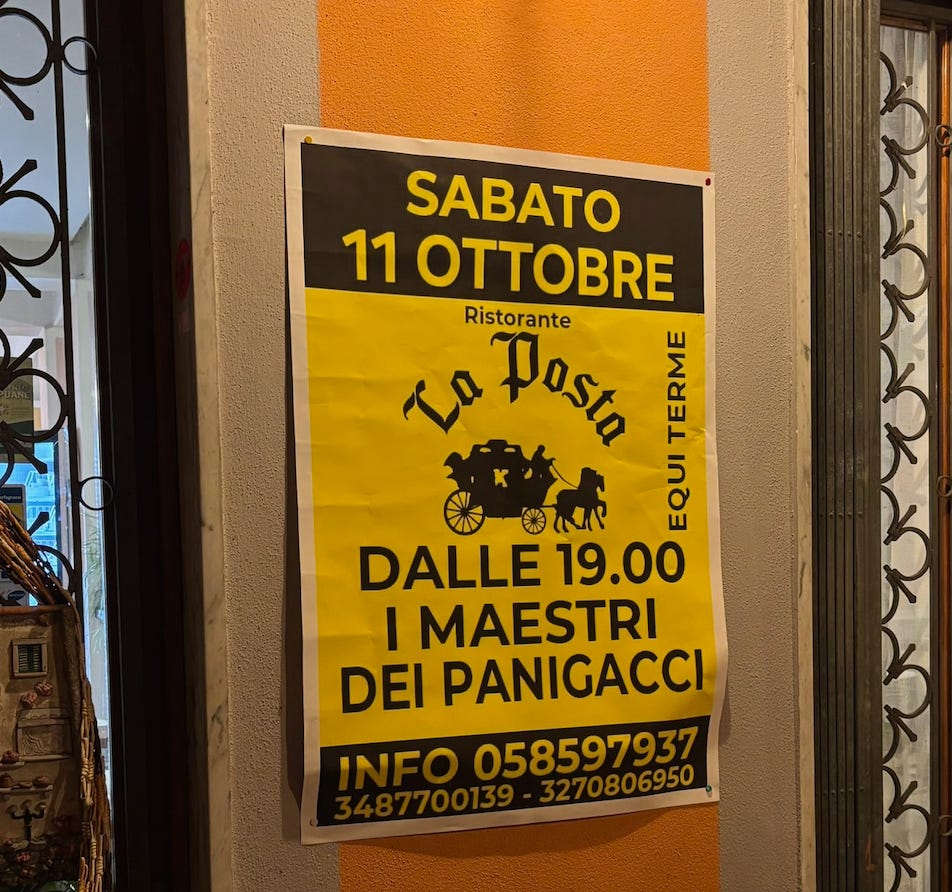
We did not know what panigacci was. The sign by the front door, I now realized, read masters of panigacci, which I had glanced at on the way in and not registered. The two men outside, with their fire and their plates, were making the panigacci. The whole restaurant, I now realized, looking around at the long table and the balloons and the locals starting to come through the door, was here for one thing tonight, and one thing only, and the question was whether we were also here for that thing.
We did what any sane person would do on a day that was not planned at all: we said yes. Of course, we were. Who wouldn’t? We had come specifically for the panigacci. Si certo, panigacci.
The young man nodded, satisfied, and left.
I have eaten at many small Italian restaurants in remote parts of Italy, and I have learned the rule about timing. The rule is that the restaurant opens at seven because that is the hour the law and the sign on the door require, but the kitchen does not actually serve food until eight, and serious eating does not begin until eight-thirty, and the room does not fill until nine. We had arrived at seven because we are foreigners, and at seven we sat alone in a room of empty tables with a basket of plain bread, a bottle of red, and an hour of silence ahead of us. We drank slowly. We had not eaten since breakfast. We watched two more women come in to set the long birthday table, smoothing the cloth, laying out fistfuls of cutlery. The synth player, whom we did not yet know was a synth player, came in carrying a black case and disappeared into a back room. The light outside turned blue, then went dark. We were getting, I noticed, slightly drunk on an empty stomach.
At eight, exactly at eight, the room came alive. The door began to open and to close every fifteen seconds. The locals arrived in pairs, in groups of four, in extended families. They were the faces of these mountains. Men in their sixties in collared shirts and corduroy jackets. Women with their hair done specifically for the evening. A few younger couples. The eighteen-year-old himself arrived with a small entourage and was applauded by a few tables that knew him. The kitchen door swung. The waiters multiplied. Two of them came out carrying the first stacks of panigacci, fresh from the fire outside, in towers of fifteen or twenty, wrapped briefly in cloth napkins to hold the heat, and the room turned its head as one. This, the body language of the room said, was The Day. Saturday in November in Equi Terme. The panigacci dinner. The week’s main event.
For the price of a glass of Chianti, unlock the full Anywhere Italy experience. All of our articles, private stories, and access to our chat travel community.
Start your free 7-day trial.
The panigacci itself I want to describe carefully, because it was different from anything I have eaten in Italy or anywhere else, and because its simplicity was so total that it bordered on confrontation.
It is not focaccia. It is not bread. It is not piadina. It is not the Ligurian farinata of chickpea flour. It is not the Tuscan cecina. It is, technically, just flour and water and salt, mixed thin into a batter and poured between two hot terracotta discs called testi, which are stacked up over a fire and rotated through the heat in turn, and the batter cooks in seconds between the two clay surfaces and comes out as a flat round about twenty centimeters across, slightly thicker than a tortilla and slightly thinner than a focaccia, the color of pale toast on the outside and white-soft on the inside, with the faint mottled pattern of the testi pressed into both faces. It tastes of itself, mostly. There is smoke from the fire. There is a slight crispness to the surface. There is a softness in the middle that wants to absorb whatever you put on it.
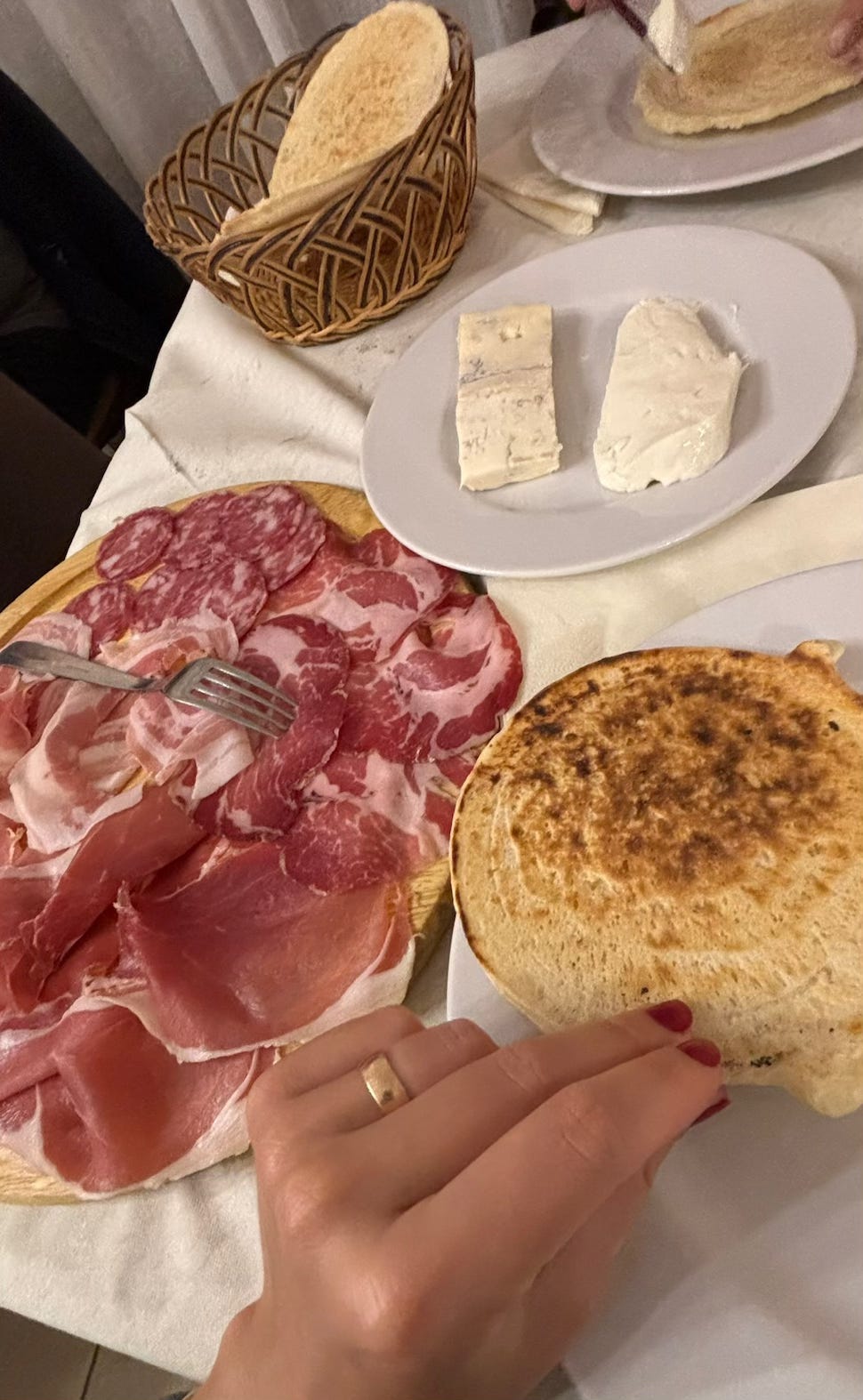
The first round came with a wooden board the size of a tea tray loaded with cured meats and cheeses. There was a soft, spreadable cheese, the consistency of clotted cream, that the locals called crescenza, but which I think was a kind of stracchino, a young cow ’s-milk cheese still wet, slightly sour. There was prosciutto crudo sliced so thin you could see the table through it. There was a hard salami studded with peppercorns and fennel. There was a softer salame that was almost a paté. There was a wedge of pecorino. The waiter put the board down and said, si fa così, and demonstrated. You take a panigaccio. You put a slice of cheese on it, or a smear of the soft one, or a couple of folds of meat, or both. You roll it. You eat it with your hands. You move on.
We did. We ate the entire board with the entire stack of panigacci, 10 of them between the two of us, in a way that we would not normally eat at a restaurant. Around us, every other table was doing the same thing. The eighteenth birthday table had three boards going at once, and the kid was being toasted in glasses of red wine that he was trying to pace himself through. Two of the older men in corduroy jackets were holding court at a center table, telling some story that had an ending the rest of the table already seemed to know.
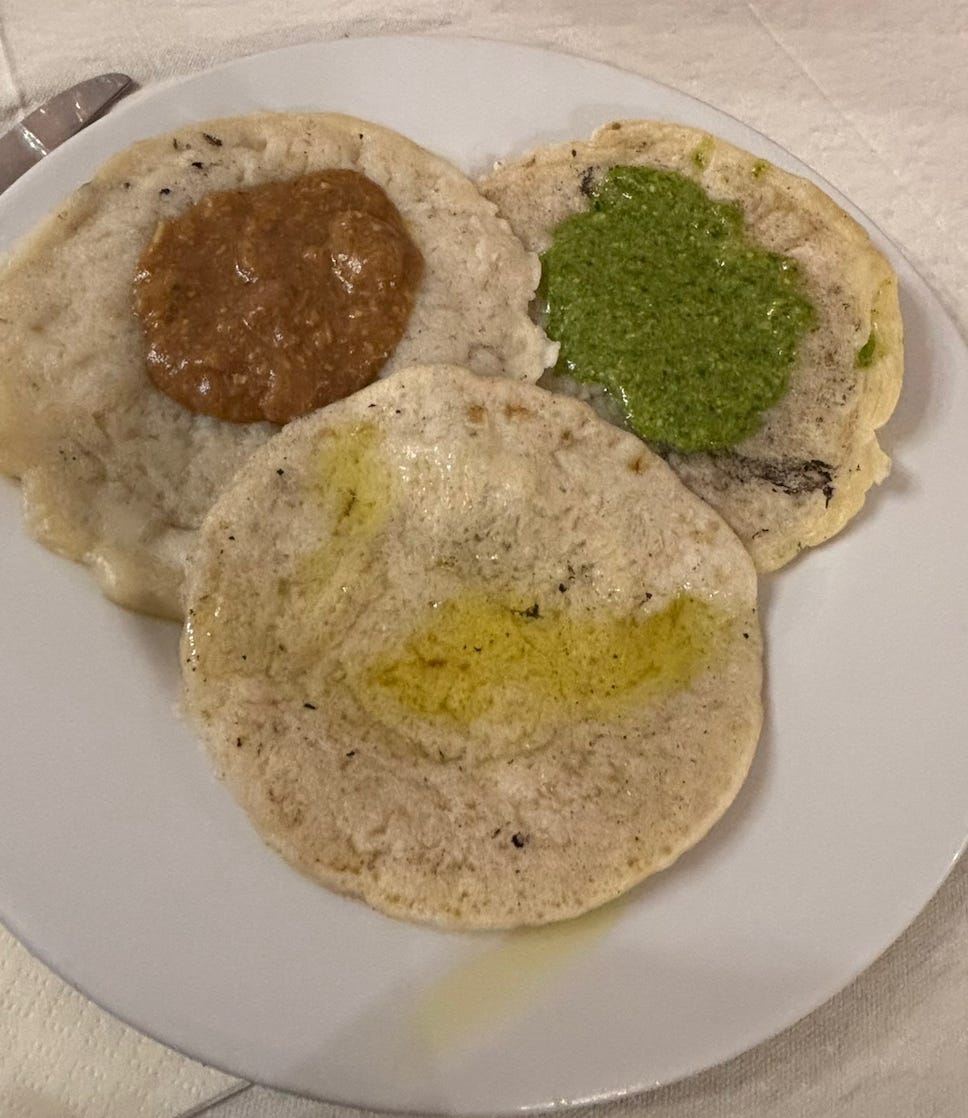
The second round came as we were starting to slow down. Fresh stack of panigacci, hotter than the first. New board: this time with a rich meat ragu, a bowl of pesto, and some oil. Same idea. You take a panigaccio. You spoon something onto it. You eat it. The ragu was sweeter and lighter than the Bolognese I had grown up making at home, less tomato-bright, the pieces of meat more obvious, slightly sweet from a long reduction. The pesto was rougher than the smooth Genovese kind I had eaten on the Ligurian coast — coarser, more garlicky, with an oil that had a peppery finish. We ate slower this time, because we were getting full, but we also did not stop eating, because the waiter kept circling and we kept saying yes.
The third round was sweet. By this point, I was laughing because of the structure of the meal, which was now openly absurd. Same panigacci again, fresh again, hot again, but now spread with chestnut cream the color of dark honey, or with Nutella for those who wanted it, or with both, and you ate them open-faced like a child eats a slice of toast. The chestnut cream tasted of the woods and the autumn, and the entire region we were sitting in the middle of. The Nutella tasted of being seven years old. We ate three of them.
It was past ten o’clock. We had thought we would be home in Pietrasanta by ten. We were nowhere near home. We were warm and full and slightly drunk, and the locals around us were just hitting their stride, and the synth player, whose name I would never know, came out of the back room and unpacked his keyboard and his microphone in the corner of the dining room. Two waiters started moving tables. The dance floor was about to be created out of the room we had just been eating in, the chairs pushed back against the wall, the floor cleared, the synth setting up his speakers, and as we paid the bill and stood up to leave the first chord came out of the speaker, a slightly compressed minor-key Italian pop song from the 1980s with a drum machine and a synthesizer string section, and the older couple at the table next to us stood up and walked into the cleared space and started, slowly, to dance. Mountain ballroom. The Friday night that the rest of the village knew was coming, and we had walked into it without knowing.
We did not stay. We were tired, and we had a forty-minute drive on dark roads to make, and we are not, anyway, a couple who dances at strangers’ restaurants. But we stood at the door for a long minute and watched. The room had been a restaurant, was now a dance hall, and was about to be a wedding party that was not a wedding. The eighteen-year-old boy, looking slightly heroic at this point, was being pulled onto the dance floor by his grandmother. The two men who had made the panigacci had come in from the cold and were sitting at the bar with beers, watching the dancing the way men who have been working all night watch other people enjoy what they have made.
In the car, neither of us could stop talking about it. We talked about it the whole way down. We talked about the bread, the cheeses, the spreadable one, the chestnut cream. We talked about the men outside with their fire. We talked about the synth player. We talked about the eighteen-year-old being toasted by his grandmother. We had not heard the word panigacci before that evening. We have not forgotten it since.
