
Road to Siena | The Long Way Is the Better Way
Two roads to the same city, the case against sleeping in Florence, and the one time I tell you to take the crowded road.

The traffic we wanted was going the other way. Around seven most evenings, the road back toward Florence filled with the day’s rental cars heading down out of the hills, and we drove up against the current of them, into the town where we were sleeping, past the people who had spent their afternoon where we were spending our week. They had it backward, and almost everyone does. The hill towns between Pisa and Siena are not day trips you take out of Florence. Florence is the thing you give up the best hours of these towns to go back and sleep in.
So the first decision on this road is made before you drive any of it, and it is the only one that matters: do not base yourself in Florence. Base yourself in one of the towns, inside the old walls, or in a farm stay out in the hills between them, and run the trip from there.
The practical reason is that everything here sits about an hour from everything else, so staying in the middle of it saves you the daily commute down to the city and back. The real reason is the one I wrote about in San Gimignano and will only point out here: these towns belong to the buses until about seven, and then the buses leave, and the town comes back to the people who live in it. Sleep down in Florence, and you arrive everywhere at the worst hour and leave before the good one. Sleep up in the hills, and the good hour is the one outside your window.
One thing this road is not, before anyone arrives expecting it. This is not the silent Tuscany of the calendar, the single cypress lane, and the one farmhouse alone on a golden hill with nothing around it for miles. That country is real, but it is south of Siena, dropping toward Lazio, and it is a different drive for a different day. It’s called Val d’Orcia, and it is what everyone thinks of when they think about “Tuscan countryside.” This road trip is about two lanes from Florence to Siena. The road from the west, the Val d’Elsa, follows the Elsa river valley, and the other is the road from the north to the south, the Chianti region. Almost everyone takes the Chianti option. And this time, probably the only time I would tell you this, the popular version is the good choice.
Up here, it is hills stacked close, vineyards and market towns and traffic, fields worked hard, the occasional shed and warehouse. Handsome, busy, lived-in. If you came for the empty dream, keep driving south. If you came to see the part of Tuscany that actually works, you are in the right hills.
And it has always worked. Drive these roads with half an eye on the land, and you are looking at old money, the oldest in Italy. This was the heart of Etruscan country, the people who were here before Rome was anything, before the Greeks set up shop down the coast, and it is no accident they planted their center in exactly this ground: rivers that water the fields without drowning them every spring the way the Po does up north, hills high enough to defend a town on and low enough to farm, fertile soil between an indefensible flat north and a poor mountain south. The crown for the richest region has moved on to the factories around Milan and Torino and to Rome, being Rome, but the deep wealth is still here in the hills and the towns, and you can read it from the car. I will make the full argument elsewhere. On this drive, it is just the thing you see out the windshield, town after prosperous town, a region that has been rich since before the word Italy existed.
There are two ways in, and they meet near the end. Come from the west, off the highway past Pisa, and you climb through the working country to Volterra and San Gimignano. Come down from Florence, and you drop through Chianti, the wine hills, by way of Castellina. Both roads run into Monteriggioni, and from Monteriggioni, it is a short last stretch to Siena. You do not have to choose one. The towns are close enough that you can take one road in and the other out and see all of it in the same few days.
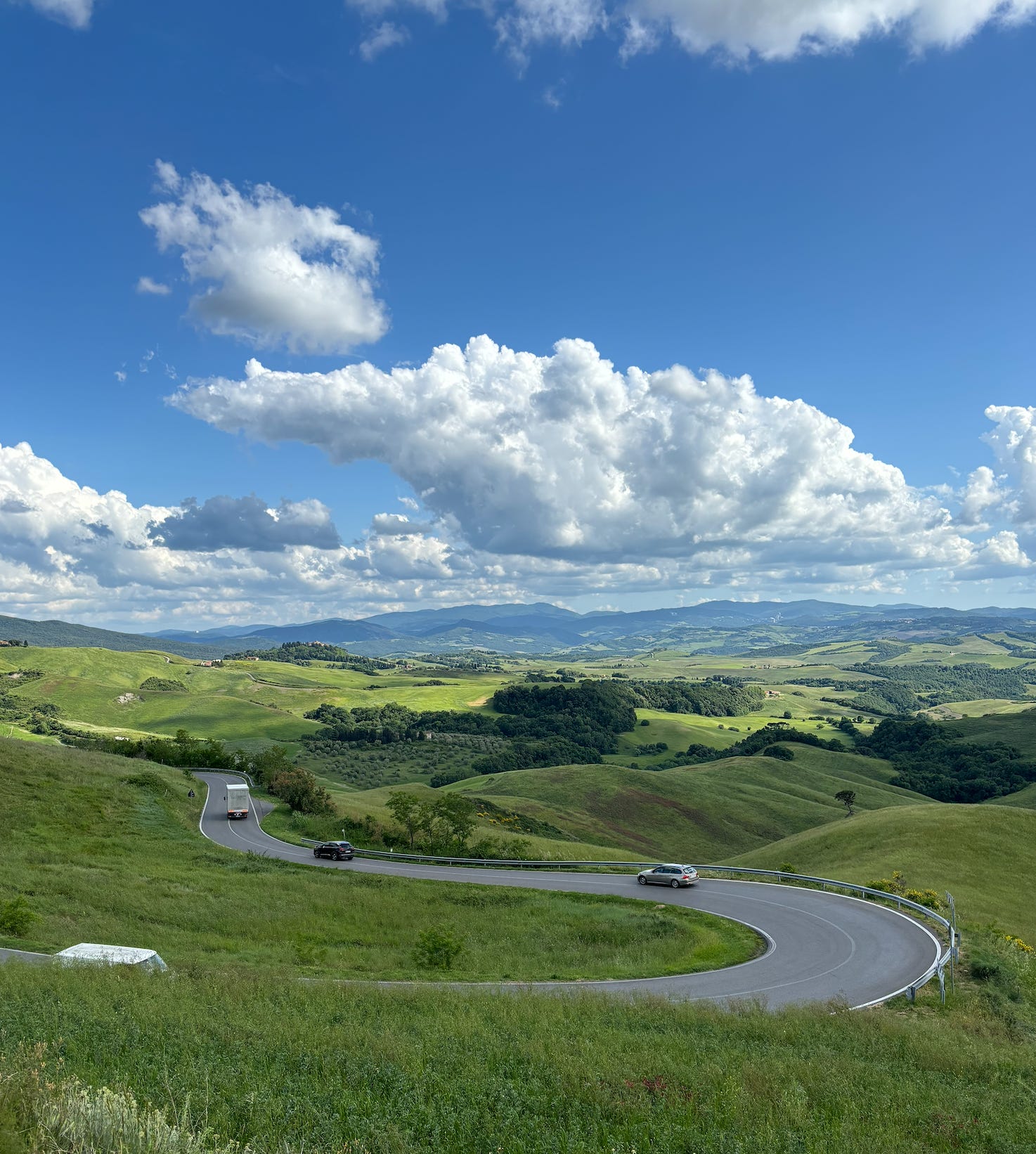
From the west, the first of the famous ones is Volterra, and if you only see a single hill town in your life, this is the efficient choice, which is both its strength and the reason it left me a little cold. Volterra is the Platonic version of the thing, the town everyone has in their head when they say Tuscan hill town: bigger than the others, fully walled, the walls mostly intact, set up on a high point with parking right against the old center and a main road that gets you there without an hour of switchbacks. It is the easiest of these towns to reach and the most crowded once you do, more packed on the day we went than anywhere else on the trip. What it gives you that the others cannot is the view. From the walls, the country falls away for what feels like the whole region, ridge behind ridge, nearly to Siena, the best long look in Tuscany. And the hill it stands on is slowly losing its grip, the western edge crumbling off in pale clay cliffs that have been eating the town’s outskirts for centuries, so the place is built tight to the last safe stone, every inch of the peak used, the ground itself quietly slipping from under it. People also come because the vampire novel Twilight set its ancient clan here, which is a small joke on everyone, since the film adaptation of the book was shot in Montepulciano rather than in Volterra at all. The town wears the fame anyway.
For the price of a glass of Chianti, unlock the full Anywhere Italy experience. All of our articles, private stories, and access to our chat travel community.
Start your free 7-day trial.
Then San Gimignano, and here I will keep it short, because it has its own full piece. You see it long before you reach it, the towers standing up off the hill like nothing else around, a skyline you have already met on a hundred covers. What the covers do not tell you is that the towers were paid for by a flower and a wine, saffron and a white called Vernaccia, in a region that grows red, and that the whole perfect medieval picture survives only because the town went broke after the plague and stayed too poor to ever modernize. The rest, the towers up close, the evening, the part where the place comes back to life after the buses go, is in the other piece. Read it before you sleep there.
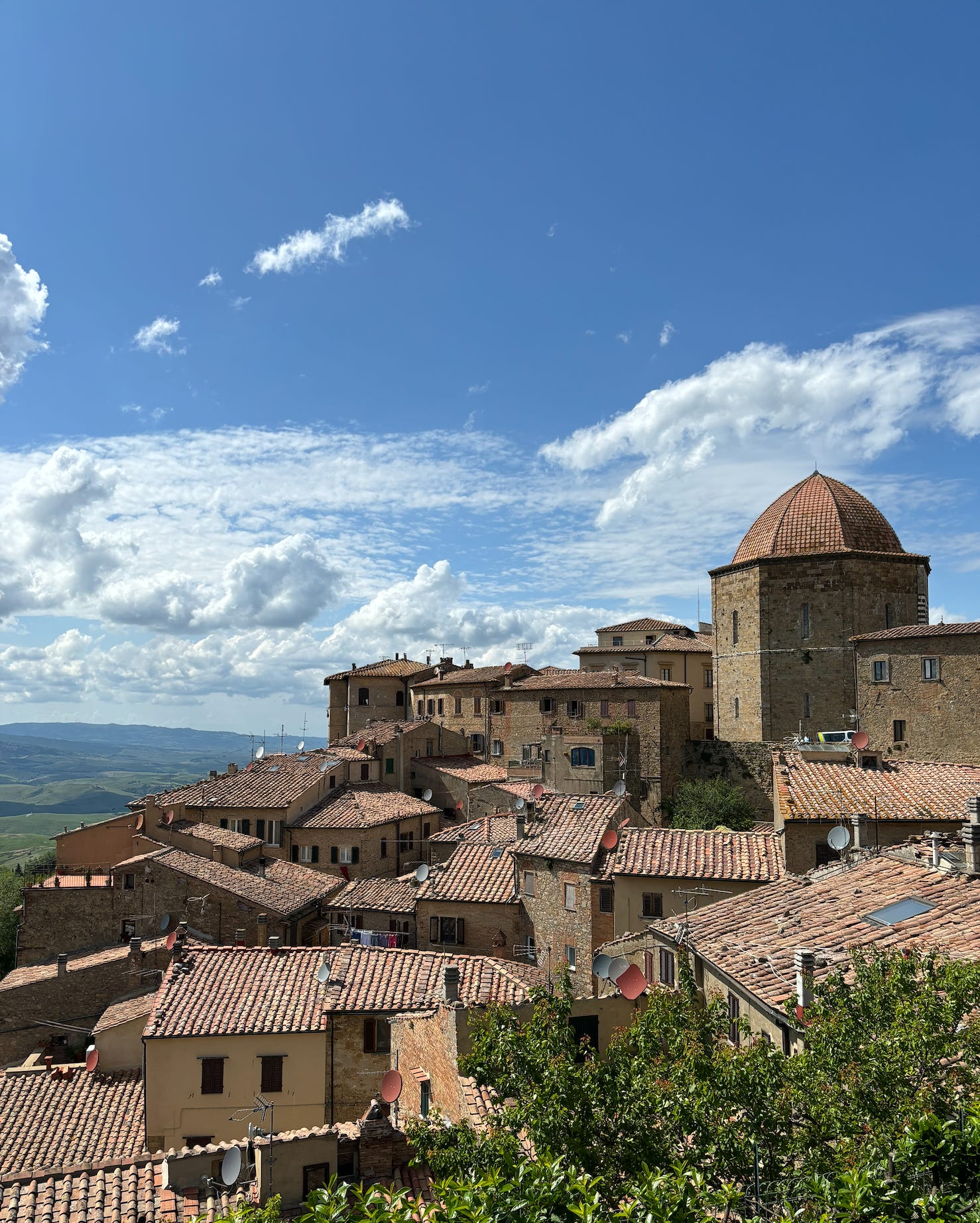
The other way in, down from Florence, is the one most people take, and for once, I am going to tell you to do what most people do. The Chianti road is the best drive. Where the western approach through the Val d’Elsa shows you Tuscany at work, the industrial sheds and the packing yards and the flat hard-farmed fields where it seems half of what the region grows gets boxed and shipped, the Chianti hills are the easy rolling wine country you had in mind before you ever came, vineyard after vineyard, the road bending through it past Castellina with no warehouse in sight. It is busier precisely because it is nicer, and I would still send you that way.
The wine is the whole economy of these hills, every village with its own, the region’s name stamped on the most famous red in Italy. Tuscan food runs to cured and roasted meat, so the wine ran red to meet it, lighter than you expect, almost fruity, easy, made to sit beside a steak and not to be lectured about. Here is the only wine knowledge you need on this road: it is all good. We are not wine people. We never did a tasting on any of these trips, and one of our favorite everyday reds is a ten-euro Chianti off the shelf at Esselunga, the supermarket, which I am told ships to America at several times the price and tastes exactly as good here for the cost of a sandwich. An Italian will gladly spend an hour choosing which bottle belongs with which plate, and that hour is a real pleasure if wine is your hobby. If it is not, the thing nobody selling you a tour wants you to know is that you can skip the whole apparatus and drink the cheap local red, because down here, the cheap local red is already better than fine. We are not Italians. We order the house red, and we are happy.
Both roads end up at Monteriggioni, and I had wanted to come here for years before I did. I am not a person who plays video games, not at twenty and less now in my forties, but a few times in my life, one has taken me all the way under, and one of those was a single game played mostly because it was the only one that ran on my Mac, and I had nothing else. It was Assassin’s Creed, especially the one where you control Ezio Auditore, the hero of the game. It’s an open-world game where you can move freely on maps, and it involves a lot of cultural and historical references. In this part of the game, you move through Renaissance Italy on foot (or riding a horse), and the place the character keeps returning to, above all, is a small walled town on a Tuscan hill called Monteriggioni. It’s the hometown of the main character. It took me two years of living in Tuscany to admit that this was reason enough to go, and then one afternoon, on this road, we went.
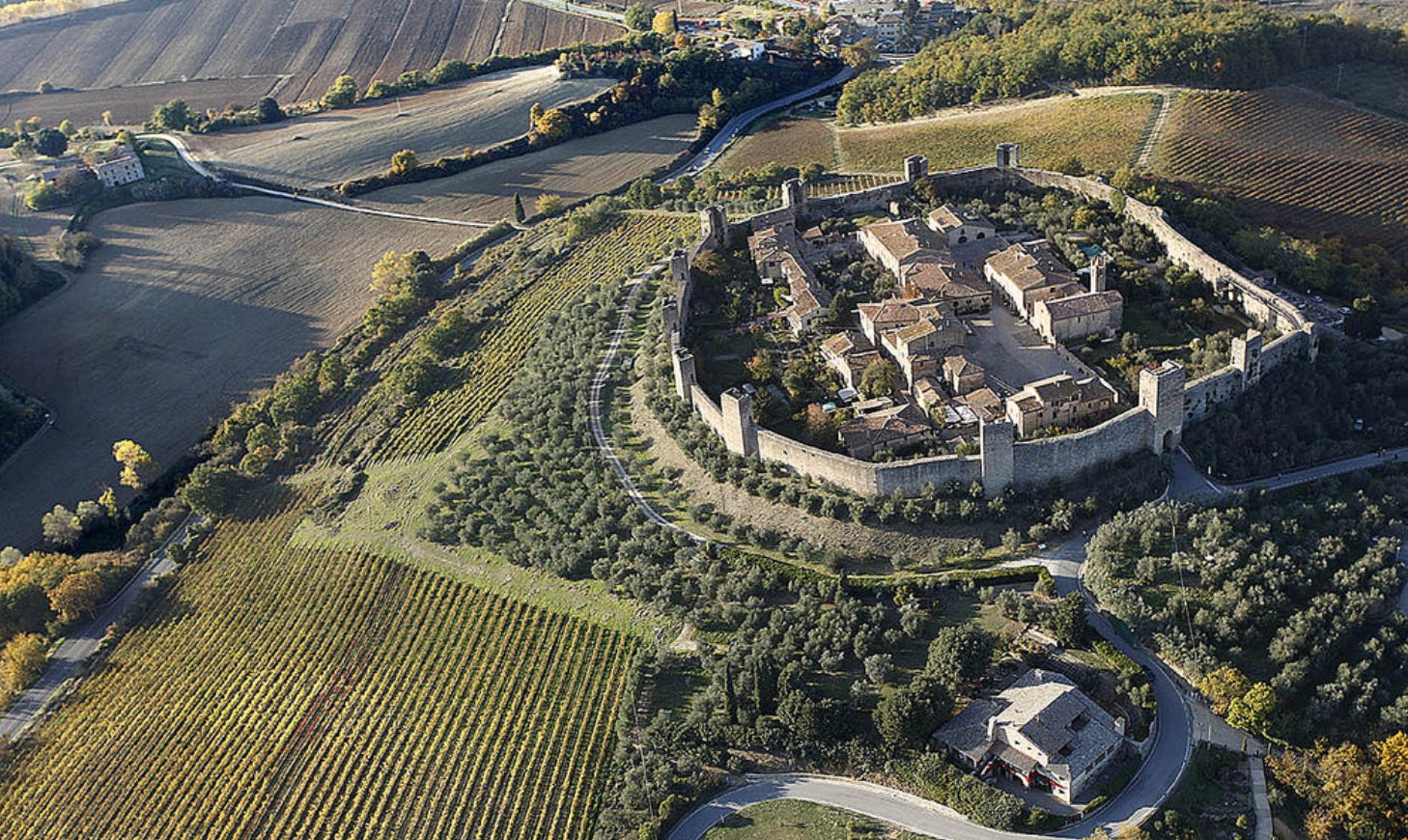
There is something specific about arriving in a place you have already walked without your body. The walls came up over the vines the way they had come up a hundred times on a screen, a low stone crown on a low green hill, and I knew their shape before we parked. Seven centuries ahead of me, Dante came along this same road and saw the same thing, and in the Inferno, he turned those towers into giants sunk to the waist around the pit of hell, standing guard over the dark. That is the strange fact of Monteriggioni. It has always been more image than place. People have been arriving here with a picture of it already in their heads since before Italy was a word, and I was only the latest, bringing mine in from a video game instead of a poem.
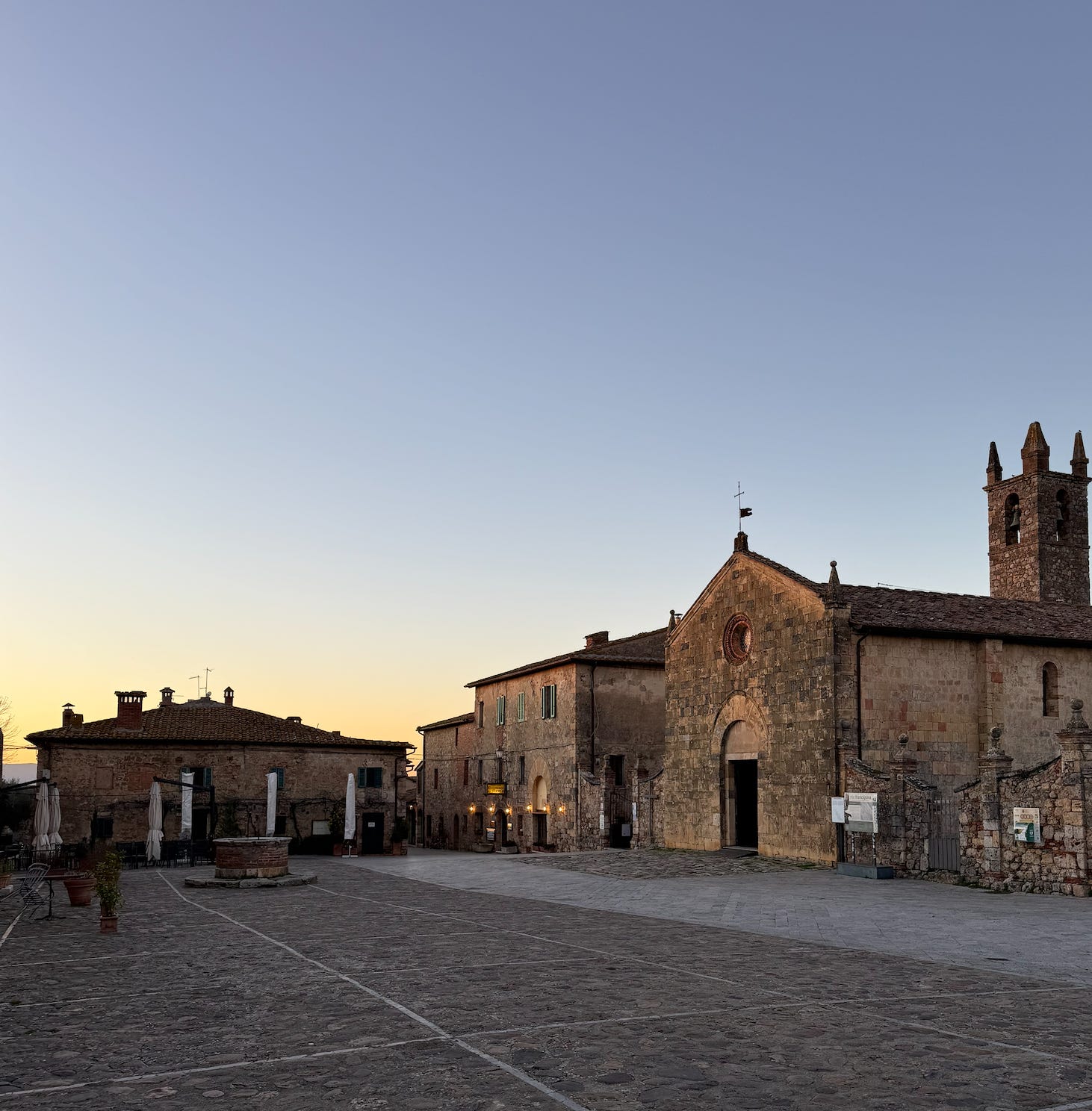
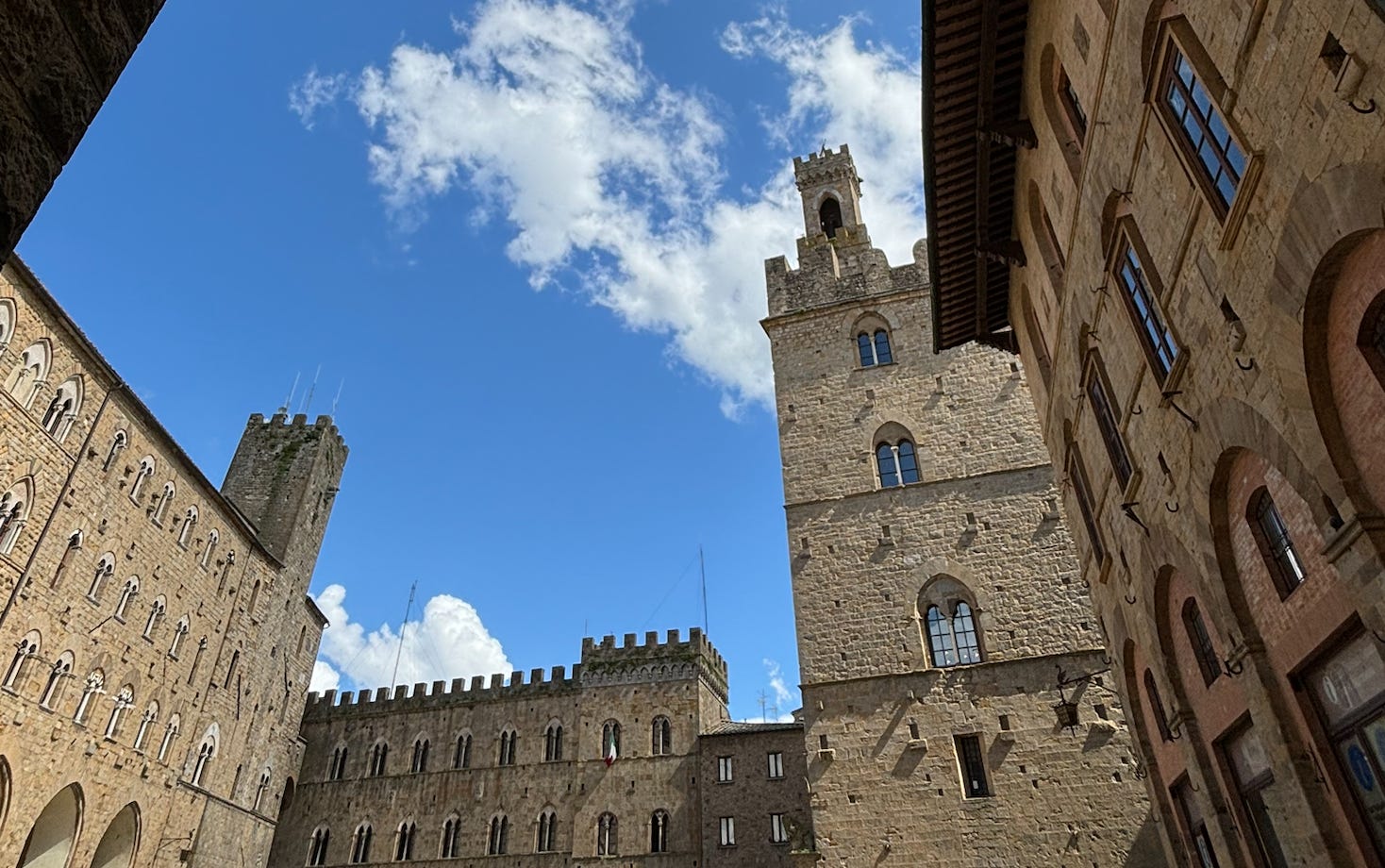
This is also the town to point to when someone asks what a borgo is, because the word does not translate, and Monteriggioni is the cleanest example of what it means. It comes down from an old root for a fortified place, a walled spot you could run inside when the valley turned dangerous, and that is the whole of it: a few streets and a church and a well, wrapped in a wall built so people could shut a gate. Most borghi across Italy are half empty now, the houses turned into holiday rentals or left to no one, and there are travelers who collect them, who plan whole trips around how many they can reach. Monteriggioni is the easy one. It sits beside the main road, it is in better repair than almost any of them, and you are inside the walls a minute after leaving the car. Three streets, maybe four, one small square with a church and a well and a couple of places to eat. You can climb a stretch of the wall, but the hill is too low for the kind of view Volterra hands you, so the better move is to stay down in the streets and let it be small.
We came up in the late afternoon, off-season, the end of May, close to the only people there. The light went long and gold across the stone and then began to leave. We ate at Da Remo, which has earned its own telling another time, the kind of room with nothing to prove and the cooking to prove it anyway. By the time we walked back out through the gate, the gold was gon,e and the walls had gone grey above us, lit low, the towers black against what was left of the sky, the giants still at their watch over a town that empties every night and has been a picture in someone’s head for as long as anyone has driven down this road.
From there it is barely twenty minutes to Siena, the city all of these roads were laid to reach, and the one that keeps its own piece, so I will leave you where the road leaves you: dropping off the last hill at dusk, the brick of the town going red and then a darker red as the sun quits, the whole place rising up ahead behind its walls with the towers lit, the great rival that fought Florence and lost and never quite forgave it, waiting at the end of whichever road you took to get here.


Planning a slow trip? My planner builds it for you. Free, no paywall, no email gate. Answer five questions (hub town, interests, travel month, days you want for slow discovery, and fitness level, because some of these towns make you climb), and you get a personalized route from my handpicked list of the 1,000 towns most travelers skip, with festivals, drive times, and a line on what each place is. Don’t like it? Refine it, swap towns, or browse the whole database by region.