
San Gimignano | The Town After Seven
Inside the walls of the most photographed hill town in Tuscany, and the hour after the buses leave.

We came off the highway, and the road went bad in the good way, narrowing and bending back on itself the way Tuscan roads do this all the time. It’s like the siesta break right at 2 pm, when everything suddenly stops. San Gimignano sat on its hill the whole time we climbed toward it, a cluster of stone towers standing up out of the green like nothing else around it had thought to. The towers are the reason it is on every list. They are also the reason we had booked three nights instead of three hours. By the time we visited this place, we had been living in Italy for years and had learned the tricks for avoiding the “follow me” hordes of selfie sticks.
We had lived in Florence once, for a stretch of months years back, and in Versilia for years after that, and somewhere in all that residency, it had become almost a joke between us how little of Tuscany everyone else flies in for, we had actually seen. The cypresses, the wine hills, the towns on the postcard. We did the Chianti and the Val d’Orcia on a drive and loved it. Then we had gone to Montepulciano once, and Montepulciano nearly ended the whole region for us. I still remember what I said to Sophie: “Never again will I go to a theme park like this, like ever again. It’s like a Disneyland Tuscany version, which symbolizes everything that is wrong with the world.” So, I can tell you that we were quite unsure about our trip to mainland Tuscany…
I can’t help myself, so let me tell you quickly about Montepulciano. I will say what that afternoon was, because travel writing usually won’t. The town had been hollowed out and refilled with something wearing its face. The shops sold Bolognese pasta, which is not a Tuscan dish and barely an Italian one in the form they meant (spaghetti, seriously?), alongside non-Tuscan leather and souvenirs made on another continent. The streets were full of organized groups moving in the shape their guide’s umbrella made, trucker caps and lanyards, and in an hour of walking we did not hear a word of Italian or pass a single person who seemed to be there for the place rather than for the photograph of having been. We left early and made a promise in the car: not this Tuscany again, or if we had to, then off-season, or with a plan, or some way of getting underneath it.
May, this year, with the rain finished and the summer not yet arrived, was the plan. But again, we were very, very, and I mean very skeptical and fully prepared to just leave the next day and drive home.
The plan is not complicated, and it is the only thing that actually works. It can be replicated by anyone. By then, we had watched enough Italian tourism to set our watches by it. The buses come between ten and noon, depending on whether the town is the first stop or the third on that day’s circuit through organized hell, and they are gone by six or seven. In a place like Pisa, you can beat this with geography, because the crowd comes for one object and leaves, and you can spend a whole day across the river and meet almost no one. A hill town gives you nowhere to stand outside the thing they came to see, because the thing they came to see is the town. The only door left is time. So we did what we tell other people to do, and almost no one does, which is sleep there, at least a night (we did three), and let the town be yours for the hours it is no one’s. Book a room inside the walls if you do this. The walks are shorter and the morning is closer. All the annoying things that we call mass tourism mostly hit pause after 6-7 pm. They return to their theme park routes, usually back to Florence.
For the price of a glass of Chianti, unlock the full Anywhere Italy experience. All of our articles, private stories, and access to our chat travel community.
Start your free 7-day trial.
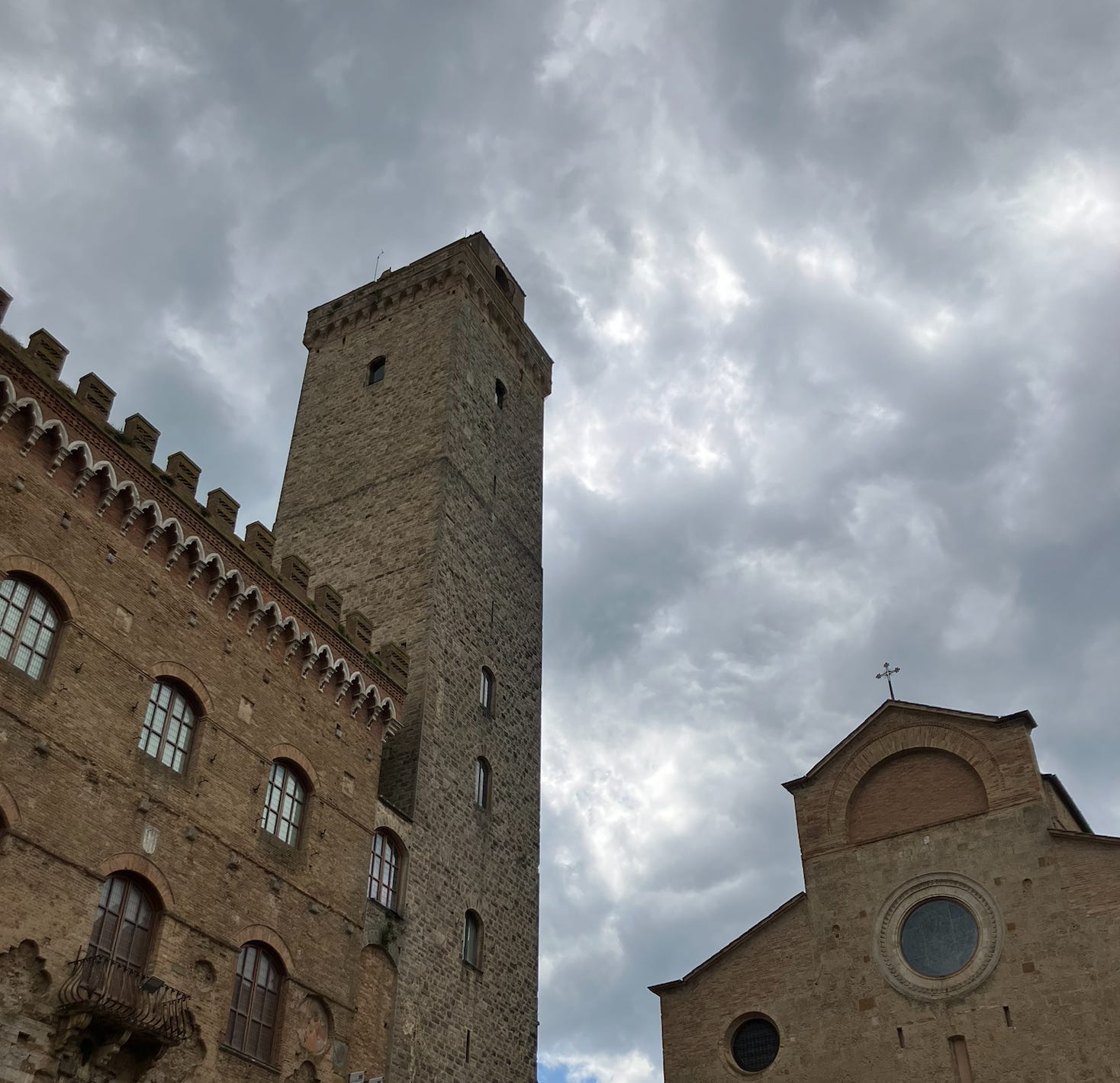
We arrived in the afternoon, into the second half of the day’s crowd. Off-season meant it was groups and guides rather than a flood, but the shops were open and doing their worst, the same garbage souvenirs, the same pasta no one local would eat, and we walked through it the way you walk through a thing you have decided not to let ruin your evening. The towers stood over all of it, indifferent, which is their whole talent.
There were seventy-two of them once, one source says, each one a family announcing how much it was worth, taller and taller as the merchants got richer on two things: saffron, harvested by hand and traded as far as the eastern Mediterranean, worth its weight against gold, and a white wine called Vernaccia, which matters more than it sounds because this corner of Tuscany is red-wine country and a serious white here is its own small rebellion. Both are still sold in the town. The saffron is mostly a tourist attraction now. The Vernaccia they still grow and still mean. The towers were the medieval version of building the tallest thing on the block to prove you could, the same instinct that gave Bologna its leaning pair and gave Florence a skyline it later tore down to put up grander palaces, and the only reason San Gimignano kept its towers while Florence lost its own is the saddest reason available.
The plague came in 1348 and killed something close to two out of every three people in the town. The survivors handed the place to Florence, and the town went to sleep and stayed poor for centuries, too poor to knock the towers down and build anything fashionable in their place. So the towers fell on their own, slowly, when they fell at all, and the rest just stood there because no one could afford to replace them. The skyline everyone photographs is what a town looks like when it dies and cannot afford a funeral. It shines now because shining is the business.
Then it turned seven, and the thing we had paid for three nights happened.
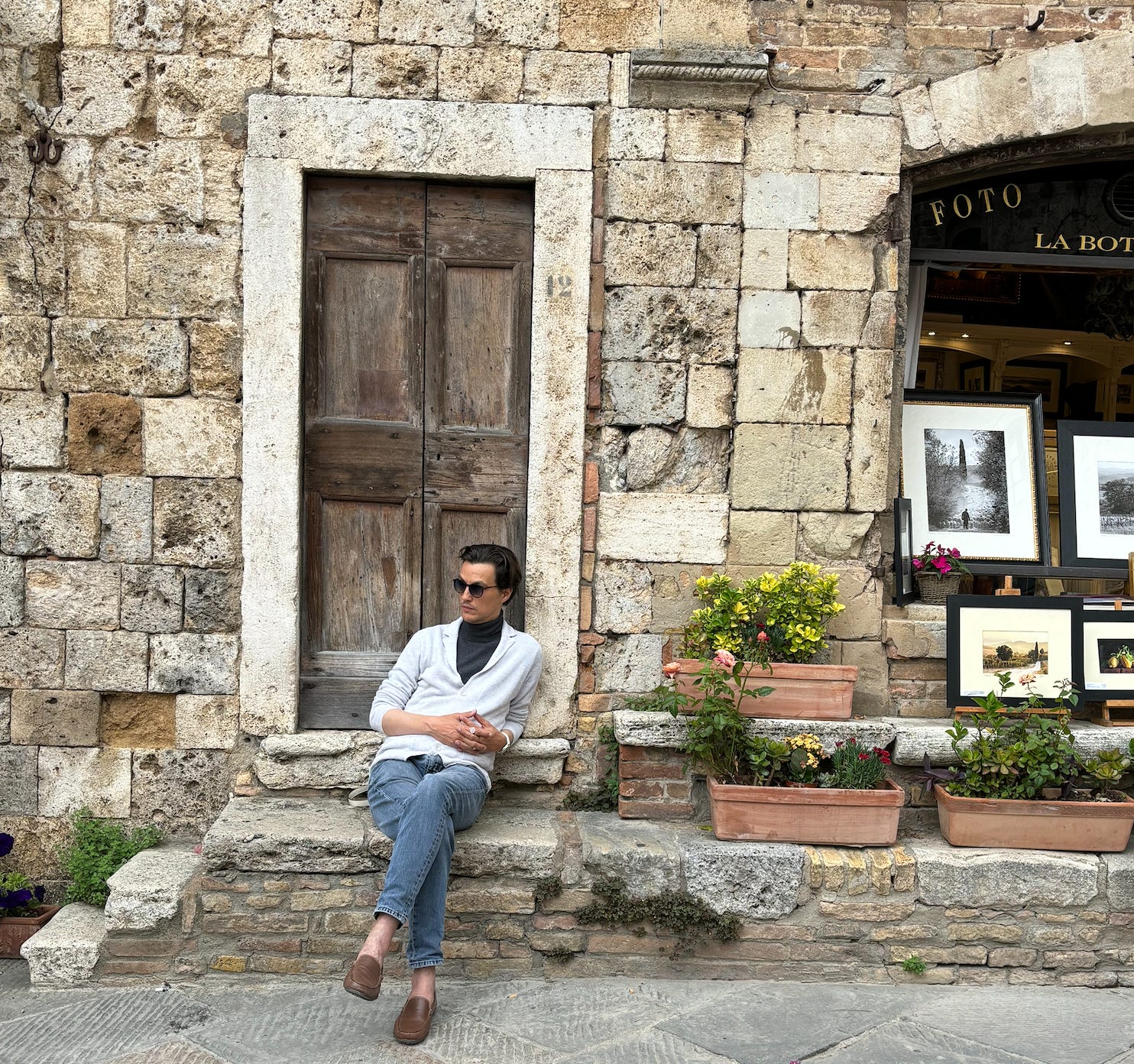
The buses were gone. The guided shapes dissolved. The town went quiet the way a beach goes quiet when the tide finally pulls back, and out of the doorways came the people who had been waiting it out, the way you come out of the cellar after the sirens stop. Locals on the stone, an old couple, a dog, somebody’s grandmother carrying bread. The restaurants that had stayed shut through the lunch rush opened their doors. And here is the part that should be taught in schools: the menus changed. The places that had been selling bolognese to people who didn’t know better either closed for the day or quietly became somewhere else, somewhere with the food the town actually eats, because the audience for the fake had left on the bus and the only people still inside the walls were the ones who lived there and the few of us who had refused to go. Nobody sells you a lie at seven thirty in San Gimignano. There is no one left to sell it to.
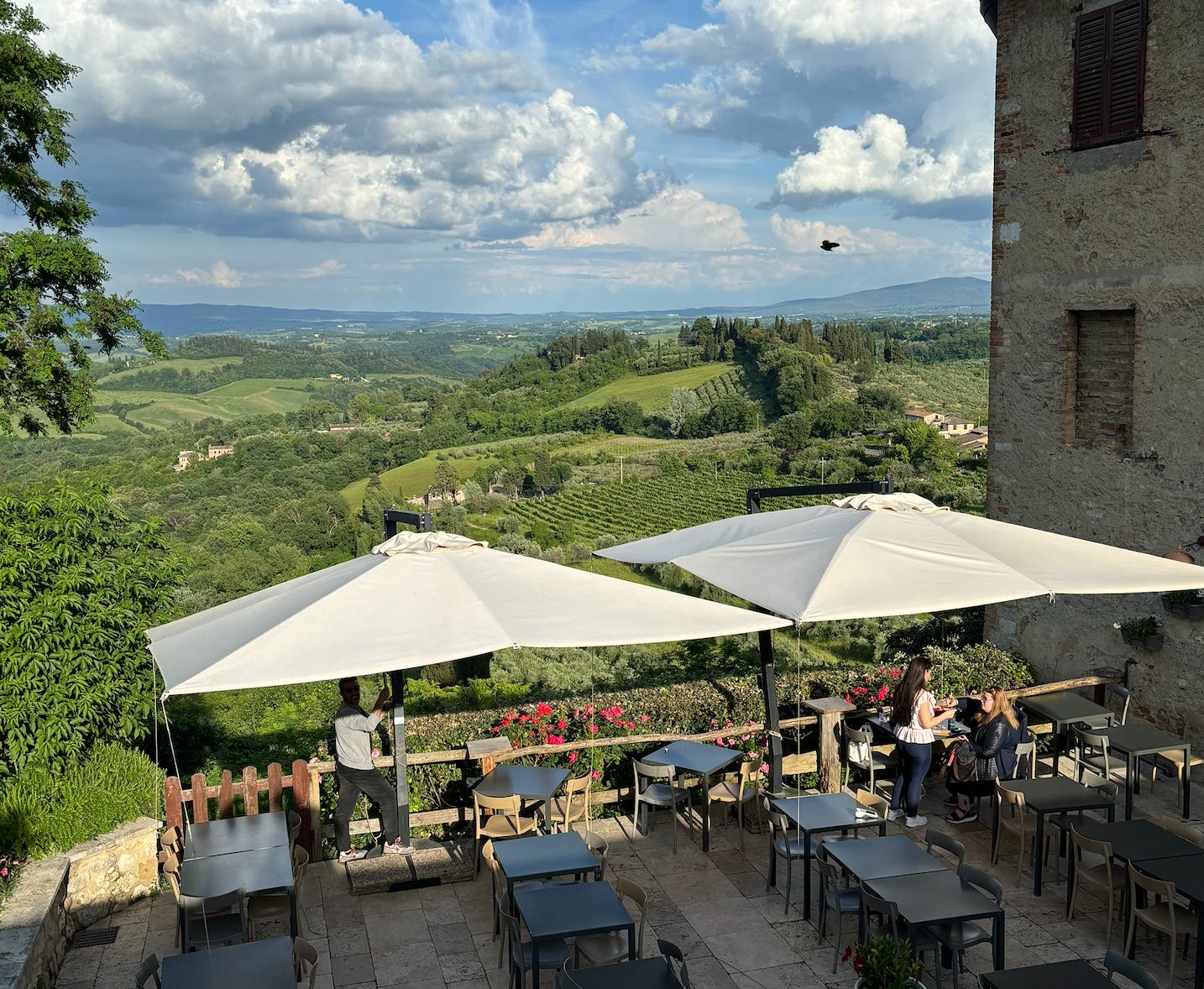
What the day-trippers never learn, because they are on the road back to Florence by then, is that they leave at exactly the hour the town becomes worth the trip. The light comes in low and gold and lies itself along the stone, and the towers throw shadows the length of the square, and Piazza della Cisterna empties of everyone who was holding a phone at arm’s length and fills instead with the kind of evening you came to Tuscany hoping existed and had started to suspect was extinct. We found a place I cannot name now because I never wrote it down, on the far edge where the buildings stop, and one whole side of it was open to the country, the Val d’Elsa rolling out flat and green under a sun going down behind the hills. We ate with that in front of us, the day’s heat coming off the stones, and not a tour group within a kilometer, and it was the meal the whole trip had been arguing for.
Afterward, we walked home. The town had gone grey by then, the gold used up, the streets lit low and uneven, the towers black against a sky still holding the last of the light. Our room was three minutes away inside the same walls, which is the only real luxury this town offers and the cheapest, and we took the long way to it anyway, through squares we’d had to share with four hundred people that afternoon and now had entirely to ourselves. A town like this belongs to whoever is standing in it at night. For three nights, that was us.


Planning a slow trip? My planner builds it for you. Free, no paywall, no email gate. Answer five questions (hub town, interests, travel month, days you want for slow discovery, and fitness level, because some of these towns make you climb), and you get a personalized route from my handpicked list of the 1,000 towns most travelers skip, with festivals, drive times, and a line on what each place is. Don’t like it? Refine it, swap towns, or browse the whole database by region.