
Siena | What you are really here for
The city that built the Renaissance, lost the war, and was preserved by losing.

We came to Siena for a single day, and we came knowing too much. I rarely tell readers this, because it has almost no bearing on whether a place is worth your time, but here it matters: I studied history at university for four years, two obsessions running side by side, one of them the Japan of the Tokugawa shoguns, which has no business in this piece, and the other one this, the medieval and Renaissance Italy that most people drive through on their way to lunch. I don’t really riff on history here, but this is an exception. Siena is the one city where I am going to let it drive, because Siena is a city that history built and then walked away from, and you cannot stand in it and understand what you are seeing without the part that hurts. Without the historical background, Siena is just a pretty Tuscan city with an amazing main square and a horse race once a year (the Palio).
The other thing I will admit is that we arrived wanting it badly, and wanting a place badly is the surest way to be let down by it. High expectations are the enemy of travel. You build a city in your head, and the real one can only disappoint. Siena is the rare place that takes everything you bring to it, the years of expectation, the photographs, the overbuilt hopes, and quietly hands them all back to you intact. It delivers. I do not say that about many places, and I am saying it about one of the most famous cities in Italy, which should tell you something.
Also, and this is the last generic comment on the city, promise, but if you are interested in Tuscany and Renaissance, it’s not Florence, Chianti, Val d’Orcia, or any other towns that you want. It’s Siena that you want. It’s Siena that you are really here for. Spend as much time in this city as you can.
Here is the part the photographs do not carry. When the world thinks of the Renaissance, it thinks of Florence, and the world is not wrong, exactly, because the art that survived and the names everyone knows are mostly Florentine. But ask why, and the answer is less flattering than the museums let on. Florence had the money, and Florence won the wars. The Medici waged a long campaign to swallow Tuscany, town by town, while financing the most beautiful art in human history. Those two facts are the same fact.
All philanthropy is public relations laid over something uglier.
Think of the men whose names sit on American museums and concert halls, the Rockefellers, the Gettys, fortunes built on things you would not want described at dinner, remembered now for the buildings they paid for. The Medici were the original version of the move. Pisa fell to them. Arezzo fell. Siena fell. Only Lucca slipped the noose, and it did so the modern way, by writing a check, buying its freedom, and keeping it, which is its own story I have told elsewhere.
Before Florence was the banking capital of the known world, the bench belonged to Siena. The word itself comes from the bench, the banco, where the money changers sat, and in the twelfth century, the Sienese ran some of the largest banking houses in Europe, moving the money of popes and kings while Florence was still finding its feet. Florence built grander banks later, and most of them blew up, the great houses going bankrupt in cascades that took down kings with them. Siena’s endured. The oldest bank still operating anywhere on earth is here, Monte dei Paschi, founded in 1472 and open every day since, older than every nation that has tried to lecture Italy about finance. There is a lesson buried in that, and it is the lesson of the whole city: Florence burned bright, changed, and broke, and Siena learned instead how to last by not moving.
The same is true of the painting, which is the part that should make any honest visitor to the Uffizi uneasy. Duccio, Simone Martini, the brothers Lorenzetti, and the Sienese school were the equal of anything Florence produced, and in some respects came first. In the Palazzo Pubblico, on the wall of the room where the city’s government actually met, Ambrogio Lorenzetti painted the Allegory of Good and Bad Government in the thirteen-thirties, a vast picture about how to run a city and what happens when you run it badly, with the first real cityscape in the history of European art folded inside it, streets and shops and people working, painted from life a century before anyone agrees the Renaissance started. The painter died later, exactly when the golden age of Siena had ended.
For the price of a glass of Chianti, unlock the full Anywhere Italy experience. All of our articles, private stories, and access to our chat travel community.
Start your free 7-day trial.
That year (1348) is the hinge of everything you see. The Black Death took something close to three out of every five people in the city, and it stopped Siena mid-stride. They had been building a cathedral meant to be the largest in all of Christendom, a deliberate humiliation aimed at Florence, and the plague killed the men building it and the money paying them, and they never finished. The wall they had raised for the nave, never roofed, still stands at the edge of the cathedral, a giant blank face of marble open to the sky, the most honest monument in Tuscany, a building famous for the part that was never built. Then, two centuries later, the second blow. Siena was the last free republic in Tuscany, and in the war that ended in 1555, the Medici starved it out, a siege so total that three thousand Sienese women raised their own militia to defend the walls, and when the city fell by hunger, the republic was finished, and Cosimo Medici took it. Florence won and went on building over itself, century stacked on century, Renaissance atop medieval, never still.
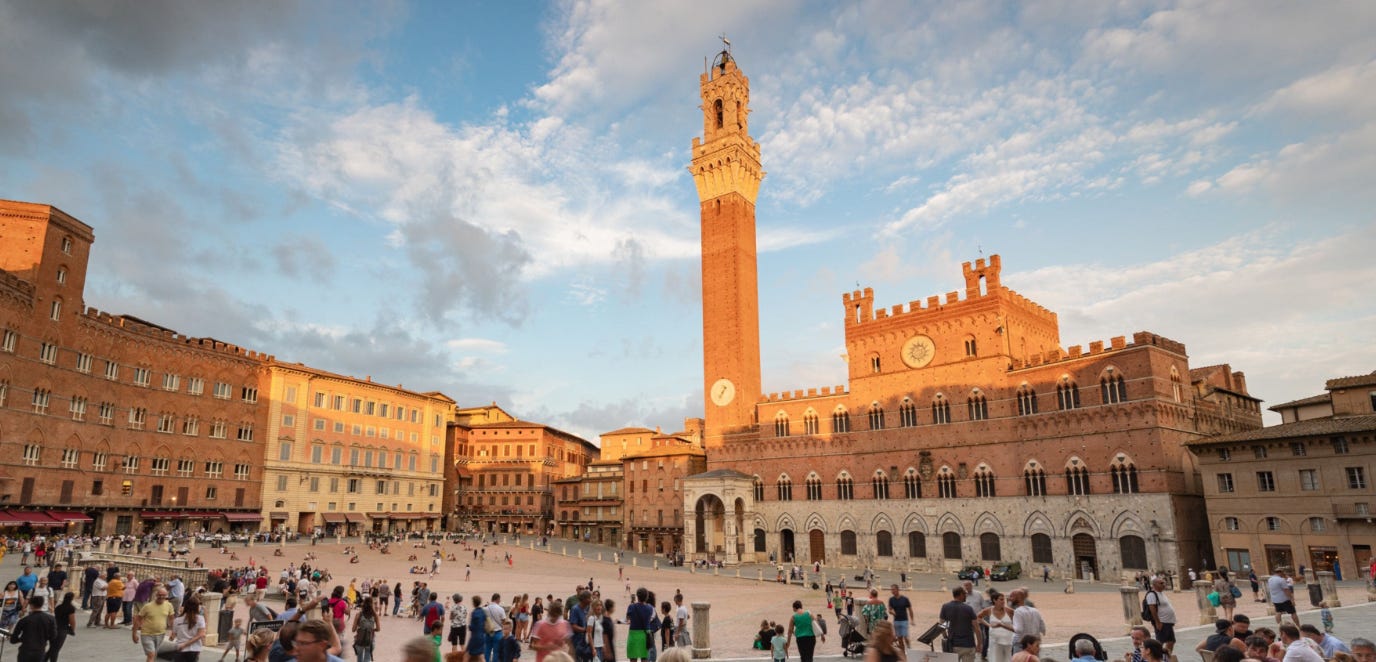
Siena lost and stopped. And that is the secret the whole place is keeping: it is the most intact medieval city in Italy (and in the world) because it is the city that lost. It is a sentence that the plague and the war cut off in the middle, and it has been waiting in that unfinished state for five hundred years.
Which brings me to what visitors get wrong: the easy, lazy reading that the Palio and the contrade are just costumes put on for the crowds. They are not. The city is carved into seventeen contrade, neighborhood tribes with their own colors, their own churches, their own fountains, and a Sienese is born into one, baptized into it, carries it throughout his life, and is buried in its colors. Walk any street away from the Campo, and you read the borders in the stone, the ceramic plaques on the corners that tell you whose ground you are standing on, the painted symbols, the long banners hung from the upper windows. The horse race that the buses come to photograph twice a summer is the visible tip of a structure that runs beneath the surface every day of the year, rooted in the militia companies that once defended those same walls. The tourist sees a medieval festival. The resident sees the only thing that has never stopped mattering. To call it decoration is to look at a living body and see a painting. All in all, I have said this many times: Italian culture is highly regional. People’s identity is built around cities. In Siena, it’s literally street by street.
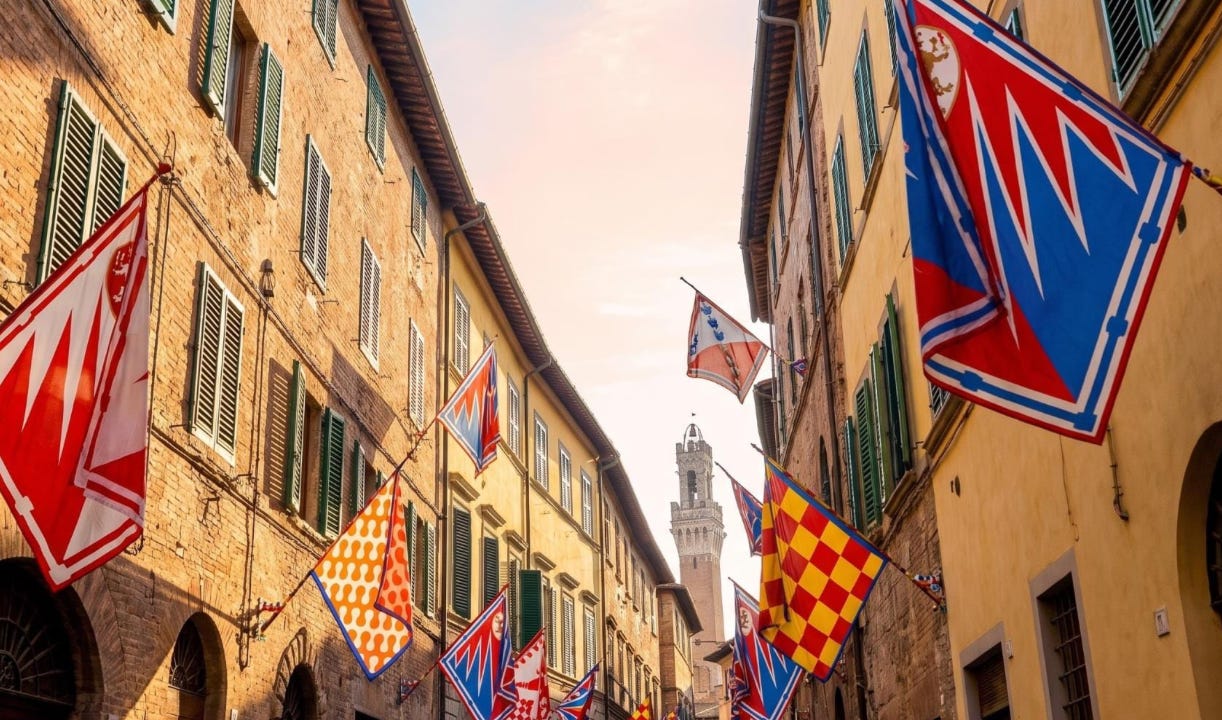
So here is the experiment I want to leave you with, and it is the only instruction in this whole piece. Stand somewhere in Siena at the end of the day. Take away the cars, the cash machines set into the medieval walls, the television antennas, the shop signs, the lit screens in the windows. Take away the modern century, layer by layer, and what is left underneath has not changed by a single stone in five hundred years.
We did this for real, not in imagination, because we stayed until the light went and the day visitors climbed back onto their buses and drained out of the gates, and the city did the thing it does every night, which is travel backward. The streets emptied of everyone who did not belong to them. The lamps came up small and yellow along the contrada walls. The Campo went from a place full of people holding phones to a great dark shell of brick with the tower black above it, and for an hour, walking back through streets that held no one, it was not 2025. It was 1450, and we were the anachronism, two people moving through a city that had quietly closed over the wound of the modern world and gone back to being itself.
I will say the disloyal thing plainly, since the whole point of this publication is to send you past the famous places to the ones nobody photographs. Siena is famous, and Siena earns it. It belongs in the company of Venice and Florence and Rome, and of those four, it is the one most fully itself, because it is the one that lost, and stopped, and was saved by stopping. Go knowing everything. Want it badly. It will not let you down. Just be there when the buses leave, and watch the centuries come back. It’s like traveling in time.
PS: In all of our posts, we use photographs that we took. We sometimes use others', mainly drone photography, which we don’t have, and there we credit them properly. During our visit to Siena, it was raining, and most of the photos we took were horrible. So we used stock photos from Adobe in this post. Sorry!


Planning a slow trip? My planner builds it for you. Free, no paywall, no email gate. Answer five questions (hub town, interests, travel month, days you want for slow discovery, and fitness level, because some of these towns make you climb), and you get a personalized route from my handpicked list of the 1,000 towns most travelers skip, with festivals, drive times, and a line on what each place is. Don’t like it? Refine it, swap towns, or browse the whole database by region.