
The ingredients of a perfect Italian city
Sunday Espresso XIII.

On a more personal note, I’ve spent my last week in Turin. I am moving here and was looking for an apartment. Now, the buying process, or more like the experience with real estate agencies in general, is a whole other story, and I will write it up as more like a manual for those who are also looking to buy their property here. But for now, I wanted to talk about Turin. Or not even about Turin, but about the ingredients of a perfect Italian city.
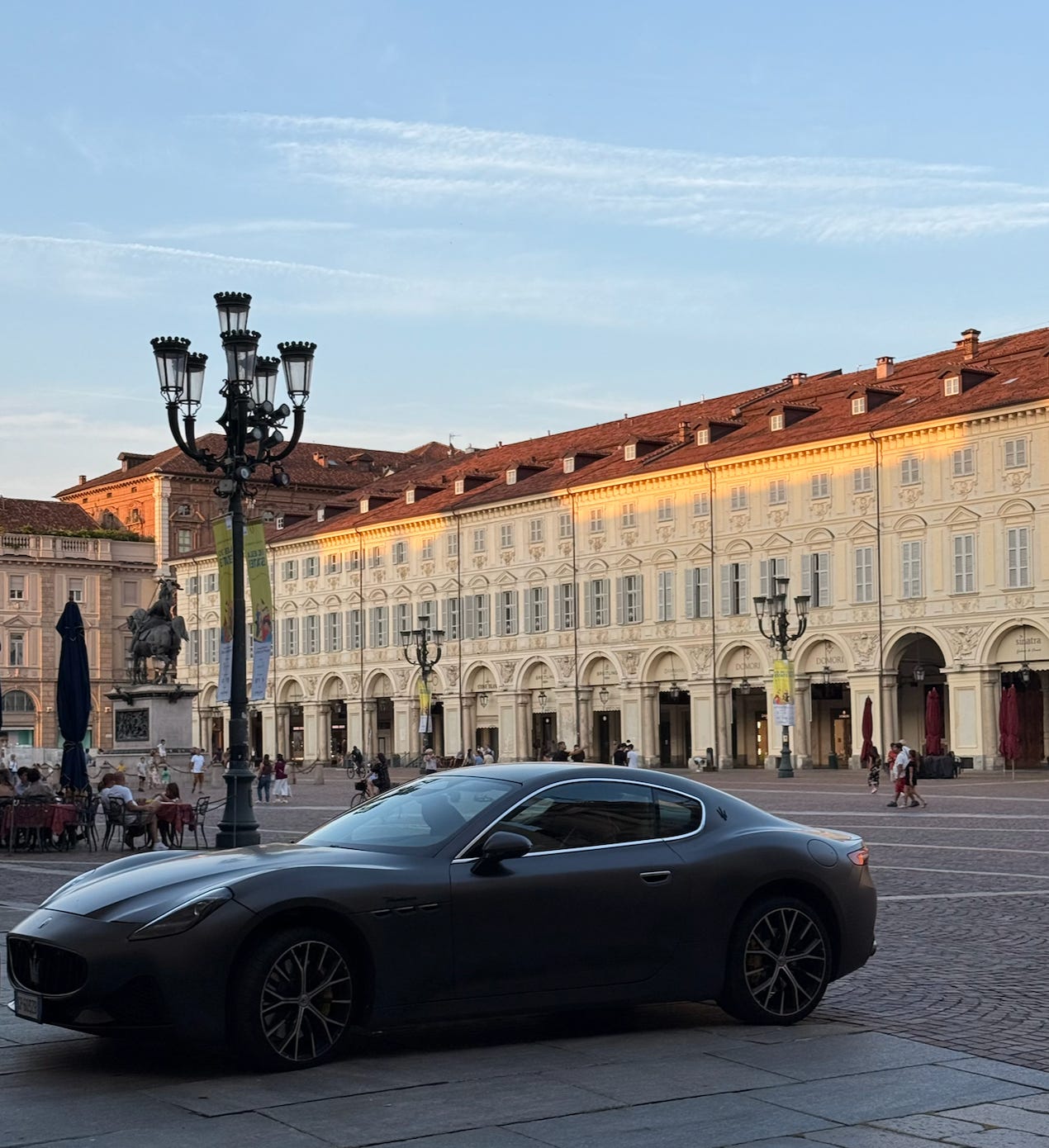
This is a bit of a clickbait topic, I admit, so let me clarify what I mean exactly. There are certain factors that a city has to offer that make it perfect for both locals and slow travelers. I will use Turin as an example, because Turin has it all, clearly.
One quick clarification, again, before. I put locals and slow travelers in the same group, pretty confidently.
First, ego, sorry, they are my two main target groups: I write either for those who want to dive deep into Italy, slowly, avoiding fast, mass tourism targets, and for those who want to stay like a local by either moving here entirely, or having some sort of an established base here.
Second, I believe these two groups are the same because it was the same for me, personally. Certain people enjoy road trips, and I am not one of them. The perpetual travel makes me tired, and I am lazy and convenient, sorry. So picking a hub where I sprawl into directions slowly is much more preferred than being constantly on the road. To me, this is slow travel. It is also the same as living somewhere as a local. So, again, these two groups are the same, I think. For both of them, the perfect city looks somewhat similar.
Lastly, a tourist looks for an entirely different experience. They want things that can be captured instantly and shared with everyone who immediately gets the experience, without spending a minute there. A tourist wants instant, pre-packaged fun, compressed into short periods of time. 10 things to see in <insert city name> under 2 days.
So, let’s talk about the perfection. Five categories.
1
Absence of landmarks. I wrote about this when I wrote about Lucca, a city you can’t photograph. The perfect Italian city has nothing to offer for the camera. Therefore, almost no one comes only for pictures (a surface-level experience). If you shoot a picture in this perfect city, people might recognize that it's Italian, but they have a hard time pinpointing which one without some context.
Turin has almost no landmarks. Maybe the Mole Antonelliana. Maybe some of the Savoy palaces. But honestly, none of them are recognizable without context for most people.
2
Surrounded by alternatives. I’ve found this true when I was writing the piece about Lerici. And it is also the most important reason why Anywhere Italy exists. When you have a peak destination, the alternatives in the immediate vicinity are totally overlooked and overshadowed by the Big Thing next to them. Venice vs Chioggia. Verona vs Vicenza. Pisa vs Lucca. Lerici vs Cinque Terre. Rapallo vs Chiavari. The list is endless. Just take Lucca. You have almost the same experience as you have in Pisa, same vibe, same food, same streets, much fewer people. But no tower.
Turin is similar. It is surrounded by the Ligurian coast on the South and Milan from the East. Most people want the sea, so Liguria. The few who do trips to cities pick Milan, because of Milan and the lakes, Como, and others. Turin sits between them, as the 3rd and 4th alternative.
3
Off-branded. Yeah, sorry, I can’t help my inner marketer. If we don’t know a place, we simply prefer a callout about it. This <insert city> is the city of <insert value or perception>, and it is famous for <insert ‘stuff’>. Philadelphia is a cheaper and smaller alternative to the New York lifestyle, and it is famous for its sandwich. Florence is the city of the Renaissance, and it has amazing art and culture. Obviously, the reality is not that simple. But the perfect city doesn’t have this simplicity, so it doesn’t draw that much attention. It is either confusing in branding, or the branding itself is not very appealing.
Turin has both. It’s not very appealing, because for most people, it is still the industrial capital of Italy. Rome: capital of religion and government. Florence: capital of art and culture. Milano: capital of economy and fashion. Turin: capital of industrial factories.
Even if you look deeper, it gets confusing. Turin is the birthplace of Italian unification, the center for both fascist and antifascist politics, and the home of the most prominent intellectual movements in Italy. Basically: it’s the political and intellectual capital of Italy, or it was. Turin is also the home of the Savoy monarchs, who gave Italy its unification and were the country's first and last kings. It’s a royal city, built for and entirely around the royal family and its castles and palaces. Therefore, the city is a decadent, Art Nouveau, Baroque masterpiece, with insane avenues, huge piazzas and more palaces than you can find in France. And on some of these avenues, it also houses huge factories, and it is home to Italian industrial innovation and engineering.
In short, it’s hard to decode the city. So it's perfect to spend more time there. Time helps to unfold the secrets.
4
It’s connected. The fact that it has alternatives means not just that it is overlooked or overshadowed, but also that it is connected to other prominent hubs. From Chioggia, it’s much more convenient to reach Venice’s main islands than doing it with all the masses from the grand station. It’s also better to retreat to Chioggia’s old town after a day trip in Venice than staying in the center of Venice for the night. It’s so much better to live in Lucca and do the day trips to Florence, rather than living in Florence and doing the other way around. The best hubs are connected to prime destinations with silence, convenience, and ease of reach.
Turin’s best thing is that it takes a couple of hours by car or train to reach Milan, the famous lakes, the Ligurian coast, the Alps, and one of Italy’s best wine regions. Make it more than 3 hours and you are either already in Tuscany or on the French Riviera. Turin also has an international airport, so reach is truly limitless.
5
It’s interesting on its own. So, this is tricky and highly personal for everyone. First, I think almost every city with at least a million people can be interesting. If there is population and economic power to spend, services will follow so the city stays interesting. Second, the city has to have some history. By history, I mean it has to be hundreds of years old or older. With time, the city itself becomes interesting. With time, stories become layers upon layers of history.
Turin was the home of the Savoy monarchs for hundreds of years, which still marks a big chunk of the city's history today. The center of Turin really looks like a royal city with palaces, castles, and royal residences. Then, industrialism came. It’s the HQ of FIAT and home to a very long list of other big brands across a wide variety of industries. It left a mark on the city in the form of economic housing and expanded the city limits to its current size. It also gave the city a very reliable and modern public transport system that is rare in Italy. Now, the city is transforming from an industrial hub into an innovation and creative capital. It is also a home for intellectualism and food, rebranding itself as Italy’s smart city. We’ll see about that, but for sure, it makes it more and more interesting with time.
The perfect Italian city has almost nothing you can photograph or anything that you can’t get elsewhere. It probably either has a bad rep, is confusing, or is simply unknown. Yet, it is the perfect place to live or spend a sizeable chunk of time because it is standalone interesting, giving you everything that any Italian city can give you but without the overpriced services due to mass tourism. It is also the best hub option because it is connected to famous destinations, which you can visit day-by-day, saving money, time, and energy by returning to your less-interesting hub every time.
If you come to Turin, you will have a hard time finding fridge magnets. Some shops sell them, and there are some souvenir places in the center. A few maybe. But compared to Florence, Rome, Venice, or Pisa, you literally have to be on alert to find anything touristy to buy.
The fridge magnet-per-shop ratio is pretty low here. If you ask me, that’s the best ever sign for a perfect city in Italy…
Peter
Torino, 25 July 2026
What’s new on the page
Guide on the Riviera di Levante
As promised, I made the posts about the Riviera di Levante region into a guide. That’s the part of Liguria that is East of Genova, basically anything between Genova and the Western border of Tuscany, which is Versilia, and it has its own guide since (for now), we are living there.
The Cinque Terre, the Tigullio, the Magra Delta, and Genova, all-in-one. The plan is to extend this guide with the Western part of Liguria, but we will do those trips once we move fully to Torino. San Remo is just closer from there.
Guide | The Riviera di Levante

This guide is about the eastern Ligurian coast, from Genova to the Tuscan border at the Magra, which is eighty-odd kilometers of the same steep, bright, vertical country that contains, somewhere in its middle, the five most visited villages in Italy. Most guides to this coast are guides to those five villages. This one is built the other way around.

Planning a slow trip? My planner builds it for you. Answer five questions, and you get a personalized route from my handpicked list of the 1,000 towns most travelers skip, with festivals, drive times, and a line on each place. Don't like it? Refine it, swap towns, or browse the whole database by region. Simple. Free. No paywall, not even an email gate. Pure discovery for you.
→ Start planning your trip on Anywhere Italy.
I started learning Italian after moving here. Restaurants run on English, but anything past ordering lunch doesn't. Before I hired a teacher, Babbel did most of the work, with more real learning than Duolingo's gamified fake learning. I'm a Babbel affiliate, but I only point you to things I've used and liked.
Since Italian music is my thing, when I hear Turin I am obligated to ask your opinion of Subsonica (I love them)