

The Iron Coast | The Wrong Sea
Tuscany below Livorno and the iron under the beach

The hotels are the first thing, and they are the wrong shape for the postcard. We came down for two weeks one summer, my parents and I, when I was in my late twenties and the plan was nothing more complicated than the sea, and what rose up along the front when we arrived was a wall of tall pale blocks, six and eight stories of them, flat-faced and stacked close, the kind of building that goes up fast when a country decides a stretch of coast is going to be a holiday. I had a sea, and behind it, a town that looked like it had been poured out of a mold around 1982 and left to stand in the salt ever since. I was on the Tyrrhenian, the western sea of Tuscany, and everything in front of me said I was somewhere else entirely.
I know that somewhere else now, because I am from Eastern Europe and I know a socialist seafront when I am standing on one. This was that. Not in fact, but in feeling, in the brutalist blocks and the long flat beach and the single-minded purpose of the place, which is families, sun, water, and a room with a balcony, and nothing else asked or offered. If you have stood on the Adriatic at Rimini or Bibione, you have the register, the identical restaurants, the interchangeable hotels, and the sea promenade that is the whole of the entertainment, except that the Adriatic at least leans into it. This coast feels left behind by it. I would not call most of these towns beautiful. I would call them interesting, which is a different and more honest word, and the most interesting thing about them is the reason they are not beautiful. Still, I wanted to cover this area of Tuscany because it is totally off the map and famous for its white-sand beaches. But read on and you will understand what “white” means here.
Because I live on the other Tuscan coast now, the Versilia, up where the sand has a velvet rope around it, where the beach clubs have names, and the cars in front of them cost more than the houses behind, and the contrast between my coast and this one is the whole story. The Versilia sells glamour. The shore below Livorno has none and never did, because it was never built to be looked at. It was built to work.
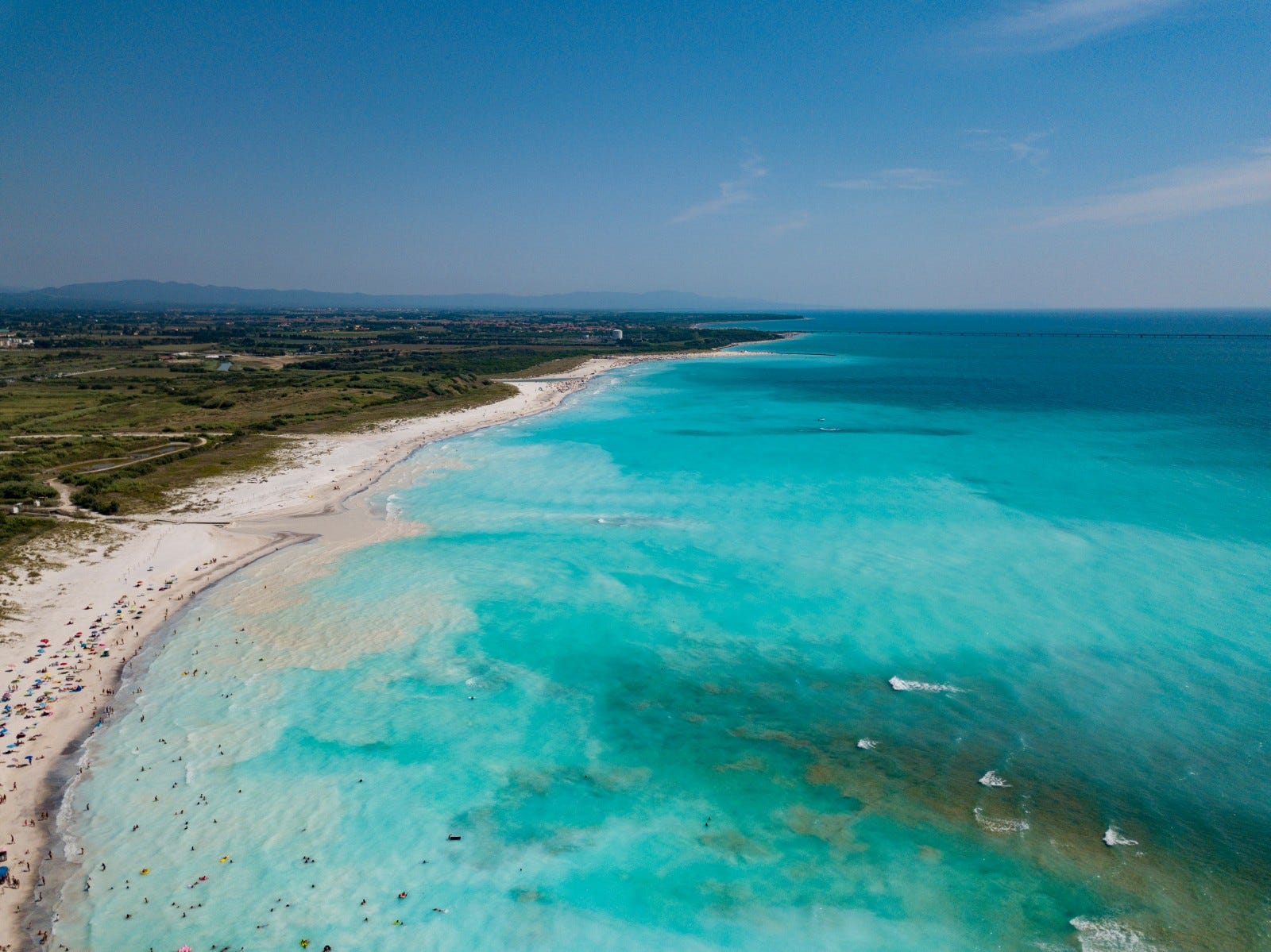
That is the thing the young man on the beach did not see, and the man who lives here cannot stop seeing. This is an industrial coast wearing a beach towel. Run it back far enough and the whole of it, the swamp and the steel and the slag and the white water, is one long story about iron, and the holiday is the costume the story put on after the work ran out.
Start with the ground itself, which for most of history nobody wanted. The Maremma, the country behind these beaches, was Tuscany’s curse for centuries, a malarial marsh where the fever came up off the standing water every summer and emptied the towns, where bandits worked the empty roads and the grand duke’s own officials sent condemned men to labor and die. There is an old song about it, Maremma amara, bitter Maremma, the bird that flies in loses its feathers. Then, in the eighteen-thirties, a Habsburg grand duke, Leopold the Second of Lorraine, decided to drain it, and he planted an iron foundry on the gulf at Follonica and smelted ore shipped from the island of Elba, and the town grew up around the works, the way a company town does. The church he built on the square, San Leopoldo, has a portico and an altar cast in iron, a church poured in the foundry that stands beside it. The decorative ironwork on the Duomo balustrade up in Florence was cast in this fever swamp. The same grand-ducal family, the same Habsburg thread, that I followed through Bolgheri a few towns north runs straight through here too. They built this coast out of marsh and metal.
For the price of a glass of Chianti, unlock the full Anywhere Italy experience. All of our articles, private stories, and access to our chat travel community.
Start your free 7-day trial.
And the iron is older than the grand duke by two and a half thousand years, which I learned standing on it without understanding what I was standing on. North of Follonica, on the bay of Baratti below Piombino, sits Populonia, the only Etruscan city ever built right on the sea, and it was built there because Elba’s ore came across the water to be smelted on that beach. I went up to the necropolis once, years ago, when I was studying history, and it was a field trip more than a holiday, and I walked among the great drum-shaped tombs and read the panels and thought the whole subject was the dead. I did not know that the low hills I was crossing to reach the tombs were not hills. They were slag. The Etruscans smelted so much iron on that shore, for nine centuries, that the waste piled six meters deep over a million cubic meters and buried their own graves under it, and the swords Rome carried into the Punic Wars were forged from this ore, and then the city died, and the slag sat there for two thousand years. And in the last century, the modern state came back and dug up the ancient slag to feed the steel mill at Piombino, because the Etruscan waste still held iron, and, in tearing the heaps open with machines, they uncovered the tombs beneath. The steel mill’s hunger exhumed the city that fed Rome. I stood on top of all of that at twenty-something and saw only the tombs. The iron was under my feet the entire time.
Elba is out front of it all, an hour by ferry from the gulf, and it is where the ore came from, the source of the whole story sitting on the horizon. It is also the one place out here that does not feel like the mainland coast at all, a small island with the island temper, few cars, no rush, the crowds thinning the moment you are off the boat. We took the crossing on that family holiday, and it was the clean break in the middle of the two weeks, the day the flat brutalist front fell away behind the wake, and something smaller and older took its place. The mines that gave Follonica its reason are up there, worked out now. The island kept quiet.
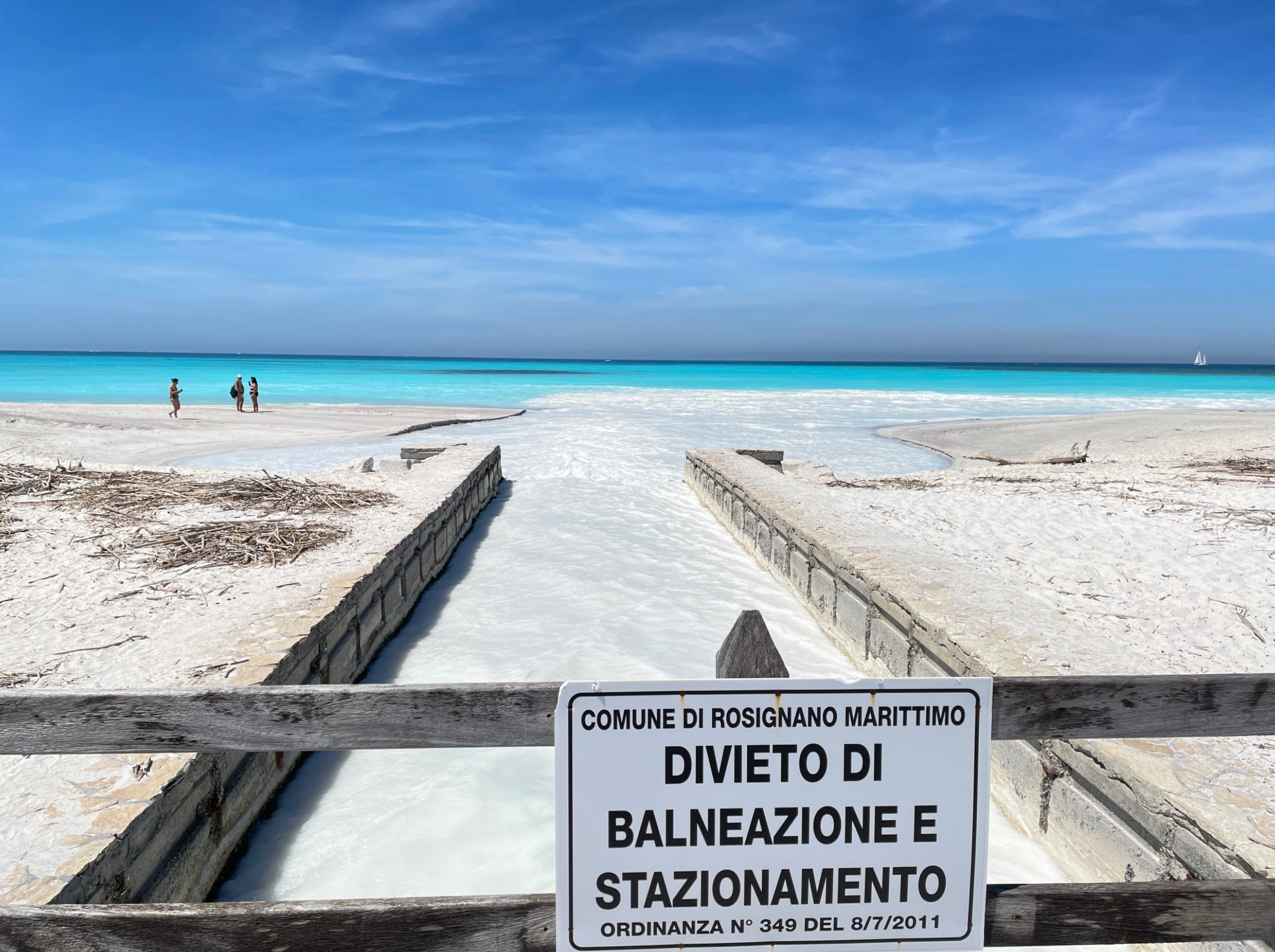
Then there is the beach I cannot show you without a warning, the most beautiful water on the whole coast, and the least innocent. Up near Rosignano, toward Livorno, there is a stretch they call the white beaches, sand gone limestone-white and the sea over it turned a flat tropical turquoise, the kind of color that stops a foreigner in his tracks because it has no business on this grey shore. The color is not natural, the way a Caribbean lagoon is natural. It is white the way water goes white when a chemical works has been emptying into the sea beside it for a hundred years. People here will tell you flatly that the beach is bleached by industrial discharge. The company that runs the plant will tell you it is harmless limestone settling out of the process, and the beach is open, and people swim. You can lie down on the whitest sand in Tuscany and decide for yourself which of those two stories the turquoise is selling you. Either way, it is the coast’s whole nature in one image, a beauty that is really a byproduct, the holiday costume worn by the work.
The rest of the gulf fills in around the spine. Punta Ala is the exception that proves it, the one stretch where money landed, a yacht marina and a manicured resort that belongs more to my coast than to this one, glamour parachuted onto the working shore. Castiglione della Pescaia keeps a real fishing harbor and, behind it, the reclaimed marsh of the Diaccia Botrona, where an old engineer’s red sluice-house stands out in the drained lagoon, the bonification made into a single building you can look at. And the whole gulf has the saving grace of position, because for all that the coast itself is grey, you are an hour or two from Siena, from the hill towns, from the middle of Tuscany, so the beach can be the base and the postcard country the day trip, which is the right way around and the opposite of how most people do it.
The southern end is where the iron coast quietly stops being the iron coast. Down past Grosseto, which is its own inland story and the gateway to the cattle country behind it, the shore runs out to Orbetello, and Orbetello is a different planet, a town strung along a thin spit of land out into a lagoon, an almost-island reached by a causeway, the closest thing Italy has to the Florida Keys. There is no iron in it and no brutalism either. It is the border, the place you reach when the working coast has finished and something stranger and softer begins, and it is worth the drive precisely because it does not fit.
I have driven this whole shore many times since that summer, on the way down to Rome, on visits to Grosseto, as a resident now instead of a guest, and the coast has not changed by a single hotel. I have. The young man who came for two weeks saw a sea that disappointed him, a wrong-shaped, grey, almost socialist resort strip on the wrong side of Italy, and he was not wrong about any of it. The older one drives the same road and sees the iron under the beach, the slag the tombs are buried in, the foundry inside the church, the white water that is really a hundred years of discharge, and likes the place more for all of it, because at least it is telling the truth. The pretty coast where I live is selling something. This one stopped selling a long time ago, when the furnaces went cold, and someone forgot to take the sign down. There is nobody on the front at this hour but a few families and the long pale blocks throwing their shadows out across a beach that was a foundry, and the sea coming in over sand the same color it has always been.
PS: I spent weeks here on a holiday that was 20+ years ago. Most of my photographs from that time are low-quality, so I used publicly available ones, which I have credited.


Planning a slow trip? My planner builds it for you. Free, no paywall, no email gate. Answer five questions (hub town, interests, travel month, days you want for slow discovery, and fitness level, because some of these towns make you climb), and you get a personalized route from my handpicked list of the 1,000 towns most travelers skip, with festivals, drive times, and a line on what each place is. Don’t like it? Refine it, swap towns, or browse the whole database by region.