

The only way travel changes you
Sunday Espresso XI.

I’ve read many times from other writers that travel changes no one. Some even argued that travel itself is unnecessary. It is part of a consumer status cat-mouse game. Mass tourism is killing the romance in places. All of these are true. Yet, there is a way in which travel really does change you.
In a recent article about Lunigiana, I mentioned as a sidenote that we had lived in Marciaso for a month before we moved to Versilia, where we live today.
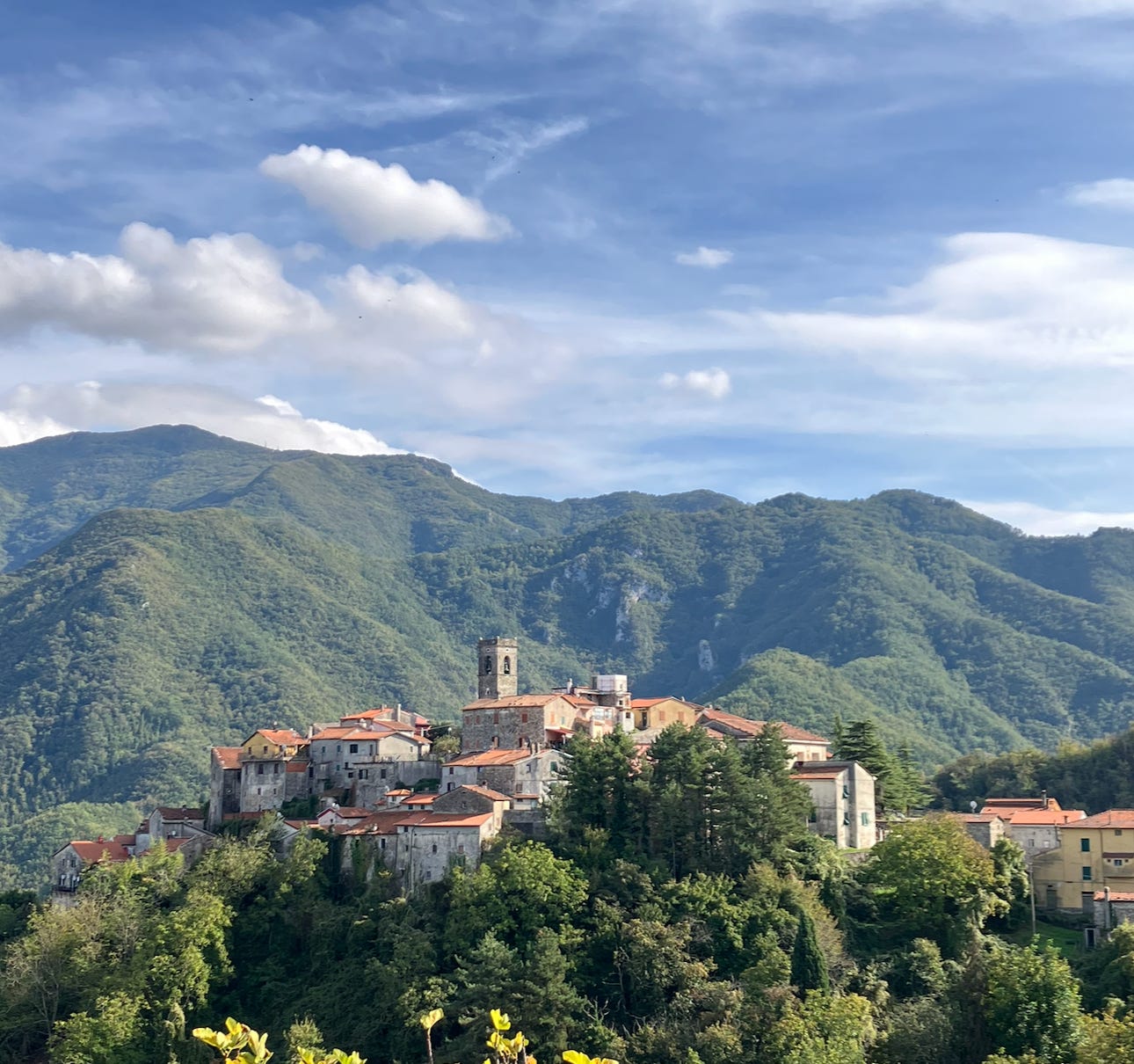
Before Marciaso, we’d spent a lot of time in Italy. Lived in Florence, Rome, and even did a tour in the South. But we always kept our home in Budapest, where we are from originally. We either rented it out or left it empty while we were in Italy. Then, after a month in Marciaso and a month in Versilia, we decided to move to Italy forever. From doing slow travel in a country to selling all your stuff and relocating there is a different story. It is always a personal story.
See, no sane person would move to Marciaso, to be honest. It’s a town with barely 100 people, and most of them are close to 100 years old. It has one bar/restaurant/place, whatever it is, that is open only on Friday and Saturday. It is a medieval walled town on a mountain ridge, in one of the most isolated areas of Tuscany, the Lunigiana. Add that it was October, raining most of the time, and you were essentially cut off from civilization because the winding roads were too risky to drive down to Carrara.
In far-off islands in the middle of the ocean, there is a saying that you are either born there or you are running from something. Marciaso and towns like this are kinda the same. Sidenote: when you buy your 1 EUR home in a ghost town, remember that. But if you knew my wife and me back then, you would immediately understand why we moved there.
We wanted to just get away. Her brother, dad, and grandfather died within 2 years. I had a heart operation that summer. We needed emotional support from various people, and we got nothing because everyone was super focused on their own drama. Only the two of us were supporting each other. So we said fuck-all and got away. I remember clearly, it was a particular evening. We decided, we booked, we packed, we went. Within the span of two days. We arrived in the first week of October.
Marciaso was perfect for this. We wanted to live on a mountain-top Italian borgo for a while anyway as an experience. The Airbnb was cheap for a month. We rented out our home back in Budapest. Just in case we wanted to go back, we couldn’t. Burn the bridges, y’all. We gave up this mountain living after around a month and moved back down to the coast, but the move was genuine.
In December, our tenant back home extended her stay until January, then nothing. The plan was to go home. I remember the conversation like it happened yesterday.
- I don’t want to go home. I’m happy here. It’s just different. I don’t know why or how, but this is a place where we can stay. (Sophie)
- I was thinking about the same thing. I don’t know how, but we can make this work. Doesn’t matter how much it costs. We will make it work. (me)
It was decided at the end of December. We informed our families. I flew back for a weekend to take care of the apartment. We kept it for a while to finance our new rental here in Italy, but on that day we decided to sell it and make our stay permanent.
It’s hard to translate a deeply personal story into something practical. But I know everyone simply just loves practical rules, so I will try to be as practical as I can. However, keep in mind that every journey is personal.
The goal is this: you go on a journey, following a set of rules. If you follow these rules by the book, the journey itself forces you to confront yourself and face a change.
What will this change be all about? It’s personal and 100% depends on your personal life. In our case, it was a decision to stay. In your case, it might be different. But there will be a transformation.
So, how does this work? Or more like, why does it work? And why travel?
It’s simple. You are part of your own circle. Friends, family, colleagues, work, community, whatever. While this is great, they are there for one reason alone: to support your self-image. They are the keeper of your identity. This is why retreats, slow trips, vacations, and anything that pulls you out of that circle, even for a while, work because they give you the freedom to give zero fucks about your identity and do what you really want, not what is expected of you.
This is why every middle-aged American woman wants to go on an Eat Pray Love tour. This is why Bali exists with its yoga retreats and “find yourself” camps. We all need a break from our identity from time to time, so we can make genuinely honest decisions that protect and serve us by the heart. We make these decisions for ourselves, not for the expectations of our neighbors/families/friends.
But this change works only if you more or less follow the rules. So, I tried to systematize how this works and came up with these.
1
Your travel should be to a different country, where the language is not your native language. So domestic travel is out. If you want domestic travel, fine, but that means camping in the woods, without people.
You need people around you who know nothing about you, and you know nothing about them. You can understand them only if you focus on their language, but I would argue it is even better if you don’t speak their language at all.
This gives you the maximum level of I don’t give a fuck what they think about me as a starting point, which is the point of all this.
Italy is perfect for this. People will smile at you and leave you alone. It’s Europe, so you are safe and sound everywhere, even if you travel alone.
2
Stay for 90 days. Eat, Pray, Love? She stayed in one place for 3-4 months. A financial quarter? It’s a quarter for a reason. A season? 3 months. Almost every transformational timing is set at around the 90-day mark. Even most visas last for 90 days.
I know it is hard to organize a 90-day trip away from all your commitments. I honestly don’t have any tips here.
Both Sophie and I have online jobs, so we work from anywhere and don’t need to go into the office. We don’t have kids, so schooling is not a problem we need to solve. We don’t have debt, loans, or any financial restraints that require us to continually work or make payments.
Every life is different. All I can say is this: if you really want to make this work, you will make it work.
3
Stay in one, a maximum of two places. Perpetual travel is the real-life version of endless scrolling of the feed. It kills attention. The entire goal is to be without expectation and be with yourself.
You want to stay put. Travel is a vehicle for change. Don’t travel to your enemy by switching towns every week or doing a long 3-month road trip. In some cases, road-trip-style travel can work. But for most people, it is simply easier to stay in one place for a longer period.
Also, don’t forget the logistics and money. Booking a place for 3 months is much, much easier and cheaper than constantly switching places. In our personal example, we switched places once.
4
No day trips for the first 4 weeks. This is highly connected to Rule 3. You want to stay put. I think this is the 2nd time I've written this down. It’s kinda important.
Obviously, grocery runs, logistical runs, health runs—these don’t count. But perpetual travel can also happen via day trips. A simple rule for the day trip option is the timing (4 weeks), or you can take a day trip once the town where you are staying has truly run out of options to see or do.
5
Stay in a small town, but not in a village. This rule is a bit fluffy, but I will try to strike a balance here. We’ve learned this in Marciaso. A town that is too small functions as a sanatorium. You are truly off the grid. If you had drama like us, it could be a good option. Silence heals wounds. But for most of us, we need at least some inspiration.
I would say go with population, aim for something between 5,000 and 30,000 people. It gives you either a big village or a small town. This publication itself is written about these towns. I personally collected 1,000 of them here.
In Italy, a small town has a piazza, a couple of restaurants and bars, a small museum, and some activities. It is definitely not a ghost town, and it is a good, calm, but also very local place to be in. Pick one in a nice area so you can take day trips to amazing places from your home base.
6
Ignore expats and digital nomads. Yeah, counterintuitive, I know. But you need expat connections only if you stay longer or you settle down there. Digital nomads are also a different breed. Also, not that many of them in Italy anyway. It's too expensive to just fly around in Italy. Also, a Bali beach looks better with a laptop with a “welcome to my office” copy on the pic.
Remember that the entire goal of this trip is to stay put and look at your life from a vantage point, without shackles, without expectations, without anyone to whom you can tell your story.
The moment you meet with expats, within 10 minutes, you end up at “How’s Texas?” “I don’t know! How’s Seattle?” and give it 20 minutes, and you are arguing about the Giant Orange Baby. Remember that it is exactly why you are taking this trip: to avoid these conversations.
7
Define no goal. That is probably the hardest one, especially for Americans who treat and live their lives as a never-ending to-do list. There is no goal. Life has no goal, but that is another story. This trip surely has no goal other than this: it is happening.
So, it is not a 90-day bootcamp to build your startup in monk mode, whatever these idiocracies mean. It’s not a 90-day write-your-own-novel creative writing retreat. It’s not a 90-day find-yourself-and-become-one-with-the-world yoga camp. It’s not even an I-fuck-with-all-the-Italian-stallions-I-meet-in-the-bar sex-run (if that’s your thing, no judging!).
This trip has no goal. You don’t need to accomplish anything. You have to follow the rules and let it ride for 90-days. Or 85-days. Or 95-days. Nothing is seriously fixed here, hello. Just let the trip happen with you.
8
Define no strategy. Similar to the previous rule. There is no good or bad trip. There is no one at the end who will congratulate you, except yourself. No one will know you did this, and even if they do, they won’t understand.
There was a guy who traveled across all of Latin America alone. Almost all the countries. With a backpack. Nothing serious, no goal, no objective, just had money aside, loved the area, spoke Spanish, why not. It took him almost two years to do it. When someone asked him, how was it? His response was the same: great. He explained later, what else could he say? That he once went down a side river of the Amazon on a half-sinking trash boat, with him the only white non-local person around an area that was the local indian tribes' place, who never ever say, modern people? How can anyone understand this experience without being there? Where do you start with storytelling? Should you start at all?
I think some things are not meant to be said or shared. It’s yours only. And since something is yours only, why have a strategy for it? Who are you performing for?
9
Try to be a local. Not because anyone will treat you like a local. I can promise you, no one will. You will be the weird foreigner, probably forever. But being a local has one thing: familiarity. Habits. Traditions. A routine. And when you put yourself in a situation like this for a couple of months, trust me, you will love a nice, fluffy routine.
Frequent the same bar. Go to the same restaurant every Friday. Fill up your car's tank at the same station. Walk the same routes. Go to the same butcher. Buy at the same bakery. You won’t be a local, but after around the 10th visit, people will recognize you. It feels nice.
10
Don’t track or document anything. It’s 2026, and I can’t believe I even have to say this, but I know everyone is mega-obsessed with biomarkers, photographing every second corner, making short videos of a seagull walking on a beach, and tracking their steps, sleep, and whatever.
Now, let’s not go into why this entire obsession with tracking and documenting is absolutely wrong and why it is the most obvious sign of loneliness and loss of control over someone’s life. Let’s just say that it is about optimization.
You do this trip because you want to stop optimizing your image, yourself, or your presented self. You want to change direction, whatever that direction is. Or you just want to spend 90 days without having to maintain a smile towards people you hate deep down. Or whatever your reason is. But that reason is definitely not to walk 10,000 steps every day, counted on your watch.
By the way, this last rule should say one simple thing: no screen for 90 days. But this is not an addiction rehab camp either, so let’s negotiate this down to not tracking or documenting anything. You will do it anyway, I know you, but at least having a rule around it, you might do it less.
Now, what happens after 3 months? I have absolutely no idea. But if you maintain these rules, something might happen to you. You might change a bit. You might be calmer, more relaxed. You become stronger, more rooted, more confident. You might get a divorce, quit, or make some big life decision. We decided to sell our home and move here full-time because we realized that location helps us find some solid ground and be happier. But that’s our life. You have a different one.
I can guarantee you one thing, though. With this approach, a trip can change you. You will go home not just with a collection of photos and some tan, like everyone else does after a holiday, but as a different person.
Or you won’t go home at all.
Peter
Pietrasanta, 12 July 2026
What’s new on the page
The final guide on Tuscany
Mainland Tuscany, or shall we say, Postcard Tuscany. As I did with my main guides on Versilia, the Apuan Alps, or the Arno Corridor, I collected the articles and packaged them into a single guide. This time, Mainland Tuscany. This also concludes Tuscany as a region. I’m not sure where I will focus, probably Lazio, since I have many experiences there after living for around a year in Rome.
As you may have noticed, I have a paywall up after 4 weeks a post is published. However, these guides will forever be free without a paywall.
Guide | Tuscan Mainland

This guide is about The Tuscany on the postcard. The cypress lane, the hill town bristling with towers, the wine country, the medieval square gone gold at six o’clock, the whole famous interior that people cross the world to stand inside. It is the most photographed countryside in Europe.

Planning a slow trip? My planner builds it for you. Answer five questions, and you get a personalized route from my handpicked list of the 1,000 towns most travelers skip, with festivals, drive times, and a line on each place. Don't like it? Refine it, swap towns, or browse the whole database by region. Simple. Free. No paywall, not even an email gate. Pure discovery for you.
→ Start planning your trip on Anywhere Italy.

I started learning Italian after moving here. Restaurants run on English, but anything past ordering lunch doesn't. Before I hired a teacher, Babbel did most of the work, with more real learning than Duolingo's gamified fake learning. I'm a Babbel affiliate, but I only point you to things I've used and liked.