
Val d'Orcia | The Postcard Is Constructed
Val d'Orcia, from Florence, and the peasant house under the dream

The first time you see someone do it, you think their car has broken down. They are stopped at the edge of the road, hazard lights on, and a person is standing in the gravel with a phone or a long lens held up to a hill with some grass, a wheat slope, and a single tree. Then you see the next one doing it, and the next, a loose chain of stopped cars strung along the ridge road south of Siena, each with its photographer giving half an hour of a finite life to a frame of countryside with a touch of green and a tree in the background. It is one of the more amazingly stupid things I have watched human beings do, and also one of the funnier, and I have watched it a lot, because we drove this valley first out of Florence when we were living there, a full day’s loop down through it and back, and again later moving south to Rome, in our own car, with sandwiches in the back. That detail matters more than it sounds. The whole of this place is about people who stop. I was the one driving through.
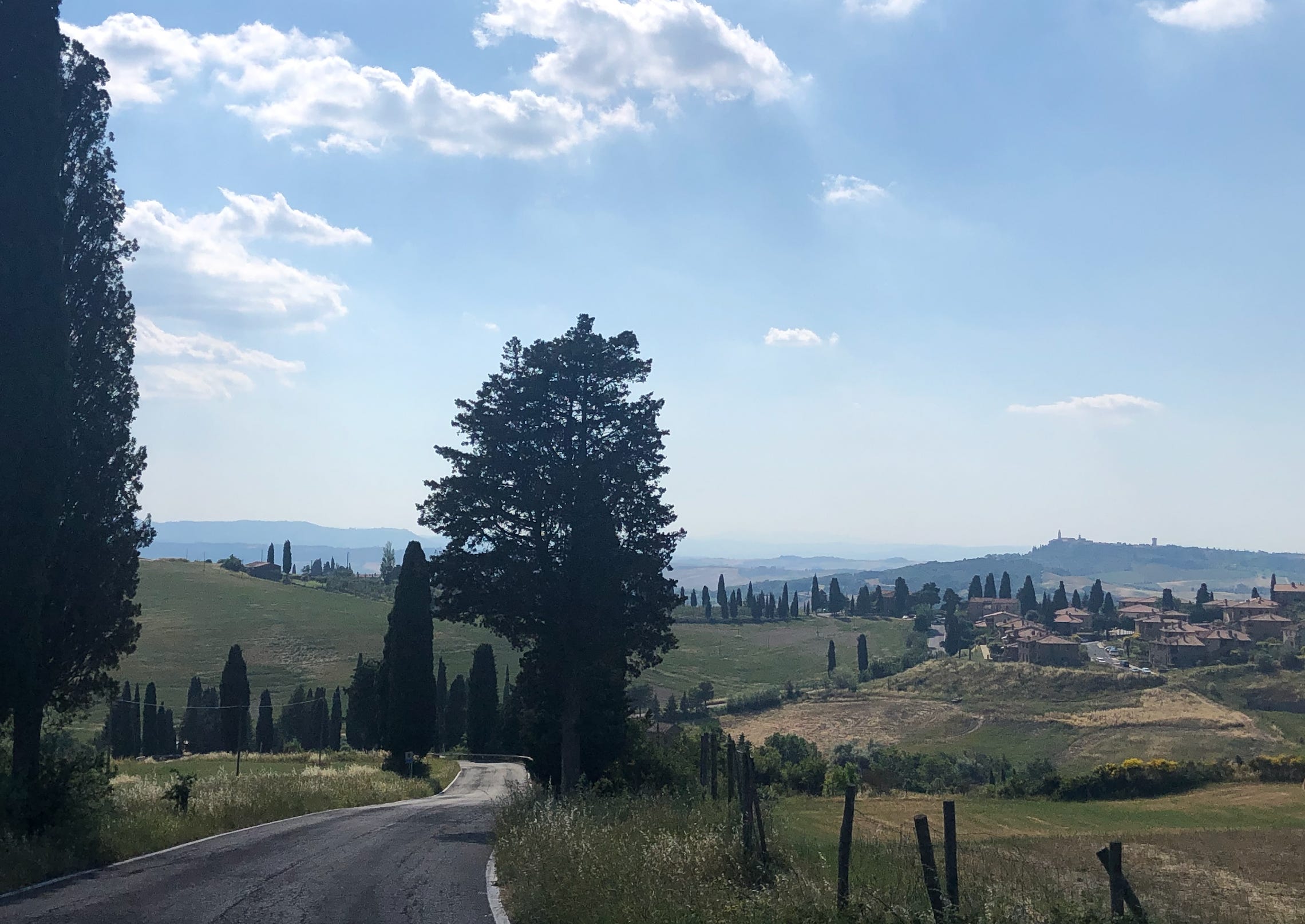
I will give the valley its due first, because anything else would be a lie, and you would see through it. The Val d’Orcia is magical. The hills run off in soft waves to Monte Amiata, the cypresses stand in their files along the dirt roads and crown the rises, the light does the thing the Sienese painters spent three centuries trying to catch, and it is, with no argument from me, the single most beautiful stretch of country in Italy. You should go. It is overrun and overphotographed, and you should go anyway, the same way Venice is drowning in people, and you still have to stand in it once. Some things earn the crowd. This is one of them. I am not going to be clever about that.
What I am going to tell you is that almost none of it is what it pretends to be. The Val d’Orcia is not nature. It is a set. It was built on purpose by city people as an argument about how the countryside ought to look, and it is one of the oldest and most successful pieces of landscape design on earth. Pienza, the perfect little town at the heart of it, was not a town. It was a peasant village called Corsignano until a man born there became Pope Pius the Second and decided to flatten his birthplace and raise in three years, from nothing, a flawless model of a Renaissance city, an idea of human-scaled perfection built to be looked at.
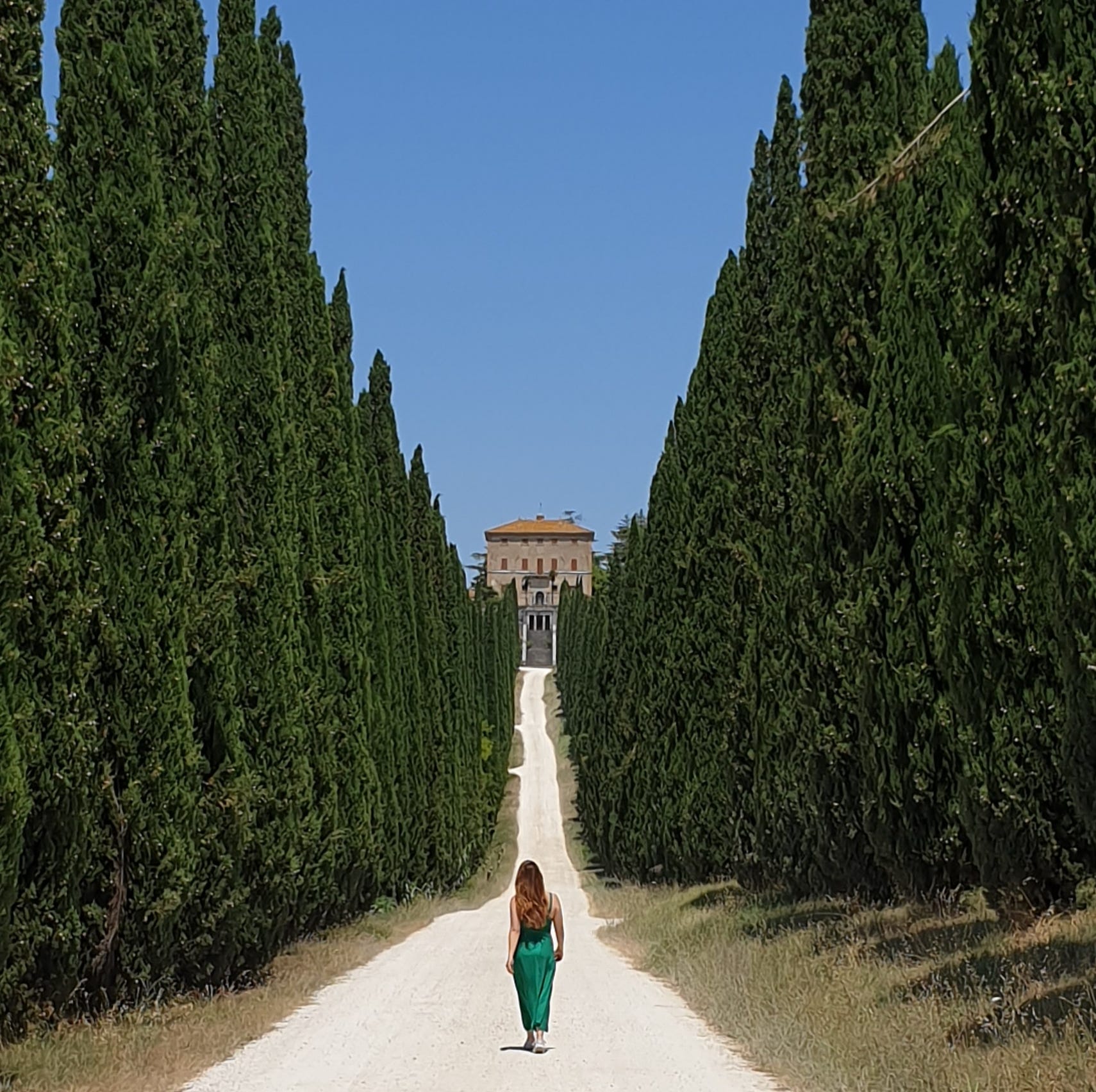
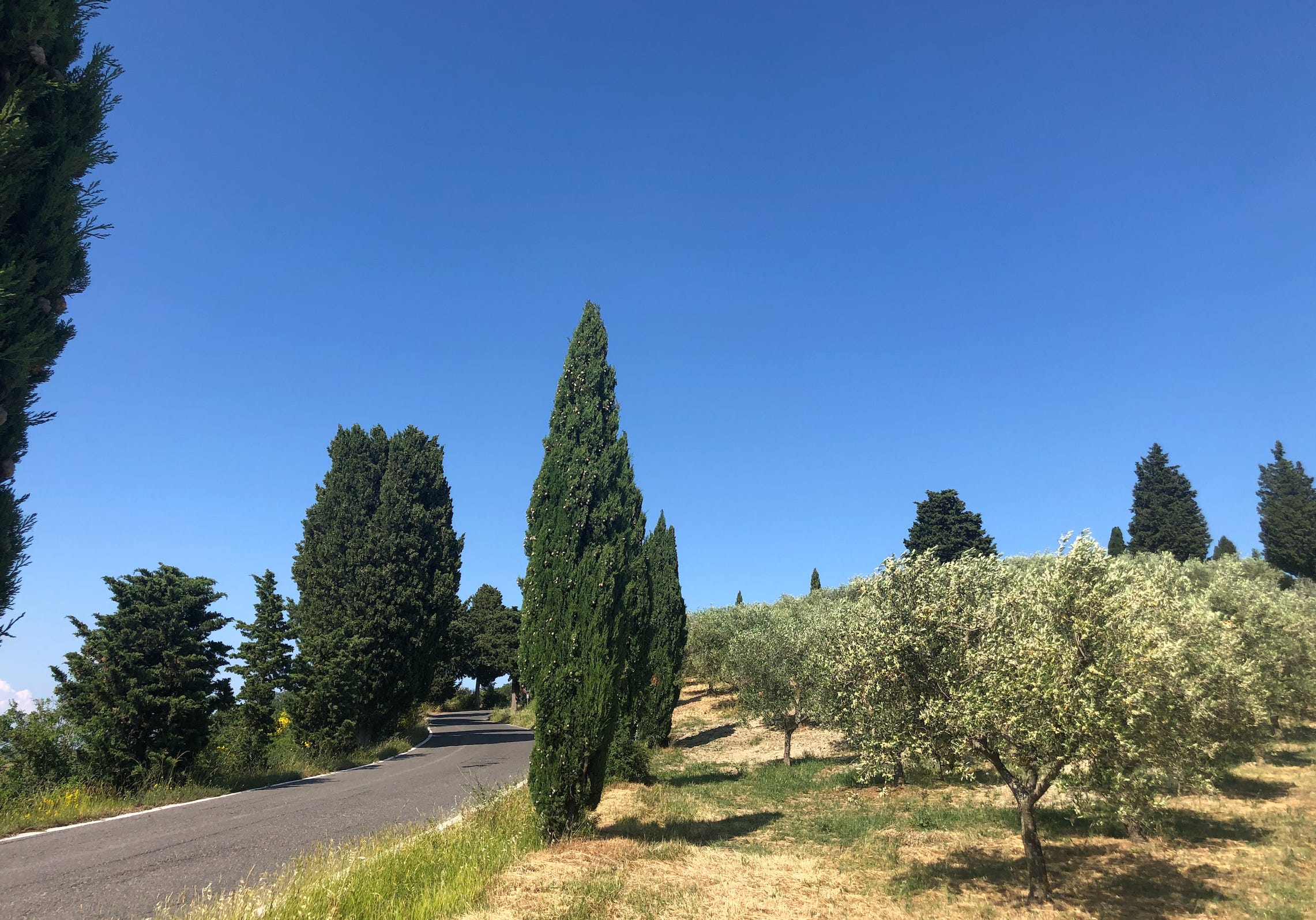
The cypresses that signify Tuscany to the entire planet are not even native trees. They were planted by landowners for shade and for the look of the thing, the way you would place furniture. The most photographed cypress road in the world, the zigzag everyone knows, the one below the villa at La Foce, was laid out and planted by an Anglo-Florentine family in the nineteen-twenties and thirties, which makes the timeless eternal soul of Tuscany younger than the motor car.
When the film industry needed a picture of heaven, of the fields a dead hero walks home to, they came and shot it here, and that is the truest thing anyone has ever said about the Val d’Orcia. It is not a place. It is the afterlife as imagined by people who lived in cities. It is how the country looks to men who never spent an hour in it, dreamed up by Florentine bankers five hundred years ago and maintained, beautifully, ever since.
If you want the country itself, the real one, dirty and sweating and unphotogenic, I have already told you where it is, and it is not here. It is over the hills to the southwest, in the Maremma, where the work is real, and the cattle are real, and you come home smelling of it. The Val d’Orcia is the postcard of rural life. The Maremma is rural life. Drive both in one trip, and you will understand the difference in your body, the dream, and the thing the dream was painted over.
For the price of a glass of Chianti, unlock the full Anywhere Italy experience. All of our articles, private stories, and access to our chat travel community.
Start your free 7-day trial.
And yet the dream is built on something solid, and this is the part worth slowing down for, because it explains every stone house with a new pool that a foreigner has paid a fortune for. The reason the Tuscan countryside is romantic, the reason it is dotted with handsome stone farmhouses worth restoring instead of the mud and rot that most of peasant Europe left behind, is feudalism, and a particular and unusually decent version of it.
Think of the feudal bargain as a dial. At one end sits the lord, his wealth and his power, and at the other sits the peasant, his freedom and his welfare, and you can turn the dial either way. Turn it hard toward the lord, and you get the dark version, the one in the history books, peasants dying young and poor and rising up in revolt. Turn it toward the peasant and something else happens. The land grows prosperous, because a farmer who keeps most of what he makes builds real things, a stretch of land, a few animals, and a solid stone house his children will inherit and work in turn. There is always a lord nearby who has to be paid, but it is closer to paying your taxes than to bondage. In the Tuscan hills, the dial sat about as far toward the peasant as it ever sat in Europe, and the proof is standing in every field, those stone houses, peasant houses, built to last by people who could afford to build to last.
The system outlived all reason. Its agricultural descendant, the mezzadria, the sharecropping arrangement where the farmer and the landowner split the harvest down the middle, survived in these hills until the nineteen-sixties, inside living memory, by which point Italy was a republic and the rest of Europe had buried feudalism centuries earlier. It lasted because it more or less worked, and the deep, recent bond these people have with their specific patch of ground is the residue of it.
The same world produced the rest of the Tuscan character too. The Italian city-states fought their wars not with mass armies of levied peasants but with hired companies of mercenaries, the condottieri, professionals with no wish to die for someone else’s quarrel, so the wars were often closer to theater than to slaughter, elaborate, maneuvering, comparatively bloodless. Machiavelli, a Florentine clerk who watched it up close and despaired, mocked one famous battle as having killed a single man, and him by falling off his horse. He was exaggerating to make a point, and the point was that this beautiful, bloodless game had left Italy soft and undefended, which it proved to be the moment real armies came down from France and sacked the place. That is the world this landscape grew out of: rich, fragmented, over-clever, fighting with money and politics instead of peasants, the world that produced both the most civilized countryside in Europe and the man who wrote the coldest book ever written about power. No accident that Machiavelli was Italian and not English or French.
So that is what is under the postcard. Now, the postcard itself, the towns, and here I have less to say than you would expect, because Pienza and Montepulciano have become, and I mean this precisely, the canteens of a theme park. They are where you go to park, walk a pretty street, use the toilet, refill the water, eat a plate of something, and buy a thing to take home. They are the food court between the rides. Montepulciano is the worse case and I have written about it before and I have not softened on it: it is constructed like everything else here, but it has also been hollowed out and sold back to you, the shops full of pasta no local eats and leather made on another continent, the streets a slow river of lanyards, and on the afternoon I spent there it nearly ended the whole region for me. The valley’s beauty does not redeem the town. It makes the town’s emptiness uglier by contrast.
Which is why the only real advice I have is about how to drive this place rather than how to stop in it. The good news is that the valley is enormous, far bigger than the famous spots, so even with the rented convertibles full of loud people and the cars abandoned at every viewpoint and the photographers giving their half-hours to the grass, you will not feel crowded once you are off the main stops. The crowding is only in the hilltop towns and the canteens. So skip them, or touch them lightly. Pack your own bread and water so you are not held hostage to the food court. Find one of the small towns the buses cannot be bothered with, the kind with a single piazza and one bar and one restaurant and two streets, sitting on a back road off the circuit, and aim the car at the spaces between things instead of the things. Keep moving. The valley is best at thirty kilometers an hour through the empty parts, not standing still at the famous overlook with two hundred other people.
We did exactly that, the last time through, on the way down to Rome. We found a town I will not name because naming it would ruin it, no bigger than a wide spot with a church, and we sat on a low wall in the late sun and ate our sandwiches with the whole gold valley dropping away in front of us and not one other person in sight, while somewhere back on the ridge the line of stopped cars went on photographing the grass. Then we got back in and drove on, down and out of the painted country, south toward the hills where the cattle are, and the dirt is real, and nobody has ever once pulled over to photograph a field, because down there a field is a thing you work, not a thing you frame.


Planning a slow trip? My planner builds it for you. Free, no paywall, no email gate. Answer five questions (hub town, interests, travel month, days you want for slow discovery, and fitness level, because some of these towns make you climb), and you get a personalized route from my handpicked list of the 1,000 towns most travelers skip, with festivals, drive times, and a line on what each place is. Don’t like it? Refine it, swap towns, or browse the whole database by region.