

Versace, Spello, and a scarf carried against the draft
Reading Table IV.

I write about Italy and the towns and experiences most people skip. Mine is one point of view. Others have theirs, and I love to read them all. So most weeks, I find a few pieces from other writers worth passing on.
This is Anywhere Italy’s Reading Table. Here are the latest articles from writers who made my days better.
Italy Untold on Gianni Versace
Everyone files Versace under Milan. This piece files him under Reggio Calabria, where he was born in 1946 and where Greek temples and Roman baths are not museum exhibits but the ground you walk on. His mother ran an atelier that brought Paris to southern society, sewing her name in gold thread on black into every dress.
What stayed with me is the habit he carried out of all that: buying run-down buildings and written-off people and spending absurd sums to prove the world wrong about them. A man trained from childhood to see value where everyone else had stopped looking. I run a publication on that exact premise, so I read this one with both eyes open.
Robert Camuto on Enrico Bertoz
I’m kinda hooked on Robert’s articles and his very personal stories. This one is about Enrico Bertoz, who left Friuli in 1998 because the Italy of the nineties felt hollow to him, and Kerouac did not. He washed dishes at Valentino in Los Angeles. The restaurant’s wine cellar rerouted his whole life, and he ended up a Sonoma winemaker with his own label, Arbe Garbe, championing Malvasia Bianca of all grapes.
Robert wrote this after visiting him in 2024. Enrico died of cancer not long after. I read plenty about foreigners moving to Italy to find themselves. The reverse migration, an Italian going west for the same reason, gets written far less, and almost never this well. It’s a tribute, and it earns the word.
Michelle Damiani on how to know you are in Umbria
Michelle walks into a bar in Spello wearing a Roma jersey, a stranger starts talking, and the stranger turns out to be the father of a friend she and her husband made by returning to the same wine bar enough times. That’s the whole plot, and it’s enough, because the piece is really about how small towns work: you become known by showing up again, and then again, and at some point the town starts introducing you to itself.
I wrote a Sunday Espresso arguing that the second visit beats the first. She makes the same case in one conversation that crosses language and two generations.
For the price of a glass of Chianti, unlock the full Anywhere Italy experience. All of our articles, private stories, and access to our chat travel community.
Start your free 7-day trial.
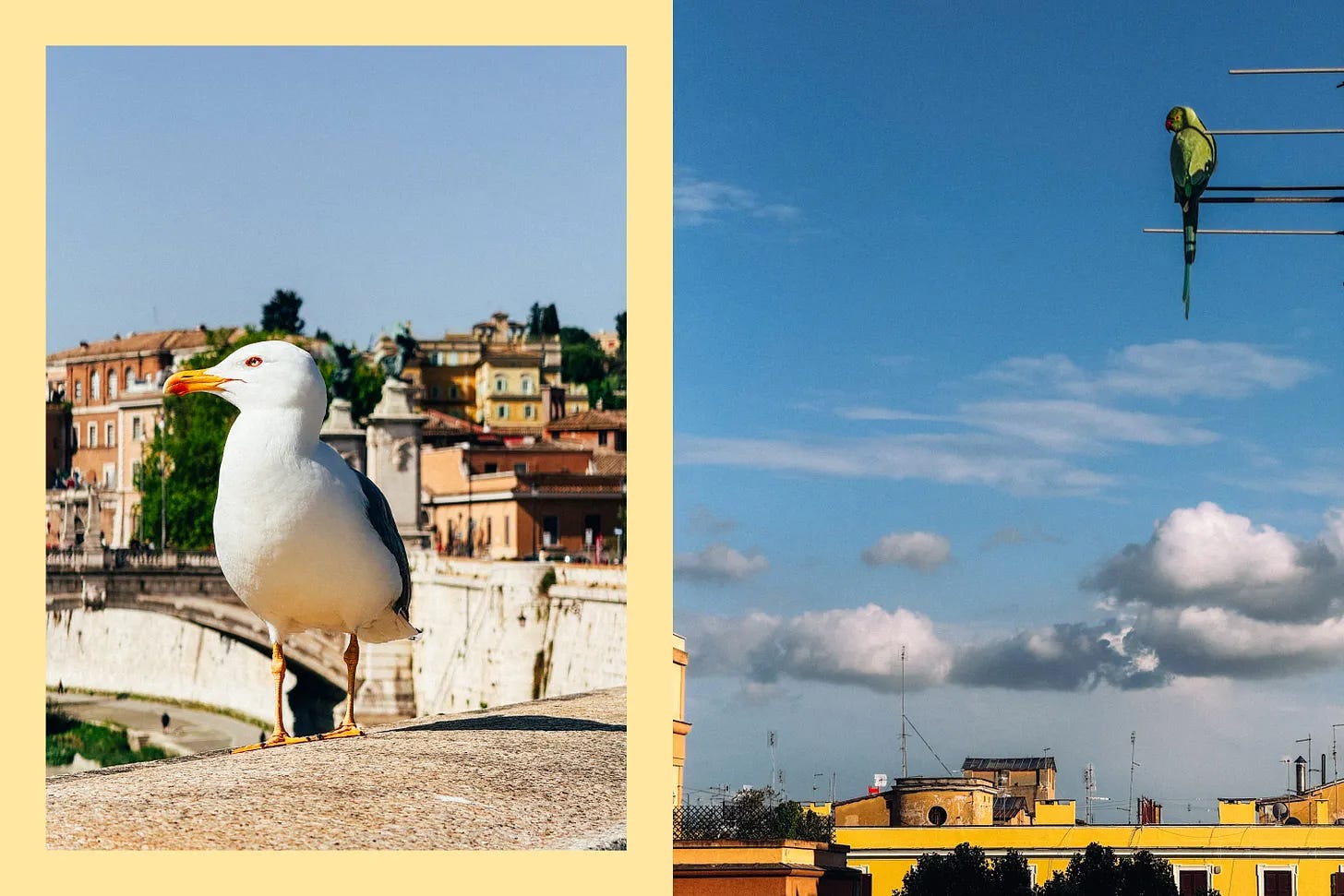
Sara White on the wild side of Rome
Not that wild… Wild boars on the sidewalks in daylight, acid-green parrots descended from escaped pets, and a writer who meets all of it from a bike instead of a car window.
I lived in Rome for a year, and the boars were already treating the northern edge of the city as their own. What I like is the vantage: this is the fauna of someone actually moving through the city, not a news item about an invasion. Rome’s fringes blur into open country faster than any capital I know, and the animals worked that out before the urban planners did.
Flavia Giordano on Salento
Negroamaro is the grape that made Salento’s name long before anyone bottled it seriously, and this piece points to where that history is being reworked: Moros, a 1950s cooperative winery turned contemporary cultural space, hosting exhibitions and concerts alongside the harvest.
It’s a pointer more than a story, but the pointer is a good one. The Salento in it is the working interior, not the beach postcard, and a cooperative cellar reborn as a cultural venue is the kind of place worth planning a detour around.
Frances D'Emilio on the air conditioning situation in Italy
Anyone who has lived in Italy has fought the war of the correnti, the drafts Italians are raised from infancy to fear. Frances traces how a country practically phobic about air conditioning came to install it in half its homes by 2024, while Rome’s electric buses retreat to the depot when their batteries run low and tourists in short-term rentals run the AC all day toward a blackout.
The ending is the best thing I read this week: a woman on a cooled bus, delighted by the air conditioning, pulls a scarf from her handbag anyway… I will write my own piece on this topic soon, because there is also a new angle- the foreigner’s angle on this.
That was this week’s Reading Table. If you read something I missed, send it my way: ciao (at) anywhereitaly (dot) com.


Planning a slow trip? My planner builds it for you. Free, no paywall, no email gate. Answer five questions (hub town, interests, travel month, days you want for slow discovery, and fitness level, because some of these towns make you climb), and you get a personalized route from my handpicked list of the 1,000 towns most travelers skip, with festivals, drive times, and a line on what each place is. Don’t like it? Refine it, swap towns, or browse the whole database by region.
Thanks for the round-up.
Just returned to the States from Italy and was struck by the change from previous years re: a/c. But I also visited France on this trip and noticed that the same change has not taken place there. I do wonder why. One explanation seems to be simply that Italy is hotter than France, but I don’t think the difference is enough to explain it, especially in light of recent heat waves.
Best of luck with your search in Torino!