

Amaro | The joy of bitterness
A beginner's guide on the world of Italian digestives

I wrote about a specific story of an amaro, the Unicum. It has some Italian roots and is very popular in Italy, but it is actually a Hungarian spirit. Today I want to write about the amaro as a genre itself.
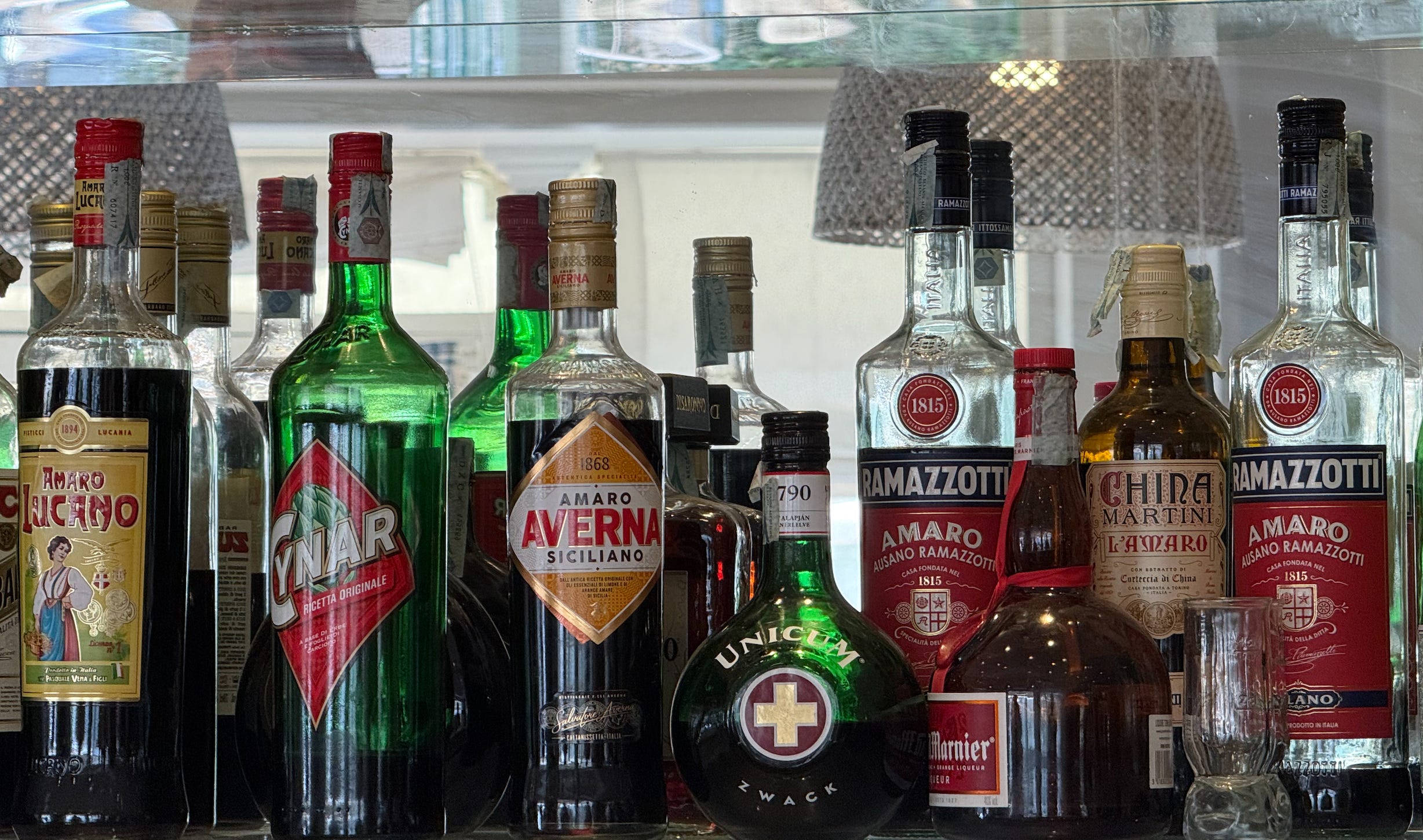
Because aside from wine, there is nothing more Italian than the amaro or bitter spirits.
Some nations have their own versions: Jagermeister in Germany, Becherovka in Czechia, Gammel Dansk in Denmark, Pelinkovac in the Balkans, Zoladkova in Poland, etc. Even gin is similar in the making, but its bitterness is “outsourced” to the tonic water.
But no other country does more versions of this than Italy. I haven’t counted it, but I wouldn’t be surprised if the number of amari in Italy equals or exceeds the number of wine categories in Italy.
And, of course, everyone knows Aperol, and its cocktail version, the Aperol Spritz, which is… no, sonny, no, it’s not a bitter or an amaro. It’s a bitter cocktail, and it is at best a cousin of amaro, but in reality, it is closer to gin&tonic. So, if you want to know what amaro is and what it is for, read on.
The unavoidable history lesson for amaro
Regionality and geography made countless versions of amaro. But all of them have the same journey: alchemists → monks → pharmacies → distilleries.
We need to touch on the super quick history lesson of distilling anything, aka, humanity’s quest to make alcohol. For that, let’s make friends with Jimmy.
Jimmy lives in Egypt or Mesopotamia and discovers a wonderful thing: if you leave a bowl of grapes alone long enough, it becomes wine. And wine is amazing for Jimmy. He also discovers something similar with other fruits and even tricks barley into the same process, calling it beer.
Now, after discovering wine, depending on where we are in time, Jimmy either becomes an alchemist or a parfumer.
If Jimmy is born in the West, he becomes Christian. And for a Christian, alcohol is awesome. It’s part of the Mass, it’s the social pacifier and free happy hour approved by the Church. And we all know that whatever the Church approves in medieval times, it’s amazing. So Jimmy becomes a monk, because they are great at running vineyards and making medicinal alcohol. More on that later.
If Jimmy is born in the East, he becomes a muslim. We don’t count anything more East than Persia here, because alcohol culture in Asia is not that important anyway, or not that important for our story on the amaro (although the Chinese have very interesting medicinal alcohol or amaro versions!). So let’s just stick with muslims here. Jimmy, as a muslim, doesn’t drink alcohol, but he surely does make perfume for muslim ladies. And that requires distilling alcohol. More on that later.
It’s the medievals, and it’s kinda dark, so whatever that is not Jesus-approved (pretty much nothing) comes from the East, where the ancient knowledge has been somewhat preserved by educated muslims. Among many things like mathematics that are not that important for reading Genesis but kinda important for a magical thing called science, comes something even more awesome than mathematics: the alcohol distillation process. Before this, only alchemists (both Christians and muslims) were somewhat allowed to experiment with potions and anything remotely close to medicine.
At that time, muslims did this to make perfume. We, clever Europeans, realized that our alchemists could make even stronger wine with it. And our Baby Jesus said OK to drink, so… guess who did the drinking first? Guess who did the drinking first: monks. So pretty much anything that requires alcohol distillation started in a monastery somewhere in Europe.
So. Bye Jimmy, we have arrived at the point where clever European Christians are able to distill alcohol. At first, believe it or not, this whole spiel had two routes.
One is making wine stronger, which later led to the long history of brandy-style drinks, which are part of another story. It was the route that later went into sprouts like the super minimalistic, we-just-distill-anything passes of vodka and whisky.
Two is putting any kind of weird but cheap herbs into the distillation. That’s the amaro, or bitter or medicinal alcohol, passage. It wasn’t a new method at all. Even pre-medieval Jimmy put herbs into the wine and fortified it. Wormwood was common for medicinal wine drinking, which was later named vermouth. Long story short: put some herbs in it, distill it, you get something bitter, nice.
And what tastes bitter but is good for you? Medicine. People connected wine with joy, so most monasteries made wine for the festivals and sacred events. When distillation arrived in Europe, monks started making bitter drinks for medicinal purposes. Herbs were the medicine, alcohol was the carrier.
Once Baby Jesus said OK to science (around the 17th- 18th century, it took him a couple of hundred years from semi-OK to fully-OK this thing…), pharmacies were the first to emerge. They started selling potions and remedies for the sick. And from where they got their first batches of distilled bitter alcohol? Of course, from monks.
From there, the route was as simple as the economic journey to capitalism. Somewhere, somehow, a pharmacist realized that this bitter stuff is not just for the sick. We can build a brand! And this is how any bitter drink got its baptism in and around the late 19th century. By the way, Americanos reading this, Coca-Cola was born the same way.
So what is amaro and what isn’t?
You know the story now, so you know what amaro is. It’s a bitter, hard-distilled alcoholic drink infused with herbs, with some medicinal uses, often connected to digestive issues. That is why it's most commonly called a digestive, or a drink you drink after the meal.
So amaro = distilled hard liquor + herbs + medicinal value + consumed after a meal.
It’s not part of the definition, but goes without saying that because of the herbs and medicinal values, you can’t drink too much of it. It’s one of the worst ideas you can have: getting drunk solely on amaro.
But what is not amaro? This might be a bit longer, but it's equally simple. Every word matters: a bitter drink infused with herbs. Gin is infused with herbs (juniper or modern versions are infused with anything really). But it’s not bitter. Bitterness is outsourced to the tonic water. Vermouth then? No, the carrier is not hard distilled alcohol. It’s wine. Grappa, vodka, whiskey—no, no herbs and botany at all. Those are pure distilled alcohols. Anything made for cocktails: Angostura or other bitters that are there only to infuse cocktail drinks with bitter flavor. Or everyone’s favorite Aperol, where the alcohol level is too low (Aperol is 11% or something?) so they are not meant to be consumed alone. Even Campari is borderline. These are more like cocktail bases than standalone drinks.
And there is the grey line. People think they are amaro, but... Limoncello, sambuca, amaretto, nocino, and all the others where the method of making amaro is there, but there is one slight thing that makes it less of an amaro. Sugar. In some cases, an absolute bonkers amount of sugar. Some of them are a bit bitter, yes, but sugar always overpowers the bitterness. As far as I know, there is also a law that says if you have x amount of sugar, you are technically a liquore, not an amaro. These are considered more like sweet digestives.
The digestive value and the hyperlocality
I think the digestive value is the one thing that defines the amaro in terms of how it is consumed. Because once we get this right, the only thing left is locality, which is purely driven by geography and makes this entire category interesting because you can discover new amari all the time during your travel.
Digestive value means it aids digestion. So it is supposed to be consumed after the meal or for weird digestive issues. In some cases, especially in Northern regions, amaro is consumed to treat seasickness. Amari made in the mountains are heavier because the meals were more meaty, fatty, heavy. Southern amaro, especially by the sea, is lighter, often made from citruses, not because citrus and the sea are there, but because the meals are lighter anyway.
Once you get that, the last thing you need to know is the ever-true thing about Italy: everything is hyperlocal.
Amaro is made from local herbs. Whatever it is favored, available, or part of the local patron saint festivities, or artisans, or whatever it is that is fully local there. There are amari known only in a few towns and made for a few towns. There are ones which are made into big-brand batches and are available on almost all bars’ shelves. And there are restaurants and local trattorias that pride themselves on having that bottle of amaro only, and they give you a look if you order the big-name Montenegro one.
Just an example: I have no idea what the name was, but I’ve had a chestnut-flavored one in Garfagnana. The most authentic amaro experience I have ever had was a bottle, not even labeled, sold by an old grandpa from his wine cellar in Equi Terme. He mentioned the herbs, but my Italian is not that deep. He made sure that even though we didn’t buy the whole bottle, at least we tasted his creation. It was a matter of pride, not a matter of transaction. It was great, a bit edgy, probably because it was 100% homegrown and homebrewed.
But I’m from Hungary, and we have a thing called palinka, which is pretty much brandy distilled from whatever fruit fell down from the trees. It is strong, definitely nothing mellow about it, and mostly homemade. Almost no one buys it from the shops, because everyone has someone who makes their version of this drink. Amaro is kinda the same in the making.
How amaro should be consumed
This will also be very straightforward. Amaro is a digestive, so you should drink it after the meal. You can drink it neat, with water separately, or with ice. This is kinda similar to whiskey drinking. Unrelated to your choices, it is almost always served room temperature. Some of them are served cold, even freezer cold (like the del Capo). Same amount as any shot, like a whiskey, again. Unlike whiskey, which is often served in a narrow-on-the-top glass to concentrate the fragrance of the drink, amaro is almost always served in a simple wide round glass. Smell is important, but taste is what you need to savor more. Some people buy a cantucci with it and dunk the cookie in the amaro as a form of dessert. I’ve seen some people dunk simply bread in it. It’s up to you.
The goal of the amaro is to prolong the evening conversation. It is by definition a slow drink. You are sipping it. Since it is often very bitter and the herbs also need some patience from you, you can’t just simply shoot it down. Professional amaro experts, like myself, drink an amaro for half an hour or more.
Some amari come in cocktails, or more like, some amari can be served as the base ingredient of a cocktail. But that’s an aperitif, not a digestive. It opens the evening, not closes it. All those versions of spritzes where some form of bitter is topped up by prosecco or simply soda. And also, some amari make into coffee. It’s called caffé corretto, corrected coffee. It’s an espresso shot mixed with a shot of alcohol. The three most popular options are amaro/bitters, sambuca, and grappa.
But when you say amaro, it’s most likely something that you get neat, after the meal, and you drink it slowly.
Some amazing amaro examples
I did some research, well, my AI did. I tried some of these personally (will mark it).
Braulio. Coming from Bormio in the Lombardian Valtellina valley. A 150-year-old recipe, aged in barrels in cellars dug under the town’s streets. The locals literally walked on their amaro cellars.
Cynar. It’s popular, and it is made from artichoke. It’s from Veneto and it got popular from the ad from the 50s post-war boom. A then-famous actor was sipping the amaro in the middle of the busy Milan traffic at a table, reading a paper, giving zero f. The slogan was “against the hustle of modern life.” I tried this, and it has this weird aftertaste of artichoke, which to me is a bit too much.
Amaro Lucano. Made by a pastry shop owner in Basilicata. It says on the bottle: work and honesty. Their slogan: what else do you want from life? Accurate. I tried it, and it is easy to fall in love with it for those who are rookies in amaro. It’s on the sweeter side (guess this is the pastry heritage).
Centerba. I have never tried it, but it has a legendary reputation. The name means hundreds of herbs, because, you’ve guessed it, it is made from around a hundred herbs in Mount Majella, Abruzzo, where it is a regional treasure. It comes in an easily recognizable green bottle. And it is 70% alcohol. It is advertised for its antiseptic properties. With 70%, you bet it’s antiseptic.
Montenegro. Named after Princess Elena di Montenegro, the wife of King Victor Emmanuel III. It’s one of the most popular amari in Italy, available in almost all places. Very forgiving, mild, mellow. No judgment here, but it is often ordered by old nonnas. I tried it. To me, it is almost like non-bitter. You put in more than one ice cube, and it’s almost a dessert drink.
The del Capo. Or fully written: Vecchio Amaro del Capo. One of my favorites. Best stuff to drink during summer. You have to ask for it or look it up on the menu because it is never out on the shelves. Why? It is the national consensus that it has to be served from the freezer, ice cold, like a vodka.
The China Elixir. The Elixir di China Clementi. Or simply just China on the bottle. Nothing to do with China. It means quinine, which is the base ingredient of this one. Comes from my turf, Fivizzano, in Lunigiana. Started as a malaria medicine because in the Versilia swamps, malaria was common. Made by the same family since 1884. I tried. It’s one of the most bitter ones. By the way, did you know that quinine is almost undrinkable in its purest form, so tonic water has to have so freakin’ much sugar that it has more sugar than a bottle of generic sweet soda? All because of quinine.
Ramazzotti. If Montenegro is a popular one, Ramazzotti is the rockstar of amari. It is the first industrial-made, mass-produced amaro, coming from Milan, of course. Mr. Ramazzotti opened his bar in the 1840s next to La Scala and tried to outsmart local bars on coffee, so he started the ammazzacaffé thing. He went to war with coffee and suggested that people should drink amaro (his amaro to be precise) instead of coffee. Nowadays, the ammazzacaffé stuck, and it is an amaro consumed after the coffee. Sort of like the caffé corretto, but instead of mixing the amaro in the coffee, it is served separately, as water would. I tried it, obviously, it is almost impossible to avoid it.
One last thing. Compared to other drinks like vodka, whiskey, or cognac, or rum, or whatever, it is not recommended to get drunk from amaro. Simply put, you shouldn’t have more than 2 glasses a day, or your stomach rebels. Because of this, amaro bottles tend to stay open for longer periods than other drinks. They live on the shelves, opened. I don’t know if it is because of the prolonged shelf life, or because in Italy anything that is artisanal tends to be beautifully designed, but amaro bottles are almost always amazing to look at. Seriously, they are a design marvel. Beautiful. They often carry their hundreds-of-years-old graphic style.
But, and I’ve said it before, the best experiences are coming from unmarked bottles. From a wine cellar. In a medieval small town. From an almost hundred-year-old grandpa. Who is proudly showing off his creation. His recipe. His amaro.

Planning Italy? Our free planner builds your route from all 1,000 towns: