
Focaccia | The Bread That Takes the Shape of the Town
One dough, three cities, and the morning in Genova when the espresso arrived in the wrong glass on purpose

I have a confession to open with: I had to do research for this piece, actual sit-down research, about a flatbread. This is embarrassing because focaccia is not obscure. It is one of the most famous foods Italy exports, and, after years of living here, it is also the food that has most consistently refused to mean one thing. Tuscan bread, I learned in a season. It is white, hard-crusted, salted, or defiantly not. It belongs to certain dishes and certain jobs, and once you have seen it at work a dozen times, you have its number. Focaccia: I have now eaten it across three regions, and each region has given me a different version with the same name. So I was quite unsure what it actually is…
Like most people, I arrived in Italy with an idea of focaccia already installed. In Hungary, bakeries sell something called focaccia, which I have eaten, and I can now report that it has approximately the same relationship to the Italian article that a poster of the sea has to swimming.
The first real one I ate was in Lerici, in Liguria, which, as birthplaces of first impressions go, is close to the source. That version worked more or less like a pizza dough with ambitions: toppings on it, many variations, served mostly hot, drunk against a beer or something cold with bubbles. It was very oily, very salty, very heavy, and I want to be clear that this is not a complaint, I liked it enormously. I filed focaccia away as loaded, hot, and slightly dangerous, and considered the matter learned.
Then we moved to Versilia, and the matter unlearned itself. Almost every shop here sells focaccia, and the Tuscans make a different thing of it: less salty, less oily, drier, lighter, a bread that has been to confession. Its job is different, too. Here it gets cut in half and filled with Tuscan salumi, or cubed and scattered on those platters of cured meat that this region considers a food group, focaccia as the delivery mechanism for finocchiona, for prosciutto, for porchetta if you’re lucky. The Tuscans half admit it’s another bread altogether: much of what fills their counters answers just as readily to schiacciata, the crushed one, a name that quietly declines to compete with Liguria at all. Same idea, different animal, and a completely different afternoon.
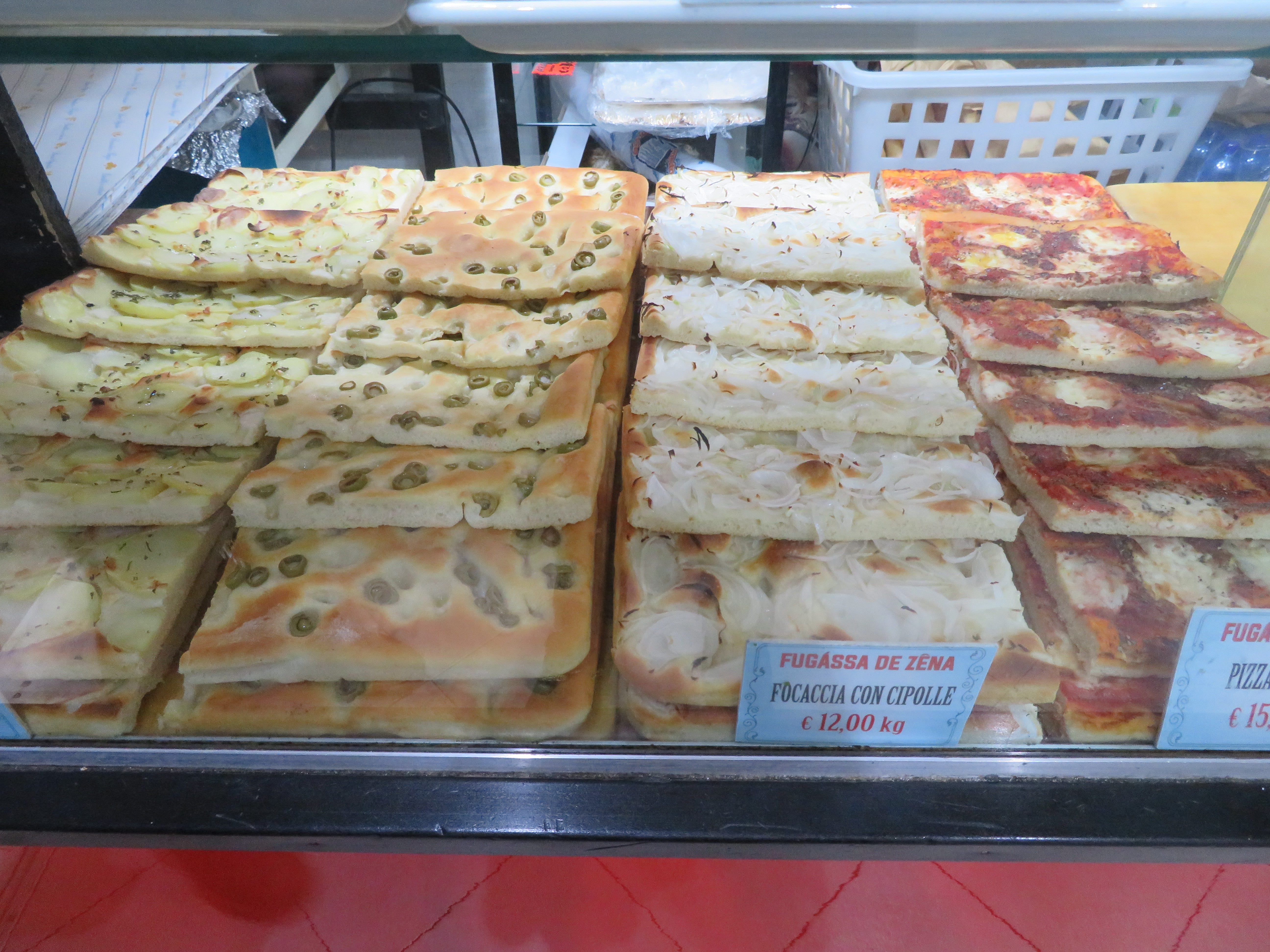
Then we started driving to Genova, and Genova retired my remaining theories. In Genova, focaccia is not lunch, and it is not a vehicle for anything. It is a staple of the cafés, and it is breakfast. The fugassa there is eaten plain, no topping, no filling, no cheese, and the Genovesi dunk it in their morning coffee the way the rest of the world dunks biscuits: into a long coffee, into a cappuccino, into, if that is what’s on the counter, an espresso. The first time I ordered focaccia with an espresso and watched the espresso arrive in a wide cappuccino glass, I thought the bar had made a mistake. It had not. The glass was the accommodation: the coffee came in the wrong cup on purpose, so the bread would fit. Nobody announced this. It was simply anticipated, the way a hardware store anticipates that you will need screws with the hinges. A salty, oiled bread, dipped in coffee, at eight in the morning, and an entire port city in silent agreement that this is the correct order of things.
For the price of a glass of Chianti, unlock the full Anywhere Italy experience. All of our articles, private stories, and access to our chat travel community.
Start your free 7-day trial.
It helps to know who invented the agreement. And here comes the research part. The old forni of Genova cluster near the port because the fugassa was the breakfast of the camalli, the dockers, men who started before dawn and needed something cheap, fast, salted, and already in hand. The bakers worked the dough at night so it would be hot when the shift began, and they still do; the name itself goes back to the hearth, a focus, a bread as old as the fire it sat on. What I met at that café counter was not a quirk. It was the last living gesture of a working port’s morning, performed daily by pensioners and office workers in a city that has otherwise moved its cranes ten kilometers west.
So here is everything I can actually tell you about focaccia, the entire yield of my research, and my three regional educations. First, it is one of the cheapest, fastest breads in Italy. Flour, water, oil, salt, and not much patience. The peninsula’s answer to the tortilla, the naan, the pita. Which is exactly why it was the food of dockers and not of dukes. And second, because it is cheap, fast, and neutral, it takes the shape of whatever town is holding it. Liguria’s coast loads it and serves it hot with beer. Tuscany dries it out and puts a butcher’s counter inside it. Genova strips it back to nothing and dips it in coffee at dawn. There is no The Focaccia, and every region will tell you, with total confidence, that theirs is it.
I have stopped adjudicating. But I will say that of the three educations, the one that stays with me is the Genova counter: the wide glass, the wrong cup on purpose, the salt and the oil meeting the coffee, an old dockers’ breakfast outliving the dockers one dunk at a time.


Planning a slow trip? My planner builds it for you. Free, no paywall, no email gate. Answer five questions (hub town, interests, travel month, days you want for slow discovery, and fitness level, because some of these towns make you climb), and you get a personalized route from my handpicked list of the 1,000 towns most travelers skip, with festivals, drive times, and a line on what each place is. Don’t like it? Refine it, swap towns, or browse the whole database by region.