

The sweet lie of 'dolce vita'
Sunday Espresso IX.

Buona domenica!
There should be an entire book written about the misunderstood concepts around Italy. Maybe there is one (if yes, point me to it, please). There is a country that has to do nothing to market itself, because the world does it anyway. While other countries spend millions on creating a mythology and advertising their strengths and the reasons why people should visit them, Italy does nothing.
If Italy does anything, like a tourism campaign, it misfires hilariously, like their Botticelli Venus influencer campaign, open to meraviglia, where a digital Venus goes to stock video wineries and famous spots in Italy. No joke, one of the winery's stock videos featured a Slovenian winery. I’m not linking it, find it on YouTube. Still, even with this amazingly stupid campaign, Italy managed to become one of the top destinations on Earth, and when the campaign came out the next year, Italy grew its tourism income by 10% from an already insane level of 50 billion. So it really doesn’t matter what Italy does, even if they mess it up, the world still comes.
That brings us to the absolute lie of the concept of dolce vita, which, even typing it, makes me itchy.
Where do we start? Let’s start with Fellini. Anita Ekberg in the Trevi seems like a good start. That’s where the entire term is coming from. The Italian journalist (Mastroianni), the blonde femme fatale (Ekberg), sea, sex, a cabriolet, parties, and a monster pulled out from the sea. Oh, you don’t remember that at the end they pull a literal monster out of the sea, a literal representation of how dead everyone inside of this peak hedonism? The entire movie is about the critique of consumerism, how empty we all are when we mindlessly follow consumption, experiences, and do all that without real depth and meaning. It’s about postwar Italy, how Italy was booming and became a world-leading economy, the Italian miracle of the late 70s and 80s, and how that intense growth removed the traditional values from the society, which had once flourished, replacing it with mindless consumerism. The entire movie is an irony. Everyone took the Trevi scene, stripped off the irony, and adopted the dolce vita = careless enjoyment of life that is available in Italy.
It’s not Italy’s fault that if this movie had been shot in the ‘70s Liverpool, people would have said it’s like Clockwork Orange, hedonism, grey industrialism, and endless booze, without any meaning or goal to life. No offense, Liverpool! It’s not Italy’s fault that if you film in almost any Italian location, you end up with the most beautiful scenes on this planet, and even the saddest story you want to tell becomes at least a sweet melancholy, but most likely the world simply just misunderstands and calls it beautiful.
But Fellini was sort of right in the long term. Dolce vita, as of today, is really about this depthless posture. It became a product. A postcard. Even worse: a framed sentence in the home office, just above the IKEA desk. Or even much-much worse: a slogan on a T-shirt. It is sold by life coaches, tourism agencies, and literally anyone selling something dreamy, carefree, and hedonistic. It has its own life, not even connected to Italy.
But when it comes to Italy, the entire framing becomes something like an allowance. If you come here, you are allowed to enjoy the dolce vita. You are permitted to do so. You have the opportunity. The ability. Because you need the travel and the being here part, otherwise, you can’t just pour a spritz at home, sit on your porch, and look at your, I don’t know, garden. That’s, at best, a nice afternoon, but definitely not dolce vita. You need Riomaggiore for that. Or Firenze. Or a photo with the Trevi.
And I don’t even want to go into the route of how this dolce vita is supported by others, if it is true anyway. In short, I am not 100% sure that Marco, who brings you the Aperol on the piazza, has the time of his life after his 7th hour and 2nd shift that day on that beautiful hot summer day in Arezzo. And the long list of problems that Italians have in their lives, just as you do, and I can promise you, they won’t say oh at least I have this dolce vita thing here.
So if dolce vita is a lie, what’s left? Because life is sweet. The chasing of the sweetness, what dolce vita is selling you, that’s a lie. It’s a treadmill with a sea view. Once it wears off, you need another shot. It’s how social media works, with its dopamine addiction spiral, you just replicate it with an Aperol on a piazza. You don’t need Italy to do this.
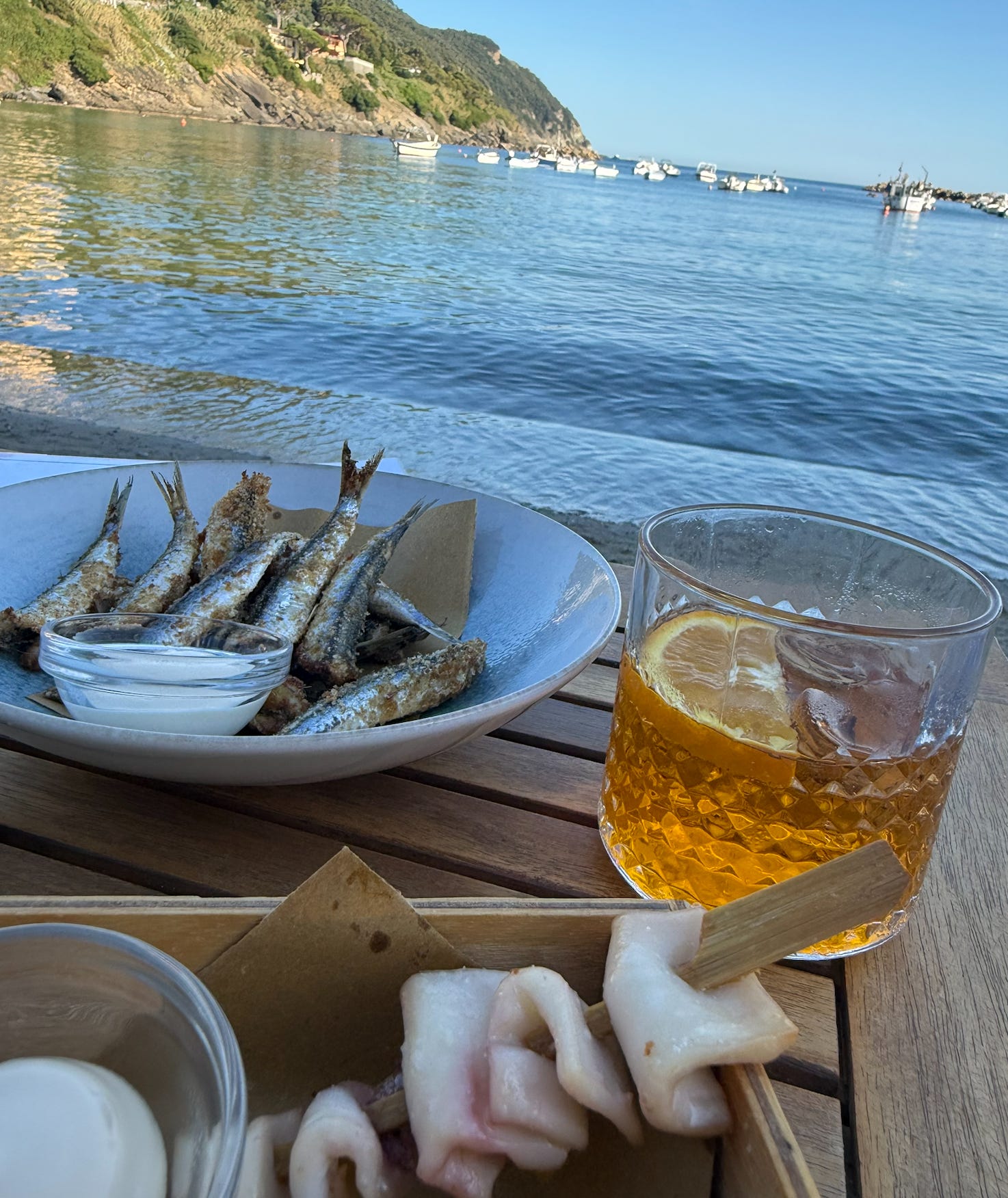
Now, this is a publication about Italy, so there should be something that explains why you really need Italy. Because I would be lying if I didn’t admit that living here has changed me. Slowed me down a lot. Reminded me to focus on the small things, the moments, even the ceremonies of ordinary activities. I guess every country around the Mediterranean has this, in some way or another, I know, since I have visited all of them. They all celebrate life in the little moments. But it’s in Italy that you can do this with a background set that exists nowhere else. The entire country’s built and natural landscapes support stillness, traditions, and slowing down to enjoy sweet moments.
But you can’t really make this yours in a few hours on a trip. What you can do, however, is to experience it as an example and learn from it. So, the next time you are on your porch, pouring a drink for yourself, looking at your garden, you would say, ok, this is dolce vita. It’s yours only. No travel was required.
A dopo,
Peter
Pietrasanta, 28 June 2026
What’s new on the page
The Mediterranean Diet is also a lie
I don’t know what’s up with this week, but I guess I’m in a mythbusting mood. I saw a YouTube video about blue zones, which put my blood pressure somewhere between Mars and Jupiter, so I decided on the spot to write about the diet, longevity, and healthy eating. I don’t want to divert this publication into gastronomy at all, but this thing still makes me itchy, so the first piece landed this week. More will come on this topic. The next will definitely be about the mega-BS blue zones.
The Mediterranean Diet Is an American Invention

Start with the fact that nobody selling you a cookbook wants to say out loud: the Mediterranean diet is American. The term, the framing, the entire concept came from Ancel Keys, a physiologist from Minnesota who landed near Salerno with the US Army in 1944 and noticed the locals were dying of heart disease far less than the executives back home, despite having far less food to choose from. He came back after the war, settled in the Cilento, and spent the rest of a very long life studying why. He coined the name, built the science, did the research. The Italians themselves never sat around calling dinner a “diet.” They ate what they could afford.
On travel, it was Liguria time again. I am obsessed with the Cinque Terre because it is starting to feel like a theme park, like Venice, so I am writing more about nearby alternative destinations that are less crowded but offer similar experiences.
One was the Magra-delta roadtrip published in early June, and the other went live this week, on Tigullio.
Tigullio Roadtrip | Four Versions of the Same Liguria

There is a thing that happens after you have spent enough time driving the coast between La Spezia and Genova, and it is the thing every honest piece about this region eventually has to admit. The seaside towns are mostly the same. I do not mean this loosely. I mean that if you take the eighty or so kilometers of coastline between these two cities, ignore the inland villages, and bracket out the

Planning a slow trip? My planner builds it for you. Answer five questions, and you get a personalized route from my handpicked list of the 1,000 towns most travelers skip, with festivals, drive times, and a line on what each place is. Don't like it? Refine it, swap towns, or browse the whole database by region. Simple. Free. No paywall, not even an email gate. Pure discovery for you.
→ Start planning your trip on Anywhere Italy.
I started learning Italian after moving here. Restaurants run on English, but anything past ordering lunch doesn't. Before I hired a teacher, Babbel did most of the work, more real learning than Duolingo's gamified fake learning. I'm a Babbel affiliate, but I only point you to things I've used and liked.