
Tigullio Roadtrip | Four Versions of the Same Liguria
The case for choosing the less crowded version of essentially the same coast

There is a thing that happens after you have spent enough time driving the coast between La Spezia and Genova, and it is the thing every honest piece about this region eventually has to admit. The seaside towns are mostly the same. I do not mean this loosely. I mean that if you take the eighty or so kilometers of coastline between these two cities, ignore the inland villages, and bracket out the Cinque Terre theme park for being its own different thing, the underlying town is, structurally, one town. A steep hill falls into the sea. The houses are crammed on the slope and painted in bright colors because they are old, packed tight, and need help. There is a small port if the cove allows it and a bigger port if the cove is generous. There is a small piazza around a small church, with maybe four restaurants, three bars, and a gelato place. There is no space for a grand square, because there is no space for grand anything in Liguria. That is what Piedmont and Tuscany are for. Parking is theoretical. The food is focaccia, pesto, small fried fish, and the same Vermentino. The streets are too narrow for the car you came in.
To a local, the differences between these towns register. To an enthusiast who has spent years on this coast, they register. To a traveler, by which I mean someone who has been to Italy enough times to know what to look for, the differences are visible but not load-bearing. To a tourist on a week’s holiday from somewhere that does not have an Italian coastline, the differences do not register at all, and arguably should not, because the underlying experience is the underlying experience. If you spent two weeks in Lerici, two weeks in Rapallo, two weeks in Portovenere, and two weeks in Chiavari, would you come home with four utterly different memories of Italy? You would not. The towns would blur. What would not blur is how many other people you had to share the towns with. That is the variable.
This is the piece for choosing the version of the same town with fewer people.
The road trip is the Tigullio, the gulf between Punta Manara at Sestri Levante in the south and the Portofino promontory at the north, a fifty-kilometer arc that catches four towns of any size and a fifth on the other side of the Portofino ridge. You can do the whole loop in a day. Most of the towns are ten minutes apart by car. We did it the first time when we were curious about the real estate around here, before Pietrasanta found us. Rapallo and Chiavari were both on our short list. The real estate is good, the access is good, and the towns are nicer than the brochures admit. The order I am going to use is not the order we drove. It is the order that makes the argument.
We start with the two famous ones and get them out of the way.
Rapallo is what happens when an Italian seaside town designed for fifty thousand people gets visited by a quarter of a million in season. The geography is what makes Rapallo dramatic: a wide flat bay, the hills rising directly behind it, a small castle sitting on its own rock in the harbor where the bay narrows toward Santa Margherita, the Liberty-era hotels along the seafront in pastel rows, the funicular climbing to the Madonna di Montallegro shrine on the hill behind. The town is beautiful. It is also, in season, almost impossible to use. The seafront is a slow-moving column of pedestrians. The cafés on the seafront have queues stretching into the street. Parking is theoretical. The experience of being there shifts from I am on the Italian Riviera to I am stuck in a crowd that is on the Italian Riviera. The difference is significant.
This is unfair to Rapallo, in one specific sense, because Rapallo used to be something else. From 1924 until 1945, Ezra Pound lived in an attic above the Caffè Rapallo on the seafront and wrote the middle Cantos there, with the heavy boats coming in from Sardinia under his terrace. Yeats came down from Ireland to visit and wrote a small essay about how Pound fed the cats of Rapallo every morning at ten, with bones and bread crusts he carried in his pockets. Hemingway came down from Paris in 1923 at Pound’s invitation, walked the seafront, ate fish, and went back to Paris to write his first short stories. Nietzsche had stayed across the bay forty years earlier, in a small pavilion overlooking the same water. T.S. Eliot passed through. And in April of 1922, in this town that is now a queue, the Republic of Germany and the Soviet Russian Republic signed the treaty that allowed Germany to begin secretly rearming on Russian soil, an arrangement that mattered rather a lot to the next twenty years of European history. Rapallo is, by literary and historical density per square meter, one of the most weighted small towns on this coast. None of that helps you find a seat in August.
The comparison I am going to make is the one Italians do not appreciate but which is structurally exact. Rapallo is what Positano is to the Amalfi Coast: the photogenic concentration that everyone has decided is the destination, and that consequently can no longer be experienced as the place it was when people first decided that. It is a beautiful town turned into a queue.
For the price of a glass of Chianti, unlock the full Anywhere Italy experience. All of our articles, private stories, and access to our chat travel community.
Start your free 7-day trial.
Portofino is the next one along and the harder case to write about honestly. Portofino has approximately four hundred permanent residents, a commune of two and a half square kilometers, and on a busy summer day perhaps fifteen thousand visitors, including the ones who never get off the day-tour boat. The town is a single small harbor at the end of a narrow road, three streets of pastel houses around a piazzetta, a church up the steps, a castle on the rock above, and the deepwater bay below where yachts of the kind that have names instead of registration numbers sit at anchor. The setting is, even now, one of the most photographed in Italy. The setting is also, even now, beautiful. The problem is not the setting.
The problem is that Portofino has, over the last sixty years, ceased to be a fishing village and become a piece of theatre. The boutiques are Hermès, Gucci, Dior. The restaurants are run for people who do not look at the bill. The cliché I am about to make is the one any honest Italian will make to you after the third glass of wine and the second time you mention Portofino: it is the Capri of Liguria. The same thing happened to it in roughly the same decades, for roughly the same reasons, with roughly the same result. The fishing village got photographed, the photograph went around the world, the world arrived, and the village quietly stopped being a village and became its own postcard. The international category for this kind of place includes Mykonos in Greece and Ayia Napa in Cyprus, with regional variants in every other coastal country that takes pictures. Portofino is the Italian Riviera’s contribution to the genre. If you are arriving on your own yacht, the genre works for you. If you are not, you are the audience for a piece of theatre that you paid to enter and that has no seats.
I am not, to be clear, saying do not go to Portofino. I am saying that Portofino has become a place you visit to confirm what you already knew it was, and that the confirmation costs you a day, a parking fee, and a queue. Twenty minutes away, on the other side of the same ridge, is a town that is structurally Portofino without the theatre. It is called Camogli.
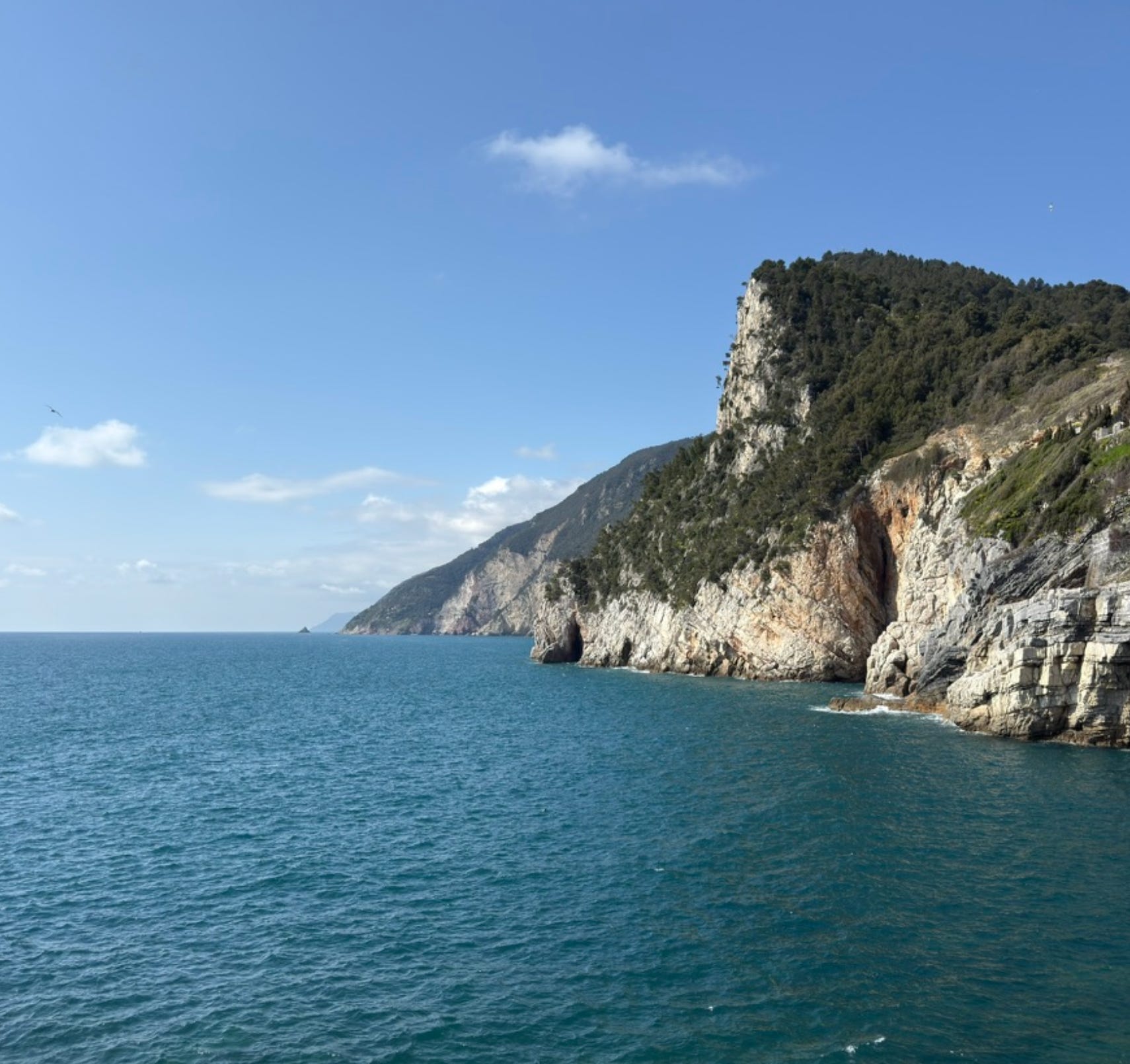
Camogli is on the western side of the Portofino promontory, facing the Golfo Paradiso rather than the Tigullio. The same ridge ends in the sea, but here it falls more gently. The extra room shows. The promenade along the seafront runs for several hundred meters where Portofino’s runs for forty. The crowd density is lower when there is a crowd, not because Camogli has fewer visitors (it has plenty), but because the town's geometry distributes them. Camogli is structurally Portofino with the theatre dialed down, and on a busy weekend the difference is the difference between a town and an attraction. We do not have a special insight into why one became Portofino and the other did not. We suspect, but cannot prove, that the photograph of Portofino harbor was the photograph that got around the world first, and that what gets photographed first becomes the version other places have to compete with. Camogli is what this coast looks like when you let it not compete. Santa Margherita Ligure plays the same role on the eastern side of the headland, slightly south of Rapallo, slightly more elegant than Camogli, slightly more touristed, never anywhere near Rapallo’s density.
Sestri Levante is the town I would tell you about if you had time for one Tigullio town and no others. I do not know why it is not on every list of Italian coasts. It is not, particularly. I see it occasionally in a roundup of underrated Italian seaside towns, which is the surest way to ensure a place stays underrated, since nothing falls off a roundup faster than a roundup. Sestri sits on a small isthmus that thrusts into the sea, the historic center built on it, the houses pressed against each other in the Ligurian way. Two bays form on either side. The northern one is wide, sandy, called the Baia delle Favole, the Bay of Fables, because Hans Christian Andersen spent some weeks here in 1833 and wrote home that he had never seen anything so beautiful. A hundred and twenty years later, a television presenter named the bay after him on a live broadcast, and the name stuck.
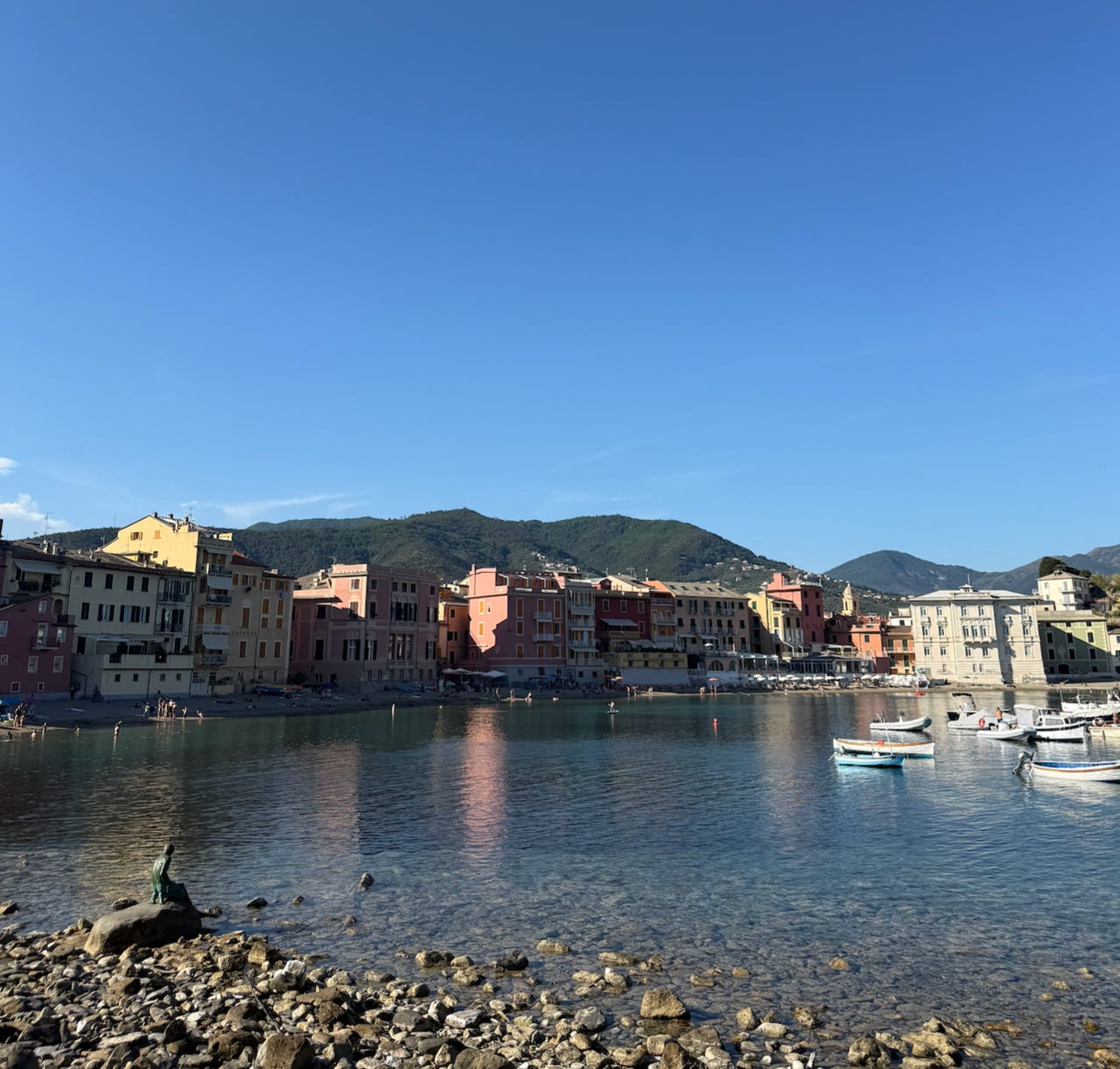
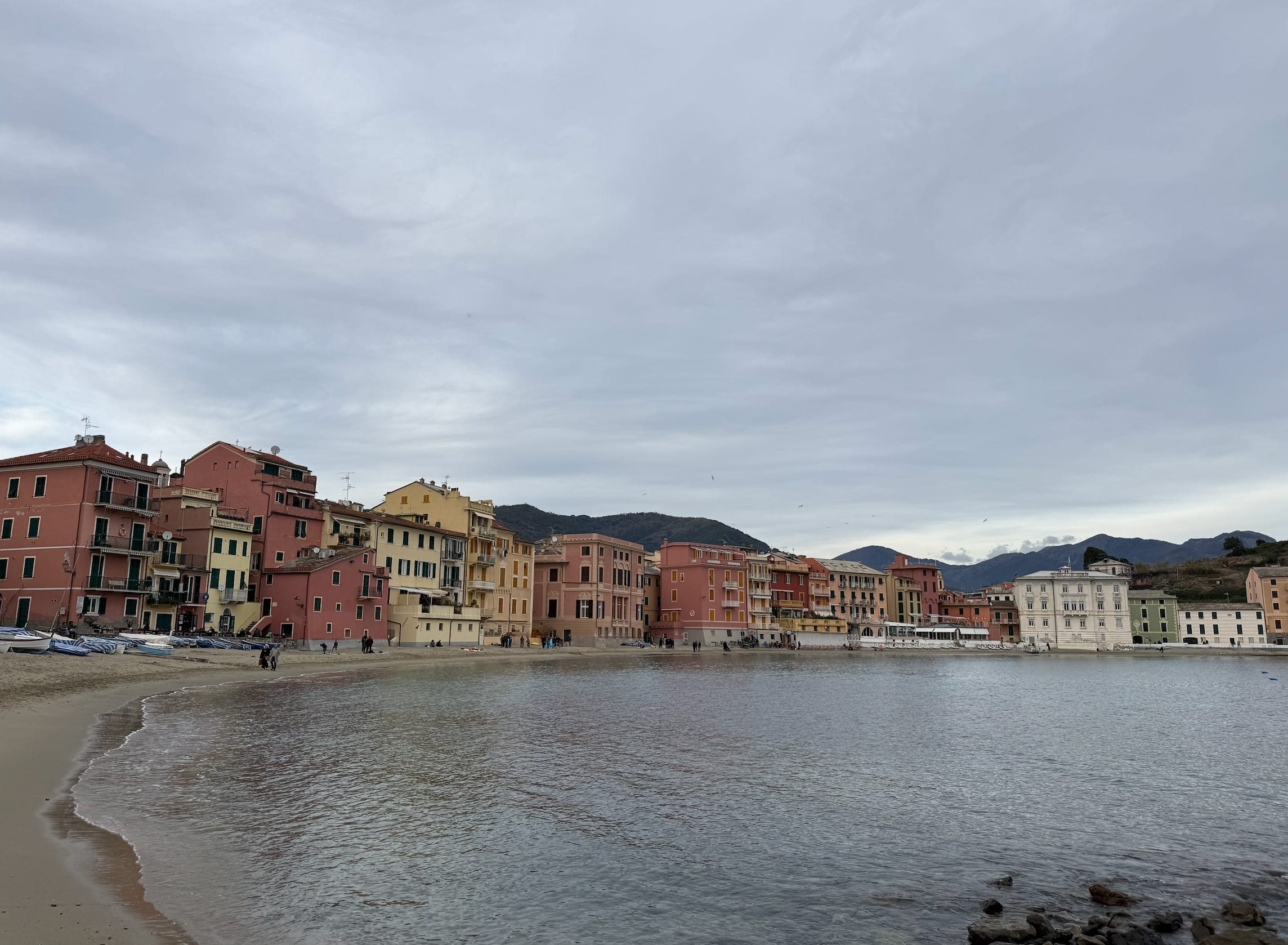
The southern bay is the one I want to talk about. It is called Baia del Silenzio, the Bay of Silence, so named in 1919 by a local Ligurian poet who could think of nothing more apt. The bay is small. It is enclosed on three sides by the houses of the old town, which come down to the sand. The water is shallow. The fishing boats are pulled up on the beach. There is a single curved arc of sand, perhaps a hundred and fifty meters long, and the houses are painted in those specific Ligurian colors, the pink that is almost orange, the yellow that is almost mustard, the green that is almost teal, the white that is never white, and the whole thing, when the light is right, is one of the most beautiful single views in Italy. I will go further. I will say it is one of the most beautiful single views I know anywhere. We have stood on the small terrace above the southern end of the bay several times with Sophia’s camera and watched her give up because the photograph cannot capture what the eye sees. People who write about Sestri Levante always promise the place is photogenic. The Bay of Silence is the opposite. It is the place where the photograph fails, and you have to stand there yourself.
Sestri is also, structurally, the most usable town on the Tigullio. The old town is flat. The streets are walkable. There is parking. Actual parking, in actual lots, with actual spaces, in actual quantity. The old town gives you the whole Ligurian template, narrow streets, bright houses, a piazza around a church, the smell of focaccia, without the steep climb that Portofino and Tellaro and most of the rest of the coast extract as the price of admission. You can do a Saturday in Sestri Levante in the same shoes you wear to walk to the kitchen. You can park. You can eat at a table that someone has dragged five meters from the sea and set with a paper cloth and a glass of Vermentino. The Ligurians, when they have space to work with, know how to use it.
When we were there the last time, the Annunziata convent at the edge of the old town was running its oil-and-bread weekend, a kind of agricultural fair where the producers from the hills around the Tigullio set up small stands inside the convent’s stone cloister and you walk from one to the next tasting olive oil on focaccia with a small plastic cup of the local white. We bought two bottles of oil from a producer in the Val Petronio, two flat tins of anchovies, and a small jar of the spicy acciughe sott’olio, anchovies cured in salt and then preserved in olive oil with chili flakes the producer puts in by hand, which I have been buying every time we have been back since. The acciughe are the load-bearing item. They go on anything. They have gone, in our kitchen, on focaccia, on toast, on cold pasta, on a hard-boiled egg, in a sandwich, on a green salad, and once, late, on a piece of leftover bread with nothing else, eaten standing at the counter at midnight after a long drive home from somewhere.
Chiavari is the working version of the Tigullio, the city to which the rest of the Tigullio existed in relation for centuries. The Genoese founded it in 1167 as a forward outpost against the Fieschi family of nobles, who controlled most of the coast east of here, and Chiavari has been the practical center of the Tigullio ever since. The name itself, Clavarium, means the key of the valleys. It is where the four valleys of the eastern Ligurian hinterland meet the sea, and where the river that drains them, the Entella, finishes itself. The whole town is built around this practical function. The medieval main street, the carruggio diritto, runs in a perfect line under stone porticoes for the full length of the old town. The vegetable market in Piazza Mazzini opens every morning of the working week. The cathedral does cathedral things. The slate from the Fontanabuona valley behind the town has roofed half the houses of coastal Liguria and a fair portion of the formal buildings of Genoa.
Two specific things matter to the visitor. The first is that Chiavari is flat. The old town has not a single meaningful climb. You can walk it in shoes that have no business on a hill. The second is that, in the nineteenth century, Chiavari exported a single object to the world: the Chiavari chair. The Chiavari chair is a small, light, hardwood dining chair with a woven straw seat, designed in 1807 by a local cabinetmaker, copied since by every country that needs to seat people at banquets, and used at every state dinner at the White House for the last hundred and twenty years. If you have eaten at a wedding in Italy, you have eaten on a Chiavari chair. The town does not make a fuss about this.
What Chiavari has that the rest of the Tigullio largely does not is space. The old town opens onto a long flat seafront. The harbor is a working harbor with fishing boats and a marina, and no yacht visible. There are no beach resorts in the resort sense, no large hotels along the shore, no boutique zone, no influencer photo spot. There is the Villa Rocca park on the hill above the town, with a small museum and a botanical garden whose paths run through the shade of plane trees, palms, and old camellias, and which we have walked several times in heat that would have killed us in the open. There is, ten minutes south by car, the smaller town of Lavagna, which is essentially Chiavari with even fewer people and a longer beach, and which we mention here mostly so we have not failed to mention it. If you wanted to do this part of Liguria as a longer trip, two weeks, three weeks, we would tell you to take a flat in Chiavari and not move.
The argument of the whole drive, if it has one, is that this is the gentle Liguria. The towns are not perched on cliffs the way the Cinque Terre are. The climbs are not as punishing as in Tellaro, Vernazza, and Monterosso. The space is generous by Ligurian standards. The food is the same focaccia and pesto and fried fish you get everywhere on this coast, with slightly more room to eat it. You could do worse than to take a flat in Chiavari for a fortnight and use it to see this whole part of Italy without ever once parking in Rapallo.
You could also keep driving. The A12 runs from Chiavari to Genova in less than an hour, and Genova is, I will say plainly and brace for the disagreement, one of the great cities of Italy and one of the most underrated in Europe. The reasons are for another piece. The pointer here is that the drive that begins in the Tigullio does not have to end in the Tigullio. You can be in Sestri Levante for the bread-and-oil in the morning and in Genova by lunch for the rest of it.
The first time we made this drive, we circled in Rapallo and did not park, circled in Portofino and did not park, and ate lunch on the Bay of Silence in Sestri Levante. We have done it many times since. The Sestri Levante stop never moves. The Bay of Silence never moves. The jar of acciughe sott’olio I open at the end of a long week, late at the counter in our kitchen in Pietrasanta, never moves either.
