

The walk after dinner
Lamenting on an Italian national treasure: the passeggiata

We push back from the table at Carlino at nine-forty on a Tuesday in May. The plates are gone, the digestivo is gone, and the conto has been paid. They wave from behind the counter as we leave. The door closes behind us, and the cool evening air finds the back of my neck. I take Sophia’s hand. We do not say anything. We start walking.
This is the third country I have lived in where I have done this thing, walking out of a meal and into a town. The first was England, where for years I walked back from my local pub to my flat through whatever streets the geography gave me, two pints in, the chips wearing off, the cold helping the hangover begin its retreat before it had fully arrived. The second was Japan, where I spent enough time in Tokyo and Osaka to learn that the largest city on earth is experienced from within, a network of neighborhoods you walk to and from. There is no such thing as Tokyo. There are wards of Tokyo. Anyone who lives in one of them understands that Tokyo, like every place worth living in, is a small town surrounded by other small towns. You eat near your apartment. You walk home. You sleep.
The third country is this one. The walk after dinner here has a name, passeggiata, and an entire civic infrastructure built around it.
Via Versilia in Marina di Pietrasanta is closed to cars from May through September. It is the via principale, our high street. Almost everything is concentrated on this street. We walk the spine of it, north towards the piazza. The shops are closed at this hour. Their windows are not. People are looking into them anyway. A woman of about seventy is studying a window display of leather handbags she has no intention of buying, and her husband is studying it next to her, and they are not talking. A boy of about ten runs past us with an ice cream the size of his face. His mother, behind him, is walking slowly with another woman and a glass of something in her hand. They are all going the same direction we are.
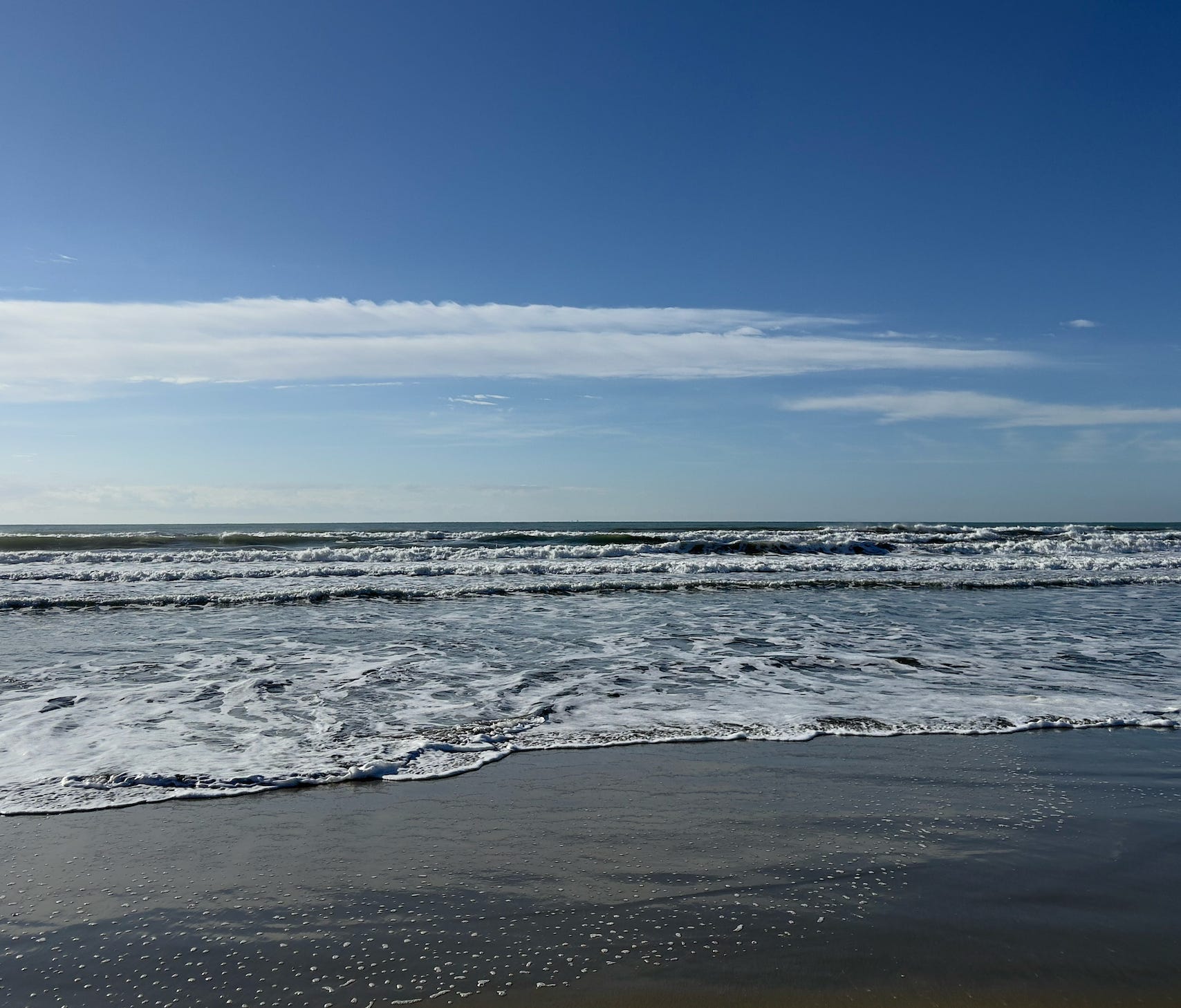
The piazza opens up. The Margherita’s outside tables are full. People are on their second digestivo now, the aperitivo hour having ended a couple of hours ago and the dinner crowd having returned to spend the rest of the evening doing nothing in particular. We cross the piazza and turn toward the sea. The sea is 50 meters away. You can hear it before you see it.
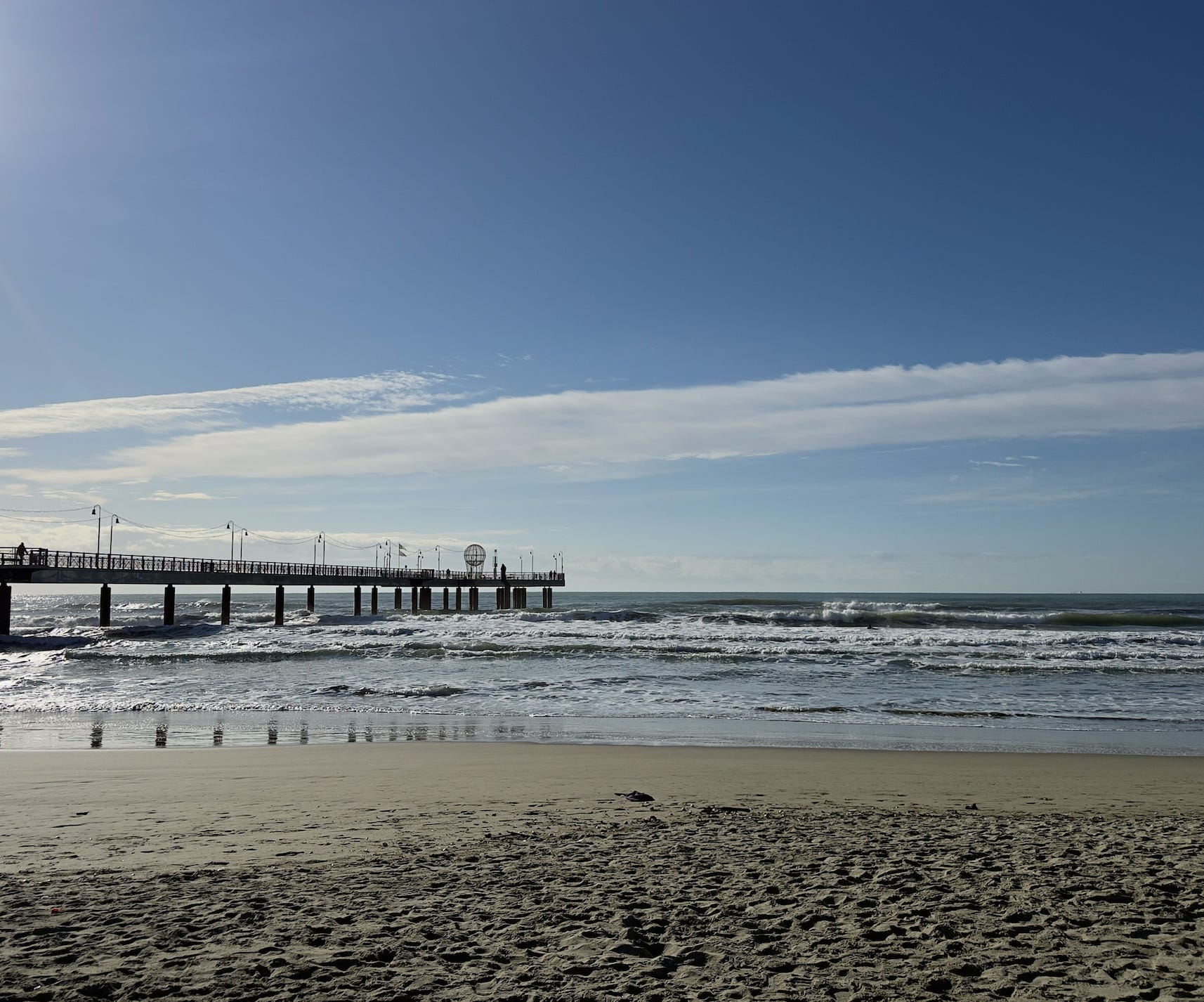
The pontile at Marina di Pietrasanta is a concrete pier that extends about 50 meters into the Tyrrhenian Sea. It has lights along the rails. At its end, there is a small platform where you can stand and look back at the town. We walk to the end. The lights of the bagni run in both directions along the coast, north toward Forte dei Marmi, south toward Lido di Camaiore. The Apuan Alps are behind us, the marble peaks invisible now but felt, the way you feel a wall in a dark room. The water is moving against the pylons of the pier in a slow way at this hour. We stand for a minute. Sophia leans against the rail. I look at the water. We do not say much.
This is the part I did not understand until I had been doing it for two or three years. Italians on the passeggiata do not talk much. This is strange, because Italians at the dinner table never stop talking, and Italians in the aperitivo hour are an unkillable radio. The dinner is a parliament. The passeggiata is something else. People walk in pairs or in small groups, and they do not narrate the walk to each other. They look. They notice. They occasionally comment on a shop window, a dog, or a passing acquaintance, and then they go quiet again. The walking is the point. The talking would interrupt it.
I have come to think that this is the same instinct that prevents Japan from sustaining a street-food culture. You do not eat while walking in Japan. You sit down to eat, with the food in front of you and your full attention on it, and when you are done, you stand up and walk away. The two activities do not overlap. The same is roughly true here. Italians do not eat gelato while walking much. They sit on the wall by the piazza, and they eat it. They do not drink coffee from a paper cup on the move. They stand at the bar, and they drink it. The passeggiata is its own thing, and it is uncontaminated by other things. You walk because you are walking.
For the price of a glass of Chianti, unlock the full Anywhere Italy experience. All of our articles, private stories, and access to our chat travel community.
Start your free 7-day trial.
Compare this to the American street, where people eat constantly and at speed. A breakfast burrito in one hand, a phone in the other, the legs moving toward an office. The walk is a transit between two activities, not an activity itself. The walk has been hollowed out. So has the eating, but that is a different essay.
We turn back from the pontile. The walk back is the inverse of the walk out, and yet it is a different walk. We pass the same piazza, the same Margherita, the same closed boutique windows. The town has thinned slightly in the twenty minutes we have been gone. There are fewer ice creams now and slightly more dogs. A man walks past us in the opposite direction, wearing a linen jacket against the evening chill, smoking thoughtfully, looking at no one. We pass him. We turn off the Via Versilia onto our smaller street, and the streetlights here are dimmer, and the sound of the sea fades.
We have walked for about 30 minutes in total. We have covered a kilometer and a half in distance. The dinner is now properly closed. The body has done the work it needed to do to digest the fritto misto and the wine. The day, which started with a coffee at the Margherita at eight in the morning and now ends with the sound of the sea and a few quiet minutes on a pier, is in the right shape to be put down.
This is the thing I finally want to say about the passeggiata. It is more than a walk. It is also not the slightly ridiculous performance the travel articles describe, the see-and-be-seen parade with everyone in their best clothes, though that version exists on Saturday nights in towns where there is something to be seen wearing. The everyday passeggiata, the Tuesday one, the after-dinner one with no audience, is a quieter thing. It is the act of refusing to drive home. It is the act of refusing to go straight to bed. It is the act of giving the meal an ending, and the day an ending, and the body its proper transition between activity and rest.
England has it, in a humbler form, in the walk back from the pub. Japan has it, in its own form, in the walk between the local restaurant and the local apartment. Italy has it most fully because it has built towns to support it, with its pedestrianized central streets, its piazzas, and its pontili over the sea. But the underlying instinct is the same in all three places, and it is the same instinct I do not see anywhere in the American suburb, the British exurban housing estate, or the new Asian high-rise neighborhood: the walk after dinner is neither optional nor auxiliary. It is the second half of the meal. The kitchen makes the food, the table eats the food, and the walk metabolizes it. Skipping the walk is like reading a novel and stopping ten pages from the end.
We reach our door. The lights inside are off. Sophia finds her keys. The sea is still audible if you stop and listen for it. We do not stop. We have stopped enough already. We go inside.
The day is closed properly now. Tomorrow we will do it again.


Planning a slow trip? My planner builds it for you. Free, no paywall, no email gate. Answer five questions (hub town, interests, travel month, days you want for slow discovery, and fitness level, because some of these towns make you climb), and you get a personalized route from my handpicked list of the 1,000 towns most travelers skip, with festivals, drive times, and a line on what each place is. Don’t like it? Refine it, swap towns, or browse the whole database by region.