

The world map of food
Sunday Espresso XII.

Anywhere Italy is partially a publication about traveling and living in Italy, a weekly newsletter, and also a product. The product is something I am building in the background. It is a curated, collected, and connected database on the 1,000 best communes of Italy. You can see it here. I am building it publicly.
As of today, the database so far has one practical use case: a slow travel planner. Later, more use cases will come, but the primary role of that product is to drive signups to the publication (for now). Most of you are reading this either because you saw my notes on Substack or other social media platforms, or you’ve discovered the content on the product’s site and arrived at the newsletter as a second thought.
Building this product has its learnings. One of which I want to share today. It's about international food and culture in Italy. Or the lack of it.
It all starts with Gambero Rosso, the Italian equivalent of the Michelin Guide for restaurants, bars, and other places. I bought the latest edition so I can enrich my town database with its findings, but it's also reminded me of Italy’s overall approach to international cuisine.
See, I’ve lived in London for many years. Probably the most international city on Earth. In London, it’s easy to find at least 10 options for <insert random country> cuisine. Some of you would say, OK, but this is because London has a high immigrant culture, or this is because of colonization, or this is because British food is weird, so people prefer other options, or whatever. None of this is true, I think. Or some of it is true.
I’m also coming from Budapest. Much smaller scale of a city. Hungarian cuisine is great, not well-known, but very tasty and spicy. We have almost zero immigration. And we have never colonized anyone (we were the colony most of the time). Yet, you can find more international cuisine options in Budapest than you can find in all of Italy combined.
If you open Gambero Rosso, the restaurant guide I was talking about, they have a very specific rating system. Forks for restaurants, tables for trattorias, bottles for bars, and world maps (!) for international cuisine. A system similar to Michelin, where they have stars: 1 is good, 3 is amazing.
Now, where is the problem? There are many. For one, the fact that international cuisine is treated separately at all. That pretty much sums everything up. Let me explain.
First of all, personal comment: you can fight against a multicultural society, be my guest, but it is kinda pointless. It’s also not so smart to expect the benefits of a global economy, then bitch about international culture. That’s not an immigration question, which is a serious problem in Europe. It’s a view on how we treat any other culture that is different than ours.
Second, and this is also personal, as it is based entirely on my own experiences. International cuisine in Italy mainly refers to Japanese cuisine. Yes, there are some Greek, Indian, Mexican, and Chinese restaurants in bigger cities. But you can find a sushi place (mostly run by Chinese, by the way) in almost every small town. If you open Gambero Rosso’s recommendations on international places, which are either selected or have gained world map recognition, they are almost exclusively either Japanese or some form of fusion of Japanese-Italian. It’s also the only international kitchen sometimes run by Italians, which suggests they have an interest in it.
I’ve spent some time in Japan, so I get why. Though it might seem weird as a comparison, Italian and Japanese cuisines are kinda the same. It comes from their similar geography and mindset towards their food. Both countries are either very mountainous or sea-reliant. Limited space to grow and limited resources for ingredients. The mindset is also the same: the absolute minimum of ingredients, not keen on using spices (except pepper, salt, and herbs), almost zero tolerance for hot spices, mostly sea and plant-based foods, and religious perfectionism in cooking. As in Japan, in Italy, this setup means almost no international cuisine.
And if they have any, it’s almost always horrible. I once had Italian Bolognese spaghetti (wrong in so many ways just to write this down) in Tokyo’s Shinjuku. It was almost inedible.
Lastly, Italian cuisine itself has absorbed most of the European cuisines anyway. The Italian South is full of Greek and Arabic cultural influences, reflected in the kitchen itself. The Italian North is pretty much a Germanic-French kitchen. As I am typing this, I am in Turin, on the border of Italy, France, and Switzerland. The amount of butter in Piemontesi cuisine would make Gordon Ramsay or any French chef ashamed. Also, there are even smaller pockets: Slavic and Hungarian cuisines are full members of Friuli-Venezia’s kitchen, especially in Trieste.
So what’s left? Anything that is hard to integrate into the local culture: Indian, Mexican, Chinese, Arabic, Middle Eastern, Russian, British, American, Caribbean, etc. Pretty much half of London’s restaurant scene.
Add in that Italy didn’t have a long colonialist history. That little they had is still visible in the immigration (East Africa and Albania), but, except for a few places, it didn’t really translate into the cuisine. Yes, there are some Ethiopian restaurants in Rome, but even Indian places are more abundant, and that says a lot. Also, most of the immigrants who open restaurants are putting a modern spin on a classic Italian place.
If you think about it, this is totally different in countries with a colonial history. Indonesian restaurants in the Netherlands are just as good as, or better than, those in Indonesia. And I won’t even mention the Indian restaurants in England, which are almost always amazing. Or any North African restaurant in Paris. I can go on and on. Colonialism is a questionable thing, sure, but it definitely contributed a lot in international cuisine, which is undoubtadly a good thing.
But why should you care about this at all?
As someone who’s spending a couple of weeks in Italy, you shouldn’t. I don’t think anyone who comes to Italy is eager to look for the nearest Chinese restaurant serving proper Cantonese food. And no one should look for the best ramen place when they are between the Uffizi and the Duomo.
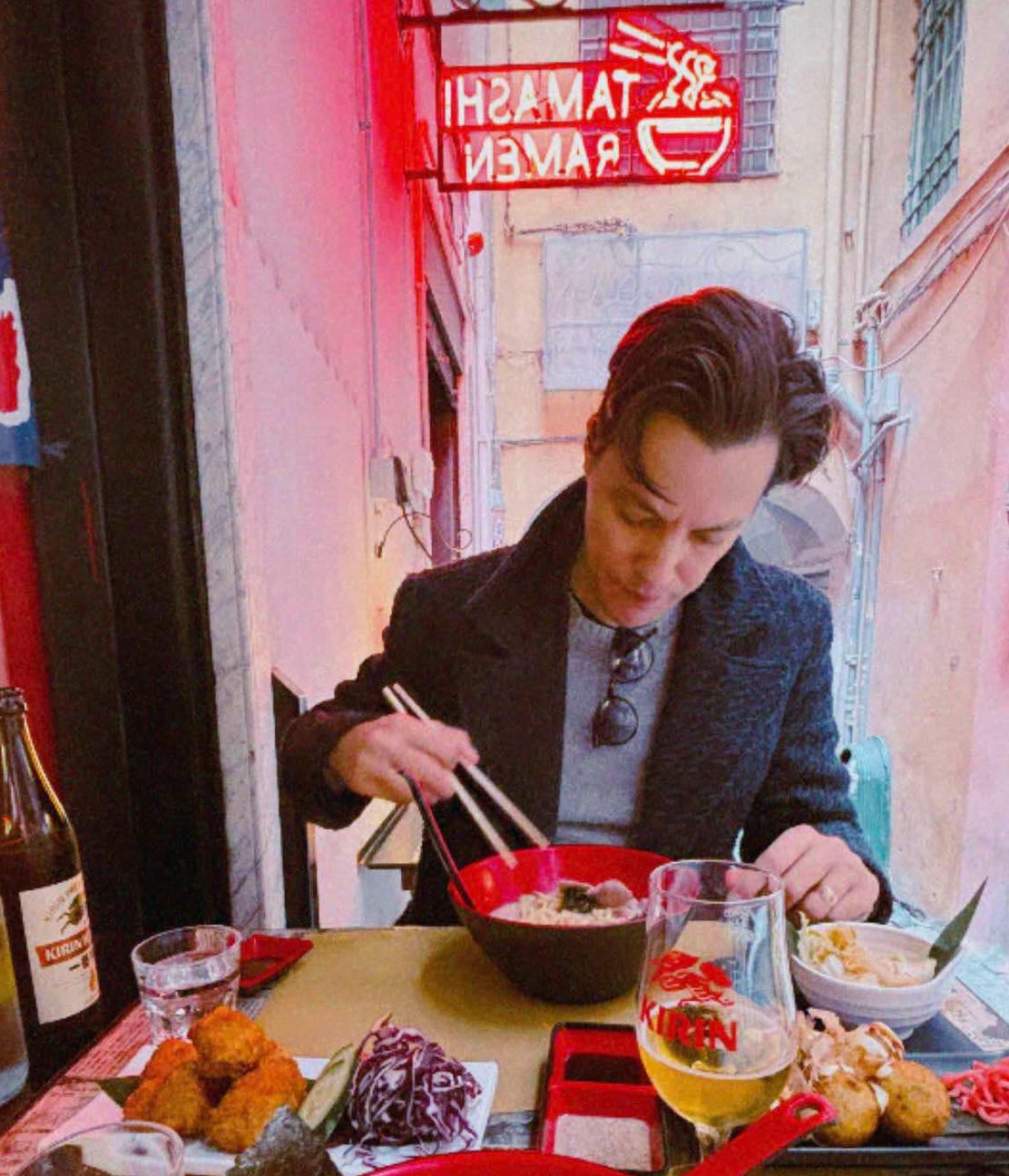
But give it a month, and I guarantee to you that you will do anything for a great chicken tikka masala. Laugh at me all you want, but we literally drive more than an hour to Genova because I know an amazing Japanese place (Tamashi Ramen), and they also serve proper kebabs, not one of those sketchy street-food versions. Yes, we also try the classic Ligurian dishes. But since ANY restaurant within a 100-meter circle around my home cooks almost ANY kind of Italian food, I get pretty freakin’ tired of them.
I have never eaten more Hungarian or British food, like ever, than in Italy. At home, we never cook Italian. I literally spent a week learning to cook the perfect ramen at home. I am pretty confident in Indian, Mexican, Japanese, American, British, and German cooking. I’m learning Chinese and Thai nowadays. All of this is because it is so hard to find these in Italy.
How can this be changed? I’m not sure if this can be changed. Italy still dubs all media that comes into its country, including movies, videos, and content. Almost no one speaks any languages, if they do, it’s usually some broken version of German, French, or maybe English. Also, most Italians travel domestically, only a small portion of Italians travel to other countries. And, as explained above, immigration is not a big thing here.
Countries like the US, UK, Canada, or even France have the same setup: monolingual, rarely travel outside, yet they have immigrants who start their own businesses. In Italy, the ease of starting a business and the immigration parts are missing. But, and no judgment here, I think there is also another missing part: interest.
And I can say this as a Hungarian.
Hungary is also a monolingual country, we dub all content into Hungarian, though younger generations speak English well. We are absolutely monocultural. I won’t be surprised if Hungary has the lowest immigration outside of Europe. It’s absolutely horrible to start a business there. And while Italians can pay in restaurants, Hungarians don’t even have that buying power.
Despite all of this, Budapest is full of international restaurants. Some of them are run by Hungarians, others are run by the local immigrants. I’m not saying you can find the best Mexican restaurant in Budapest (definitely not), but you have more options than in all the Italian cities combined. So I would argue that if there is demand, there will be supply.
In Italy, that demand is absolutely missing.
Oh, one last thing: most of my readers are non-Italians who either live here or want to travel to or move here. Friends, please. Start your own stuff. Send me the details. I will be your first guest. I would do anything for a proper shepherd’s pie.
Absolutely last thing: this is not universal in Italy. In Milan, you have it all. And I am typing this email in Turin. I just had the best ramen outside of Japan. There is hope.
Peter
Torino, 19 July 2026

What’s new on the page
Wrapping up Levanto
Anything east of Genova is considered the Levanto Riviera (Riviera di Levante in Italian, not sure about the English name). It is close to our home in Versilia, and we make regular trips there. It is also popular for tourists, especially because of the Cinque Terre. So, I thought I would sum up that area based on our experiences. There are new articles about Portovenere, the Cinque Terre, the pesto, and the little-known village of Brugnato. Last month I also wrote about Tigullio, the Magra Delta, and Lerici. A full guide to the entire region is coming next week. Stay tuned!
Cinque Terre | How To Do It Right

We almost missed the last train home because of a bottle of Vernaccia. This was in Corniglia, at a restaurant whose name I have honestly forgotten, on a terrace that sat on a ridge past the edge of the village, which is itself past the edge of reason, a hundred meters of cliff straight down to a sea that was doing its late-afternoon routine of turning f…

Planning a slow trip? My planner builds it for you. Answer five questions, and you get a personalized route from my handpicked list of the 1,000 towns most travelers skip, with festivals, drive times, and a line on each place. Don't like it? Refine it, swap towns, or browse the whole database by region. Simple. Free. No paywall, not even an email gate. Pure discovery for you.
→ Start planning your trip on Anywhere Italy.

I started learning Italian after moving here. Restaurants run on English, but anything past ordering lunch doesn't. Before I hired a teacher, Babbel did most of the work, with more real learning than Duolingo's gamified fake learning. I'm a Babbel affiliate, but I only point you to things I've used and liked.
100% agree. Same is true in a lot of France, but it’s not quite as bad as Italy. Former colony restaurants in France (Vietnamese, Cambodian) are uniformly awful. And let’s not even talk about O’Taco. I found a fantastic Dosa place in Roma, near Termini. I think it’s a chain, but it was really good. Filled with Indian families.