Trieste | Vienna by the sea
The port that chose Austria over Venice. Willingly.

Hi, I’m Peter, and you’re reading Anywhere Italy. Our mission is to cover the 1,000 Italian towns most travelers skip, in person, one at a time. Come along for free, or pay to keep us on the road.
I have never wanted to move to Trieste, yet, if I don’t count the cities where I have lived, Trieste was my most visited city in Italy. By far. I know the odd little details about the city. The way you order coffee, and how different it is from anywhere else in Italy. The food that is more Austrian, Hungarian and Slavic than Italian. The little fishing towns around it, like Muggia. It all comes down to one thing: I’m Hungarian, so Trieste feels very much like home to me.
Because of this, I have to start with the roots of this city.
Trieste is one of the few Italian cities that was more Habsburg than Italian. Yes, it was a Roman city, but it always lived in the shadow of Aquileia, a town west of Trieste with a deep Roman heritage. Today, Aquileia is a small town with a few historic sites. Then came Venice. Trieste spoke Venetian and lived like Venice, but it never wanted to belong to it. Venice took the city more than once, the last time for eleven years, and Trieste kept fighting back. Until 1382, when the city, squeezed between Aquileia and the Venetians, put itself under the protection of Duke Leopold III of Austria. Voluntarily.
In other words: Trieste chose the Habsburgs over Venice, not by conquest, but by choice. The Habsburgs ruled the city until the dissolution of their empire in 1918. That’s more than 500 years of history. And it shows.
Hungary was also part of the Habsburg Empire, for almost 400 years. And if Hungary was the crown jewel of the Empire, Trieste was its main port. So much so that Vienna built a railway all the way down to Trieste, and the city became the major hub for continental European trade through the Habsburg lands. In other words: it was a money-printing machine.
Today, when you arrive in Trieste, your first thought might be: this is Vienna by the sea. And technically, you are not far from the truth. It is an Austrian city through and through in its architecture, where people speak Italian and eat Italian food blended with Austrian and Slovenian traditions, and the city is so international that it even has its own English-language local news. But more about the independent city-state later…
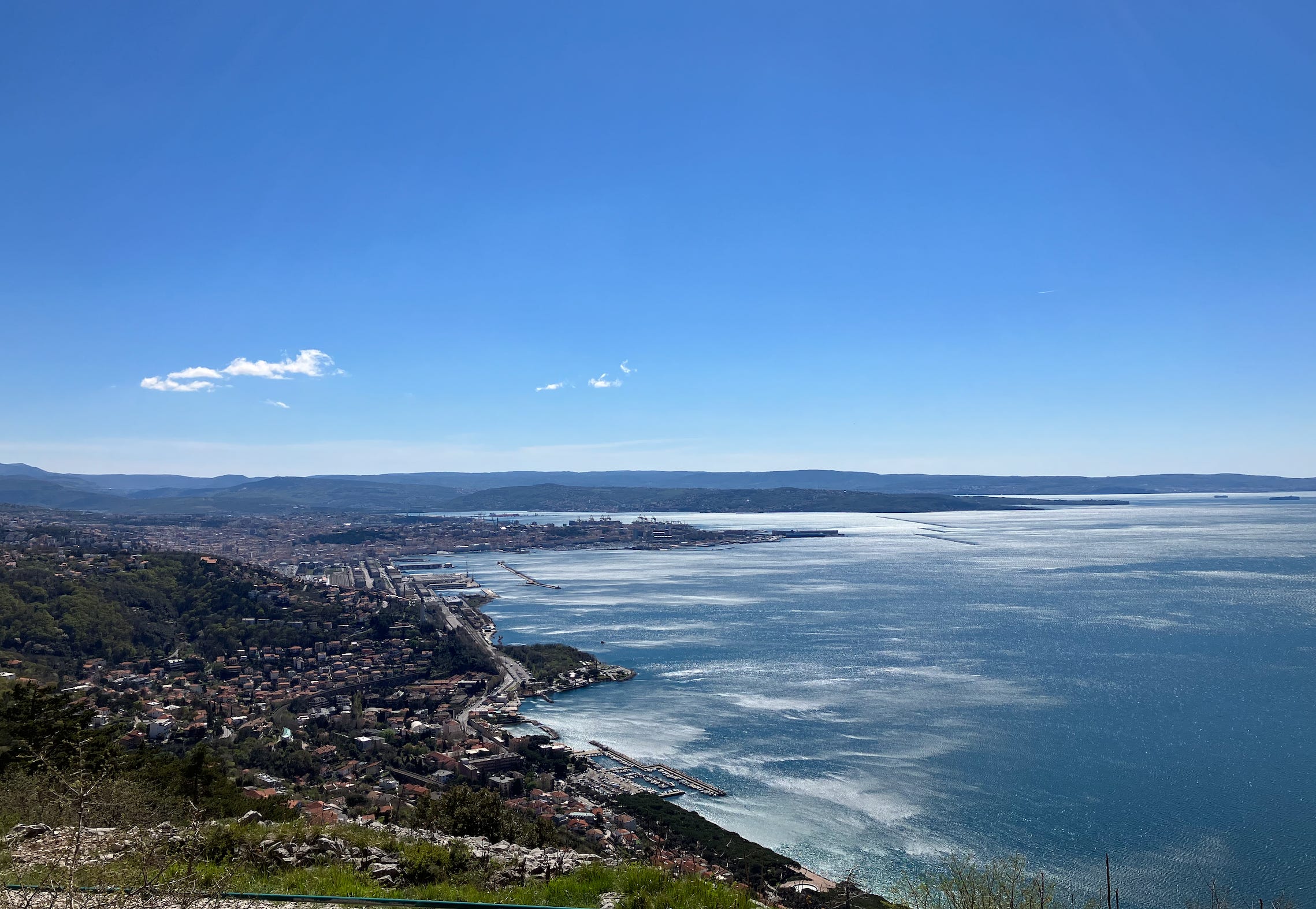
The cleanest port on this planet
So, I wrote a lot about Italian port cities. Livorno is Tuscany’s, Genova is Liguria’s, and I will keep writing about the rest. I have a thing for these cities: honest work, slightly dirtier than usual, a bit fishier in smell, busy all the time, and this is where both the booze and the coffee are the strongest.
Trieste is a port city, but it is a port that was run by Austrians for 500 years. I am not saying you can eat off the pavement (that’s Japan), but the port itself is suspiciously clean, organised, neat and tidy. I mean, it’s still Austrian, what did you expect.
The same is true of the rest of the city. It looks like Vienna with Italians.
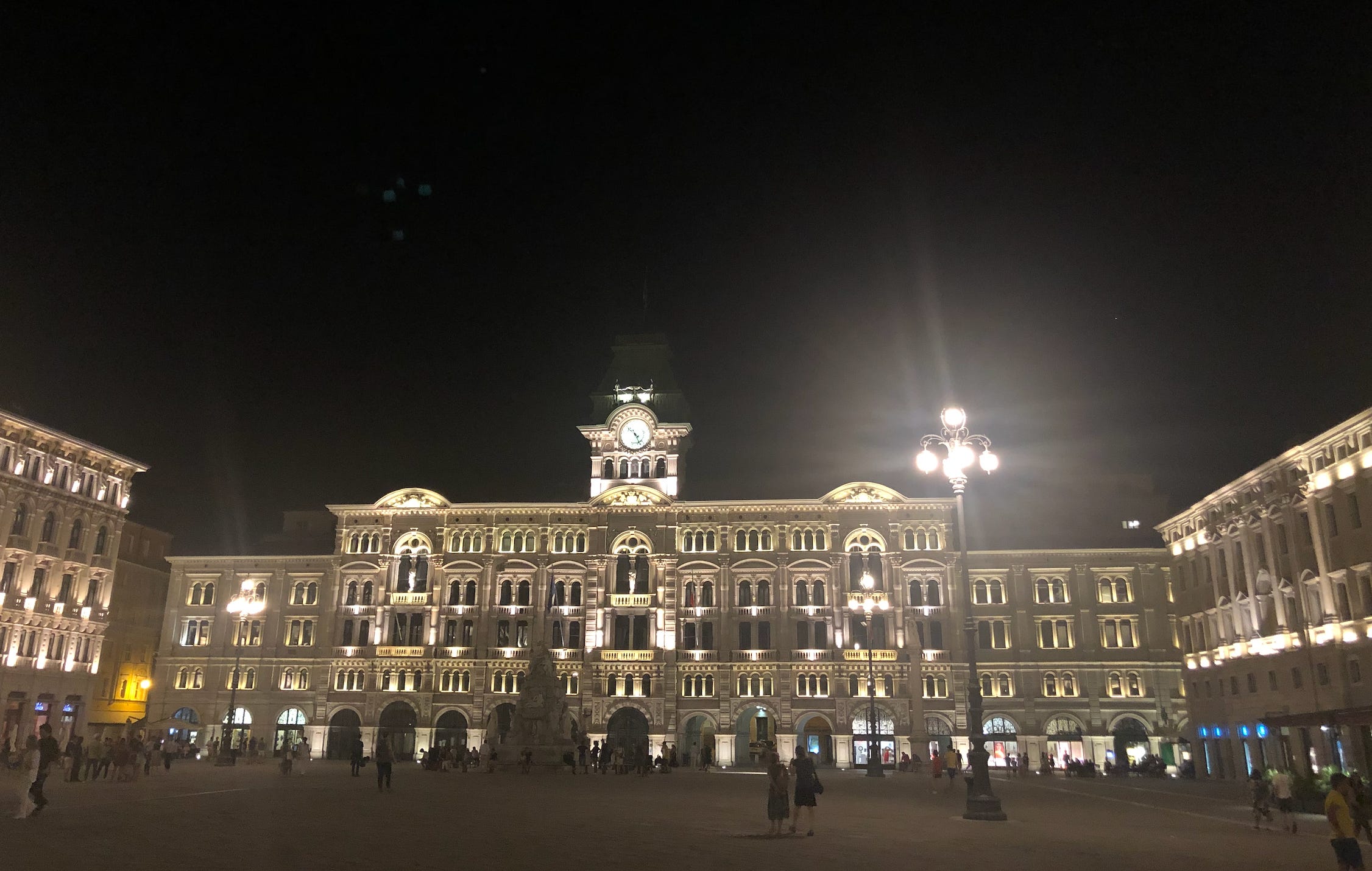
The main square, Piazza Unità d’Italia, could be in Munich. The Canal Grande looks as if Venice had been occupied by Germans. And the local beach, Barcola, looks as if Klagenfurt were on the sea, not on a lake.
The public transport? It apologises if it is a minute late. The way the houses, apartments and public places are built? Trieste is the only major city in Italy that, it seems to me, has heard of German-level engineering. The cafés and bars could be in Vienna, any time.
And that’s not all. It isn’t just the city that looks Austrian, but the people too. Everyone seems well-off, but reserved. It’s as if Zurich had a holiday home here. I wrote about this in my Treviso essay: when a city has jobs for most of its people, it shows.
In Trieste, every class has something to do. The port gives work to the workers, of course. You might have heard of Illy, the coffee brand: it has its headquarters here. Generali, the big insurance group, is also from here. And the city has its own historic stock exchange. All of which means one thing: Trieste and its people are loaded.
Unrelated, but Illy even gave the town a mayor once, Riccardo Illy. Also unrelated: the founder of Illy, Francesco Illy, was born Illy Ferenc, a Hungarian. The company is still family-owned, chaired by his grandson Andrea Illy, and it is one of the most successful coffee brands in the world. The world-famous coffee can was born out of logistics: it was simply a good way to ship coffee without spoiling the flavour. I’ll write a full dispatch on this brand, because it is so close to my heart.

Everything I write is free for its first four weeks. After that, only paid readers can access all the guides and dispatches, as well as the books I write, like these three, and the ones still come.
To gain access, get the annual plan and pay 10% less, forever.
The Free Territory of Trieste
Now, this is my favourite part of the city. When the war ended in 1945, there was a race to get to Trieste, as it was a hugely important port. The Allies were late: Tito’s Yugoslav partisan army arrived first and occupied the city for more than a month. Obviously, right after the war it wasn’t the best idea to mess with the Allies, so Tito withdrew his forces. The Allies quickly started drawing lines and maps. It all worked out so well in the Middle East, I guess, and in Africa too, so hey, why not do it in Trieste as well.
Anyway, the area was split into two zones: the city for the Allies (the US and the UK), and the rest for the Yugoslavs. Obviously, the Istrian side to the east went to the Yugos. In 1947, a peace treaty created the Free Territory of Trieste, a buffer state between Italy and the commies (well, the Yugos, but at that point they were de facto part of the Soviet ecosystem). It was supposed to be run by a governor appointed by the UN.
Now, the UN being the UN, the governor was never appointed (the Soviets and the West couldn’t agree on a name in the Security Council, who would have thought, lol), so this UN pet project, aka state, aka “thing”, never really functioned. It was just there. The city itself was run by British and American officers.
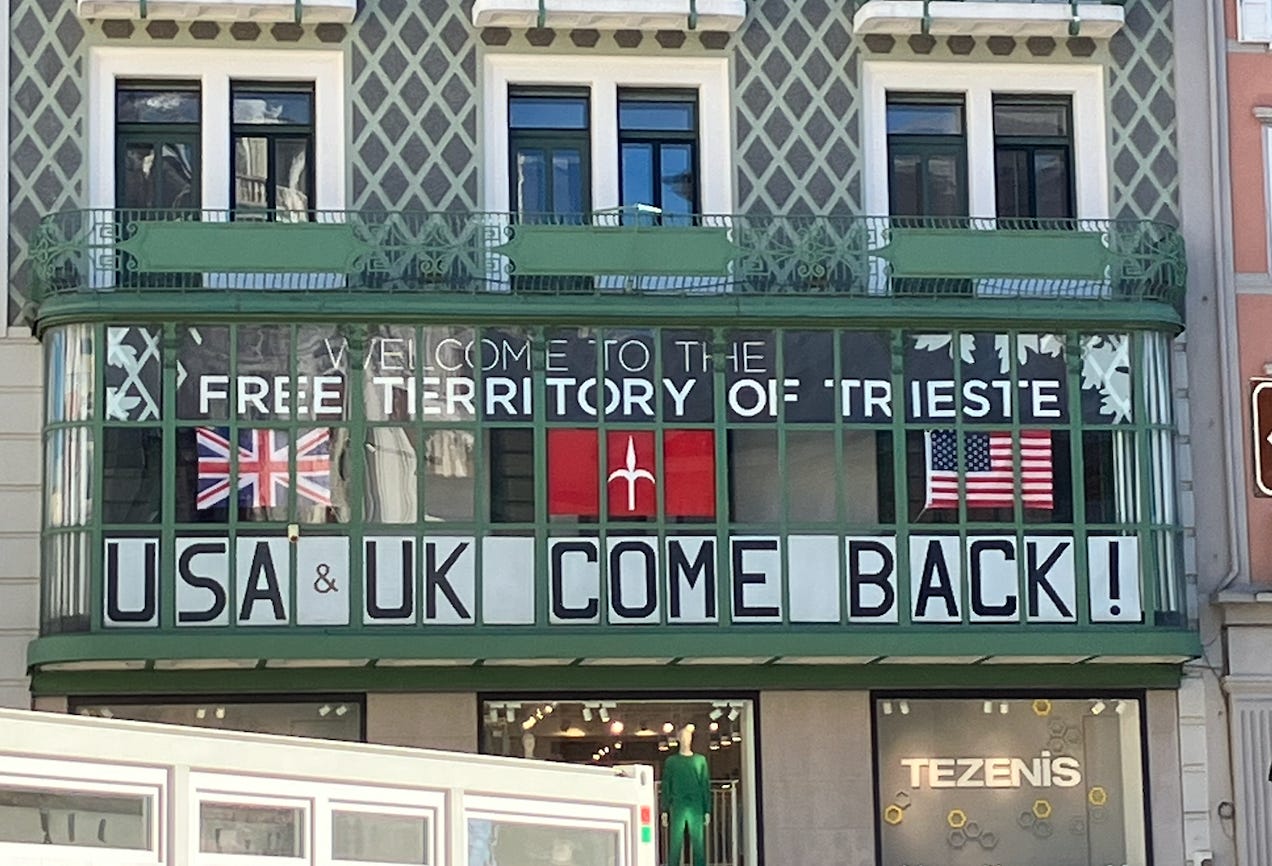
In 1948, Tito fell out with Stalin, so the Yugos suddenly became useful to the West. By 1954 this led to a deal: the Yugoslav zone, the tip of Istria that is now part of Slovenia and Croatia, stayed with Yugoslavia, and the city went to Italy. The Italian army marched in, and the locals said “Italy returned to Trieste”, not the other way around. Explains a lot.
During the Free Territory years, the city was a spy hub and a Cold War frontier, but business was also booming, with the free port running and American money flowing in. So, on top of the Italian and Yugoslav layers, the city grew a strange independence movement. It was at its biggest just before 1954, later had its own small party, and in the seventies an angry local list, born out of the final border treaty, even ran the city. It was a big part of the city’s identity. Nowadays it is mostly a footnote, but also part of the local mindset (at least for those who live in Trieste for more than 2-3 generations).
But it explains why the city is so international and why its people have these odd layers and mindsets: half Italian, half Slovenian, half Austrian, but above all, people from Trieste. Independent.
Why visit Trieste?
To be honest, I wouldn’t send you to Trieste as your main holiday destination. The city is for those who are interested in historical layers, or who want a city that looks like Vienna but has a sea.
The local beach, Barcola, is quite something. Being close to Venice, and to the Istrian coast of Slovenia and Croatia, is also a selling point. The city has amazing Habsburg buildings and palaces; definitely visit Miramare.
The best time is arguably October. There is a huge sailing event, the Barcolana. It is the biggest sailing race in the world, officially. The entire sea around Trieste fills with sailboats. A wonderful scene.
And, as you’ve seen from this post, Trieste is a very special place in Italy. It has its own distinct food culture, an oddly special coffee culture, and the fishing villages around it are also worth a visit. Everything in Trieste runs on three layers: Italian, Austrian and Slovenian.
Living here
Now, that’s a different game. And this is where I need to explain why I have never wanted to live there.
The most important reason: I’m Hungarian. For Hungarians, Vienna was the first city we went to outside our own country. I have many friends who live there. It is a classic move for Hungarians to just go and live and work there. I know Austria very well. We went skiing there all the time. I’ve spent months at Austrian lakes. Personally, if you ask me, Hungary would be better off with Austria. Yeah, I know, if you are Hungarian, please don’t send hate mail. You all know this: the best way to “catch up with Vienna” is to become part of Vienna.
Anyway. When I wanted to live in Italy, I wanted to live in Italy. Not in Vienna by the sea. To me, Trieste is wonderful, beautiful, amazing, an utterly interesting city. But it is just not Italian enough, if you know what I mean.
Also, I hate the wind and the steep climbs to get home. Half of the city is up in the surrounding hills, and it is blown through by this horrible wind. I’ve been told locals use tricks to keep their windows open without the wind breaking the glass.
Lastly, I have zero, and I mean minus one, love for the Balkans. Again, as if Hungarian hate mail weren’t enough, now I’ll be getting it from Slovenians and Croatians too, but if you ask me, the interesting things on the Balkan coast are the ones with Italian heritage. Istria, Dalmatia, and so on. The rest, to me, is just, well, not that exciting, shall we say. And one of the big selling points of Trieste is how close Slovenia and Croatia are.
But maybe you are different. If you love hearty cuisine, can take the wind and the climbs, value order and predictability above all, and make regular trips to Eastern Europe, then Trieste is The Location for you. Real estate is cheap for a seaside city, the town is highly affordable, and for around 200,000 euros you can own a solid flat built to German standards. The sea view costs a bit more. And when you walk down to street level, the city is Italian above all, no matter what the locals think or what history tells you.
What a great city!
Fun reading about the place we called home for just about 3 years! Trieste was actually our first stop in Italy (we moved for work) so we didn't realize just how unlike Italy it was until we started to explore more. The history is absolutely fascinating.
There are only 2 things I'd argue here with: the busses and the cost of living. There were a few bus numbers that were like a roulette if they'd actually show up and if so, how late they'd be. So unreliable that I'd always walk or have to plan around missing one if I had something important to do. And while the cost of living might be lower than other parts of the world, it's steadily increasing. I believe them rerouting a lot of cruises from Venice to here in the last 2ish years has played a major role.