

Cinque Terre | How To Do It Right
The case for not going, or for going when nobody else does

We almost missed the last train home because of a bottle of Vernaccia. This was in Corniglia, at a restaurant whose name I have honestly forgotten, on a terrace that sat on a ridge past the edge of the village, which is itself past the edge of reason, a hundred meters of cliff straight down to a sea that was doing its late-afternoon routine of turning from blue to pewter. We had a nearly full panorama, a cold bottle of the local white, no schedule except the one we were ignoring, and when we finally looked at the time we did the only thing you can do in Corniglia, which is run down: three hundred and eighty-odd steps of the Lardarina, the brick staircase that switchbacks from the village to the station at sea level, taken at a speed my knees have not forgiven, to a platform we reached with the train already visible down the coast.
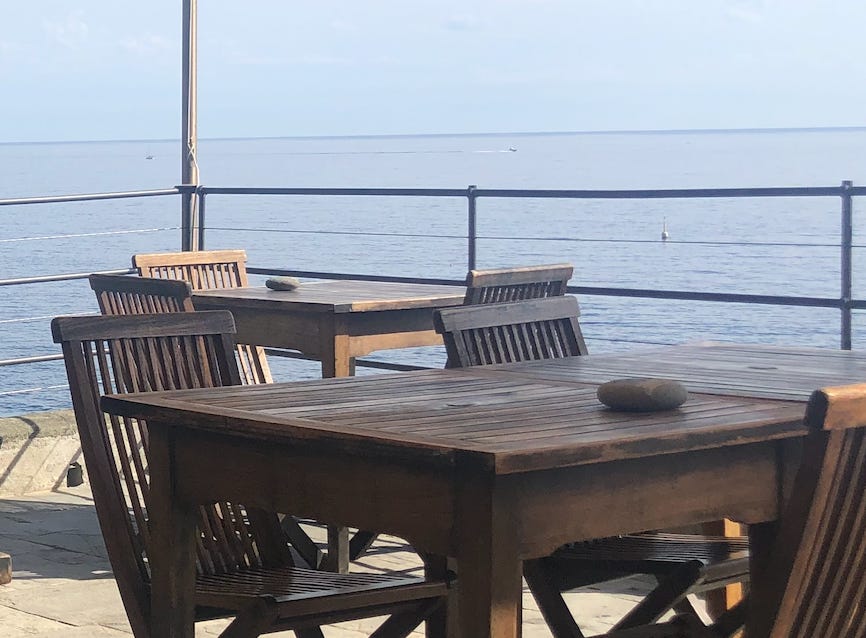
I will tell you the rest of that day, because it was a good day. But I should be honest about what this piece is, because it is not a piece telling you to go to the Cinque Terre. You do not need me for that. The entire apparatus of global tourism exists to tell you to go to the Cinque Terre. This is a piece about when the five villages are worth it, which is almost never, and about what to do instead, which is the part nobody selling you the postcard has any interest in explaining.
Start with the arithmetic that nobody on the ferry thinks about. The five villages have, between them, roughly four thousand residents. Not forty thousand. Four. The largest, Monterosso, holds about fifteen hundred people. Vernazza is under a thousand. Corniglia is a couple of hundred. Into these five small containers arrive between two and three million visitors a year, which on a summer Saturday means tens of thousands of bodies moving through lanes built for the foot traffic of a fishing economy. People call it an infrastructure problem, as if the villages had fallen short of a reasonable expectation. It is the opposite. Four fishing villages at the waterline and one farming village on a cliff, none of them ever meant to process a crowd, because for most of their thousand years, there was no way for a crowd to arrive. The railway only reached them in 1874. The road, to this day, stays up on the ridge and declines to come down.
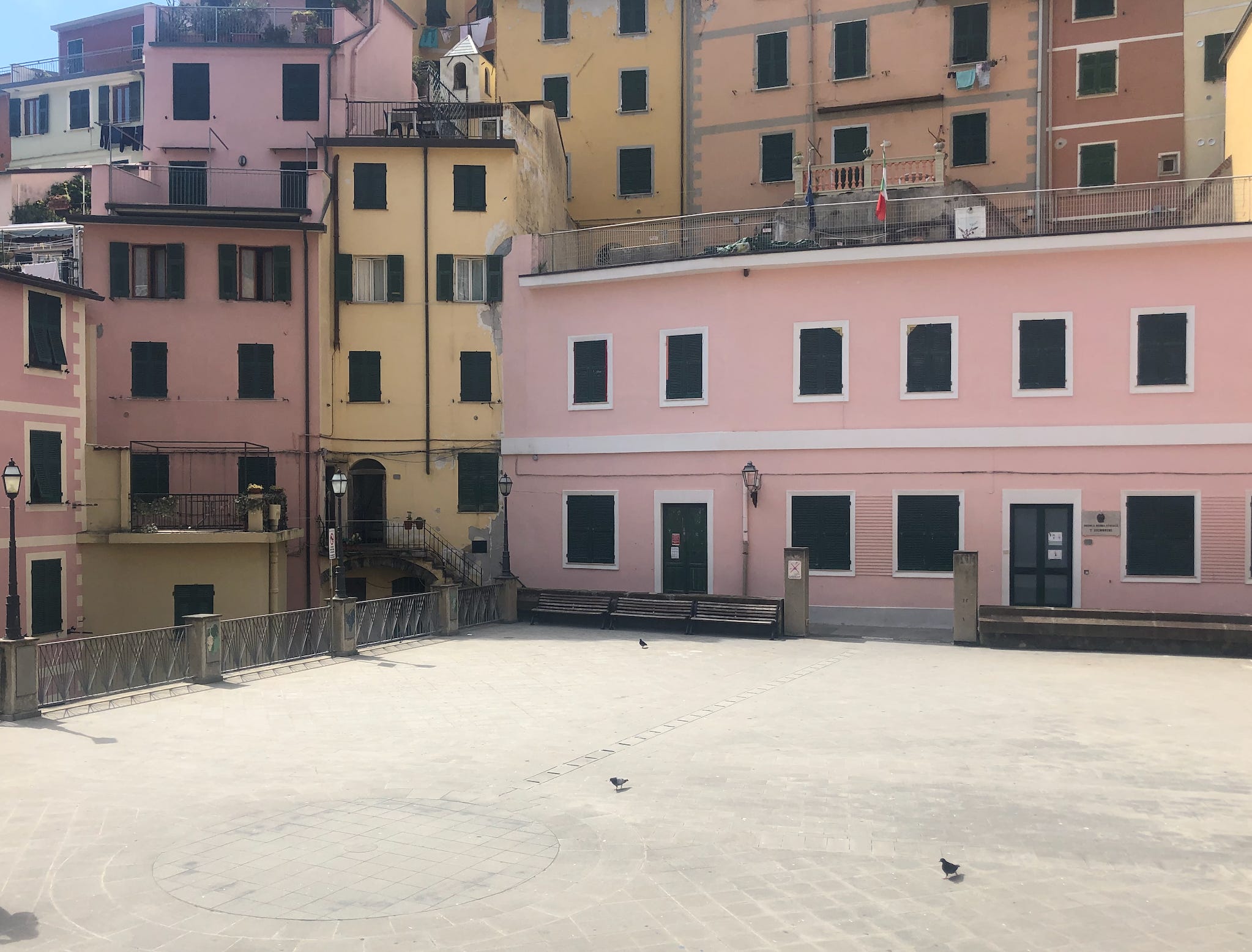
I know what the five are like without the crowd, because I caught them in the one window in living memory when the crowd was gone. I hate mass tourism. Hate is the correct word. I said no to Venice ten times and Florence five before I ever went, and it took a global pandemic to change the terms. During our first long stay in Italy, based for a few weeks in Lerici, we took the ferry up the coast on a quiet morning and did the full spiel.
The souvenir shops selling the same lemon-printed linen you can buy in Sorrento were shut. The food stalls aimed at people who would never come back were shut. There were, I checked with real curiosity, no pesto-making classes running, thanks, God. What remained, with the apparatus switched off, was embarrassingly simple: five beautiful villages where people live slowly, dramatic water, fresh seafood, sun. We finished in Corniglia, the one the day-trippers skip because it has no harbor and sits a hundred meters up, the farming village among the fishing villages, named for the Roman family whose wine jars turned up at Pompeii, technically not even a town but a frazione of Vernazza, a village that belongs to another village. The train doors open at Corniglia, the passengers look up at the stairs, and the doors close. We drank our bottle above all of it and nearly paid with a night on the platform.
That version of the Cinque Terre exists for a few months a year, and I will come back then. But first, part of your itinerary is missing.
For the price of a glass of Chianti, unlock the full Anywhere Italy experience. All of our articles, private stories, and access to our chat travel community.
Start your free 7-day trial.
A few years after that day, we moved to Versilia, and the five villages are now forty minutes from my house, with a ferry from the next town over. We could go every weekend. We go almost never, and between May and September we do not go at all, a rule we adopted after breaking it exactly once: one sunny June day I wanted my favorite spot in Riomaggiore badly enough, and no, I will not tell you where it is, that being the entire point of a favorite spot, to try the ferry from Lerici. We drove down to the port, saw the crowd from the car, and drove straight back up into the hills without stopping. A zombie film with better lighting, hordes moving with the glassy stare of people having the experience they were promised, rather than the one that is available. No thanks.
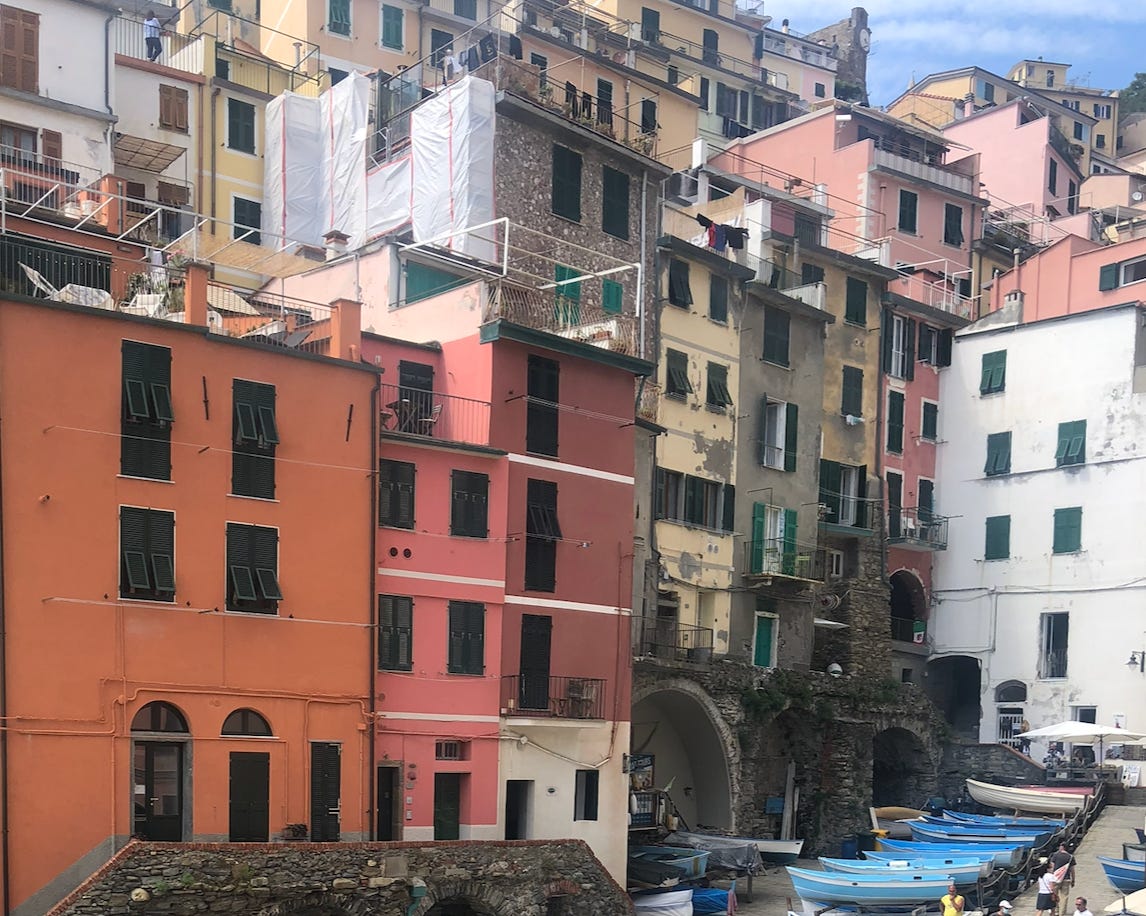
And here is the thing I have learned from living on this coast rather than visiting it: the promise the crowd came for is not even locked inside those five villages. I have written before, driving the Tigullio, that the seaside towns of eastern Liguria are, structurally, one town. A steep hill falls into the sea, the bright houses stack up the slope, a small port, a small piazza, focaccia, pesto, fried fish, the same cold Vermentino. The Cinque Terre are five towns with a national park around them and a marketing name that adds up to five. The copies without the name are a few miles away in either direction, and the experience they sell is the same experience, with the crowd divided by a hundred.
So, concretely. If what you wanted was the vertical village on the water, go to Tellaro, at the wild end of the Lerici coast, hanging over its rocks with an octopus legend on the church door and no train station, which is the single greatest gift geography ever gave a Ligurian village. If what you wanted was the fortress-on-the-sea drama, go to Portovenere, where a striped church stands on the rock where a temple of Venus stood, and where you can live a whole slow week on three streets, as we did. If what you wanted was the postcard bay, go to Sestri Levante and stand above the Baia del Silenzio at the hour when the light comes sideways, the one view on this coast where the photograph reliably fails and you have to be there. If what you wanted was the fishing village with the painted facades, Camogli does Portofino’s job without the theatre, on a promenade five times as long. And if what you wanted was simply to be based somewhere flat, walkable and real, with the whole coast on a cheap train line, take a room in Chiavari under the porticoes and do the five villages as one winter day trip from there, which brings me to the only advice about the Cinque Terre themselves I am prepared to give.
Go in winter. From November to March, the weather is jacket weather, and a rainless week feels better than in July. Half the places are closed, and the closures are a map: everything that shuts caters only to visitors, everything that stays open is open for the people who live there, which tells you in one stroll exactly where to eat. Prices come back to local, menus come back from tourist-menu English to whatever the kitchen was cooking anyway, the ferries sleep, and the lanes belong to old men and delivery vans. That is the only season the five villages are themselves, and the only season I go, quietly, in January, to a spot in Riomaggiore I am still not going to name, where the sea does the same thing it does in August for an audience of nobody.


Planning a slow trip? My planner builds it for you. Free, no paywall, no email gate. Answer five questions (hub town, interests, travel month, days you want for slow discovery, and fitness level, because some of these towns make you climb), and you get a personalized route from my handpicked list of the 1,000 towns most travelers skip, with festivals, drive times, and a line on what each place is. Don’t like it? Refine it, swap towns, or browse the whole database by region.